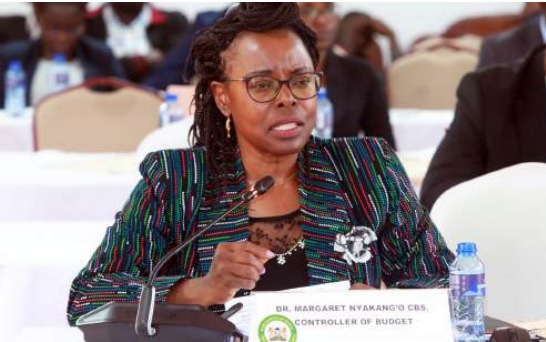
 Controller of Budget Margaret Nyakang’o /FILE
Fresh details have emerged revealing how ballooning wage bills and excessive spending on non-essential items are undermining development across the counties.
The revelation has raised fresh concerns over fiscal discipline within the devolved units.
A new expenditure report for the first six months of the 2025-26 financial year shows counties continue to spend heavily on recurrent expenses—particularly salaries, travel and hospitality—while allocating minimal resources to development projects.
According to the report released on Sunday by Controller of Budget Margaret Nyakang’o, counties collectively spent Sh32.49 billion on development, representing just 14 per cent of the total annual development budget of Sh228.20 billion.
This marks a decline from the Sh33.60 billion spent during a similar period in the 2024-25 financial year.
The report paints a grim picture of development absorption, with 17 counties recording performance rates of 10 per cent or lower.
A further 28 counties posted moderate absorption levels of between 11 and 29 per cent, while only two counties managed to exceed the 30 per cent threshold.
“The CoB recommends that county governments enhance their spending from development budgets in the remaining months of the financial year," Nyakang'o said.
"This will help boost the absorption rate of development funds and foster overall progress at the county level.”
Among the counties with notably low development spending were Nairobi, Kisumu, Mombasa, Kajiado, Siaya, Tana River and Lamu, which all spent less than 10 per cent of their annual development allocations. Some counties such as Tana River and Lamu recorded particularly poor performance at just three per cent.
The findings highlight a persistent failure by counties to comply with the legal requirement under the Public Finance Management (PFM) Act, 2012, which stipulates that at least 30 per cent of budgets should be allocated to development expenditure over the medium term.
The PFM (County Governments) Regulations, 2015, further require actual spending to reflect this benchmark.
Despite the poor performance in development, counties spent Sh160.10 billion on recurrent expenditure, accounting for 83 per cent of total spending during the review period. This translates to 41 per cent of the annual recurrent budget.
A significant portion of this amount—Sh115.39 billion, or 60 per cent—was used to pay salaries and allowances for county employees, underscoring the heavy wage burden facing devolved units.
An additional Sh44.71 billion went to operations and maintenance, while billions more were consumed through travel and hospitality expenses.
Some counties posted high recurrent expenditure absorption rates, including Bungoma (57 per cent), Tharaka Nithi (56 per cent), Meru (55 per cent) and Machakos (52 per cent), reflecting an imbalance between operational spending and development priorities.
Conversely, 10 counties recorded recurrent expenditure absorption rates of 35 per cent or lower, indicating disparities in spending patterns across devolved units.
In addition to the skewed expenditure, the Controller of Budget raised concerns over the low collection of own-source revenue by counties, further constraining their ability to fund development projects.
Under Article 209(3) of the Constitution, counties are empowered to impose property rates, entertainment taxes and other levies authorised by Parliament.
However, the report shows in the first half of the financial year, counties collectively generated Sh26.94 billion in own-source revenue—just 27 per cent of their annual target of Sh99.73 billion.
The shortfall has widened budget deficits and slowed the implementation of planned projects. Six counties managed to collect only 20 per cent or less of their revenue targets, while 20 counties achieved between 21 and 30 per cent.
Sixteen counties recorded performance levels of between 31 and 40 per cent, two counties reached between 41 and 50 per cent, and only three counties exceeded the 50 per cent mark.
The latest findings are likely to intensify scrutiny on county governments, with pressure mounting for stricter adherence to fiscal discipline, improved revenue collection and a renewed focus on development spending to deliver tangible benefits to wananchi.
INSTANT ANALYSIS
Ballooning wage bills and excessive recurrent spending are crowding out development in Kenya’s counties, with just 14 per cent of development budgets absorbed mid-year, far below legal thresholds. A report by Margaret Nyakang’o shows most funds go to salaries and operations, while revenue collection remains weak at 27 per cent of targets. This imbalance is widening deficits, slowing projects and exposing poor fiscal discipline, raising concerns over counties’ ability to deliver meaningful development outcomes.