 ODM leader
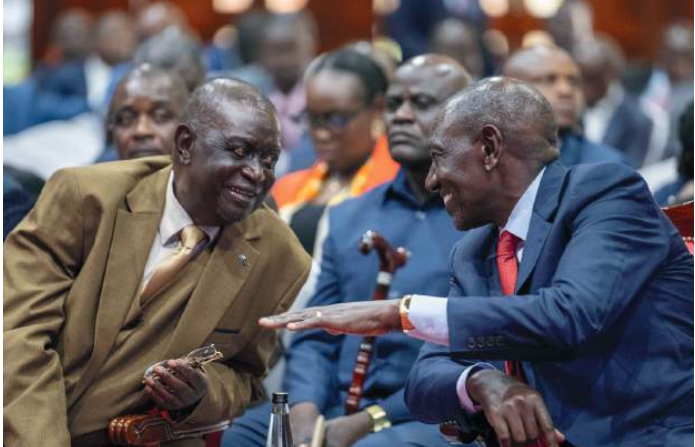
Oburu Oginga
and President
William Ruto
during the
UDA-ODM Joint
meeting on
Tuesday
/REBECCA NDUKU
/PCS
ODM leader
Oburu Oginga
and President
William Ruto
during the
UDA-ODM Joint
meeting on
Tuesday
/REBECCA NDUKU
/PCS
Read Also
The 10-point implementation battle now heads to Parliament even as rival camps clashed over the deal’s implementation timeline as well as the scorecard.
President William Ruto last week proposed the formation of a broad-based negotiating team to oversee the full implementation of the joint UDA–ODM agenda.
“We will be recommending in this PG that we have a broad-based negotiating team comprising members from both parliaments,” Ruto said.
Critics led by ODM secretary general Edwin Sifuna, deputy Party Leader Godfrey Osotsi, Siaya Governor James Orengo and MPs Babu Owino (Embakasi East) and Caroli Omondi (Suba South) have vowed to oppose such a move, insisting the agenda ‘died’ on 7 March.
The emerging standoff sets the stage for a heated parliamentary battle as both sides prepare to test their strength on the floor of the House.
The broad-based team, to be populated by members from both the ruling UDA and ODM, will, amongst other things, expedite the passage of the Nadco bills that are still pending in the bicameral house.
The committee overseeing the implementation, headed by nominated Senator Agnes Zani, had indicated that only three out of the nine Nadco bills have been enacted into law.
“Parliament received nine bills of which three bills have been enacted into law,” the Zani team said in their report released on Tuesday last week.
The three are the Independent Electoral and Boundaries Commission (Amendment) Bill, 2023, the Statutory Instruments (Amendment) Bill, 2023, and the Ethics and Anti-Corruption Commission (Amendment) Bill, 2023.
Pending legislation includes the Elections (Amendment) Bill, 2023 and the Election Offences (Amendment) Bill, 2023, which are under mediation.
The Constitution of Kenya (Amendment) Bill, 2023, the Political Parties (Amendment) Bill, 2023, the National Government Coordination (Amendment) Bill, 2023, and the Leader of the Opposition Bill, 2023 are also under consideration by the bicameral house.
The dispute escalated after Ruto signalled that his side has the numbers in the National Assembly to push through the remaining items in the agreement, even as critics dismissed the progress made so far as dismal.
“If a broad-based decision is made, Parliament will decide, because we have the numbers to drive it through both Houses of Parliament,” he said.
Tuesday’s joint Parliamentary Group meeting was attended by 253 broad-based MPs from both houses of Parliament.
The President further gave the Zani-led implementation committee an additional 60 days to conclude its work.
However, a faction within ODM allied to Sifuna has rejected the move, arguing that the timelines for implementing the agenda lapsed and cannot be extended arbitrarily.
The group insists that any attempt to prolong the implementation period outside the original framework amounts to an illegality and undermines the spirit of the agreement.
In an interview with the Star, Sifuna argued the committee was to deliver a final comprehensive report on March 7, 2026, which he argued also marked the expiry of the agreement.
“When they were appointed, it was stated in plain English that they would be required to present progress reports every two months, with a final report on the March 7, 2026,” he said.
“ This finality deliberately falling neatly on the same date as the expiry date of the two signatures on the document,” Sifuna said.
“Their sole mission was to ensure implementation of the 10 items and deliver a final report on March 7, period!”
Critics of the process have also given the implementation record a poor scorecard, claiming that several key issues remain unresolved months after the framework was unveiled.
They have vowed to put up a fight in defence of what they believe is the legacy of the late opposition leader Raila Odinga.
Omondi said they will resist any process that tries to give life to the implementation of the 10-point agenda, which he maintained is now dead and buried, signalling looming fireworks in the House.
“We will not allow them to set their own exam, they write their own exam, they mark their own exam. They award themselves marks. We cannot allow them,” he said.
Funyula MP Wilberforce Oundo, reading from the same script, called on Kenyans to join them in defending what is right.
“Kenyans, be vigilant. Keep your eyes wide, and we pray for the soul of Raila Odinga, to please reincarnate and save this country,” he said.
Opponents now accuse the government of selectively pursuing politically convenient aspects of the agenda while ignoring the more contentious reforms.
They gave the government a dismal 10 per cent score in the implementation of the 10 issues agreed between Ruto and Raila.
Among the items said to be lagging behind are electoral reforms, especially the audit of the 2022 presidential elections, measures to lower the cost of living, strengthening oversight institutions, and strengthening devolution.
“Let us take the issue of the audit of the 2022 presidential elections, what we call opening the server. There was an item like that. No work has been done on that,” Omondi said.
“To date, people are asking IEBC, if you do not address the issue of technology, not just the technology itself, but whoever supplied that technology for purposes of the next general elections, then what have you achieved?” he posed.
According to Osotsi, Ruto’s administration has not met the allocations that were to be dispatched to counties under the agreement.
“In the 10-point agenda, Raila wanted our counties to get a minimum of Sh450 billion. The National Assembly passed the division of revenue bill with Sh420 billion,” he said.
“So why are they lying to us in the daytime that he is going to give us Sh450 billion? When in the BPS it is Sh420 billion, when in the Division of Revenue Bill, it is Sh420 billion?” he posed.
“Still on devolution, he promised Kenyans that all devolved functions shall be transferred. Instead of him transferring functions to counties, he is taking over the functions of counties.”