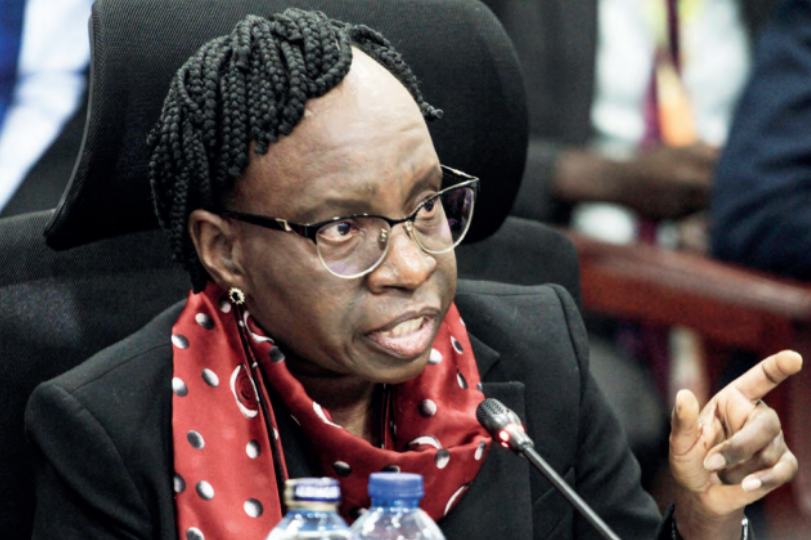
Auditor General Nancy Gathungu has lifted the lid on the inefficiencies and irregular practices in constituencies' bursary scheme, with students issued with stale and uncollected cheques amounting to nearly Sh1 billion.
The damning audit report revealed that up to 86 constituencies were unable to account for Sh2.1 billion they have purportedly issued to support needy students in the 2023-24 National Government Constituencies Development Fund (NG-CDF) bursary.
Gathungu's findings show stale and unpresented bursary cheques issued by various constituencies have accumulated to nearly Sh1 billion.
The large numbers of uncollected, unpresented cheques, she warned, could deny deserving students the financial support they need.
“For instance, in the financial year 2024-25, there were cases of unpresented cheques in five constituencies totalling Sh722,636,387. This could have benefited approximately 18,065 students in extra county schools on full scholarship,” the report stated.
“Additionally, five constituencies reported cases of stale cheques amounting to Sh14,174,132, which could have fully sponsored 351 students in extra county schools for one academic year.
From the report, Narok West constituency is leading with cases of unpresented cheques amounting to Sh218.7 million, followed by Kaiti at Sh201 million, Kilgoris (Sh137 million), Gichugu (Sh86 million) and Ganze (Sh77.8 million).
For stale cheques, Embakasi Central is topping at Sh4.3 million, Embakasi South (Sh3.5 million), Mwea (Sh2.7 million), Kasarani (Sh2.5 million) and Kibwezi East (Sh980,000).
According to Gathungu, the uncollected and unpresented cheques were reversed after six months and reissued to other learners at the discretion of the constituency committees.
The report now being considered by the National Assembly also raised serious issues with the flawed beneficiary vetting process, inefficiencies in bursary disbursement, poorly maintained bursary and scholarship records, and a lack of programme monitoring.
Gathungu sampled 23 constituencies across six counties of Nairobi, Kirinyaga, Makueni, Kilifi, Kisii and Narok. The audit covered financial years 2021-23 to 2024-25.
During the audit period, the 290 constituencies spent Sh55.7 billion on bursaries and scholarships.
The auditors also sampled 65 beneficiary learning institutions for review, especially institutions with a significant number of beneficiaries supported through NG-CDF bursaries.
According to the report, bursary awards were not pegged on applicants’ socioeconomic needs or vulnerable status, but in most cases, whether the applicants or their parents/ guardians were registered voters in their constituencies.
In the report, some constituencies issued bursary cheques without evidence that the intended beneficiaries had formally applied for the assistance.
“Review of 1,815 sampled application forms from 13 constituencies revealed that 1,127 forms, representing 62 per cent, were not duly filled,” the report states.
The forms lacked mandatory information like the socioeconomic status of applicants, authentication from local administrative leaders, religious leaders or school administration.
“In addition, 1,393 application forms, representing 77 per cent lacked the required approval by the fund managers or committee’s representatives, while 688 application forms, representing 38 per cent, lacked one or more of the mandatory documents,” the report states.
“Regardless of the anomalies, the applicants were considered and awarded bursaries.”
However, the audit also singled out five constituencies for good practice after they adopted automated bursary application systems.
The constituencies are Mark Nyamita’s Uriri, Silvanus Osoro’s South Mugirango, Edward Muuriu’s Gatanga, Vincent Musyoka’s Mwala and Josses Kiptoo’s Emgwen constituency.
The automation, the Auditor General noted, has enhanced accountability, reduced paperwork and minimised opportunities for manipulation in the allocation of bursary funds.
“South Mugirango, Uriri, Mwala, Gatanga and Emgwen constituencies had fully automated their bursary application and disbursement processes, resulting in improved efficiency and transparency,” Gathungu stated.
“Use of manual processes led to disparities in the administration of bursaries and scholarships across constituencies. This undermined fairness, transparency, and equal opportunity, as eligible applicants may be excluded."
"ln addition, it resulted in inconsistencies in the issuance of application forms and increased human error during the application.”
In another shocking revelation, Mwea, Narok East and Bobasi constituencies' learners were awarded bursaries without applying or undergoing vetting.
In some situations, learners in high-cost private institutions benefited from bursaries amounting to Sh2.7 million, yet their application forms could not be traced.
“The institutions include Moi Educational Centre, Kianda School and Consolata School, among others,” the 70-page report indicates.
In Kaiti constituency, the auditor noted that a bursary was awarded to almost all applicants from the same schools, triggering political interference concerns.
“Comparison of beneficiary lists and school enrolment data for five sampled schools showed that between 69 per cent and 100 per cent of learners in these institutions received bursaries,” the report on Kaitu indicated.
From the audit, the majority of constituencies lack disaggregated records for learners with special needs, with only Kasarani, Dagoretti South and Malindi constituencies.