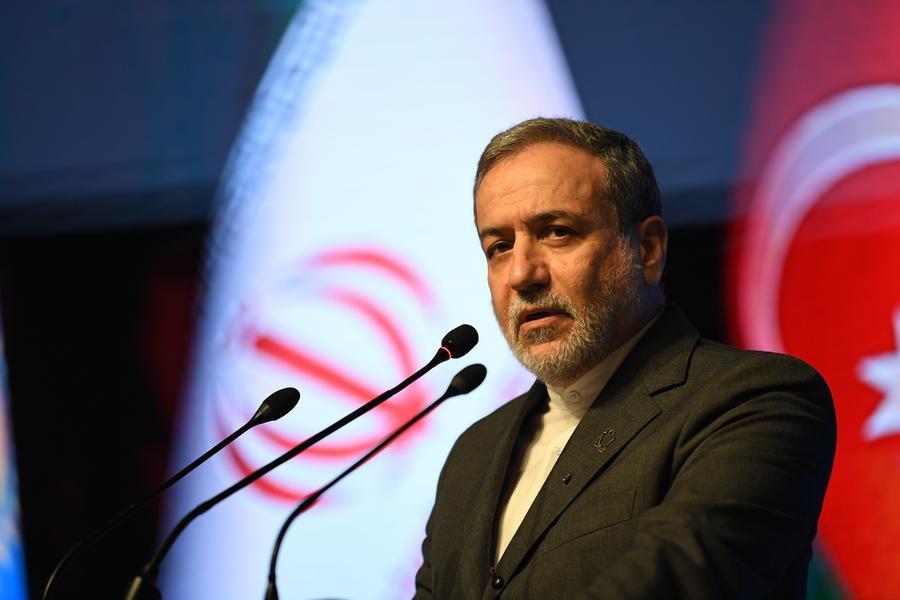
 Iranian Foreign Minister Seyed Abbas Araghchi speaks during the opening ceremony of the First Caspian Governors' Forum in the northern city of Rasht, Iran, Nov. 18, 2025. (Xinhua/Shadati)
Iranian Foreign Minister Abbas Araghchi says Tehran has "never asked for a ceasefire" in the war with Israel and the US.
In an interview with CBS News, the BBC's US media partner, Araghchi also says Iran doesn't "see any reason why we should talk with [the] Americans, because we were talking with them when they decided to attack us."
"We don't see any reason why we should talk with Americans, because we were talking with them when they decided to attack us," he tells CBS News' Face the Nation programme.
"This is a war of choice by President Trump and the United States, and we are going to continue our self-defence."
US President Donald Trump had said on Saturday that Iran wanted to make a deal, but that he felt the terms were "not good enough"
The Israeli military says it is expanding the scope of its strikes to include more areas in western and central Iran, while Iran has also fired more missiles.
"At this pace, we will end up with a ruined Iran," one man in the Iranian capital tells the BBC.
Iran 'open to countries who want to talk' about safe passage through Strait of Hormuz
Araghchi also says that Iran is "open to countries who want to talk" about the safe passage of vessels through the Strait of Hormuz - where Iranian attacks on boats have seen traffic through the shipping lane grind to a halt.
Not naming specific countries, Araghchi says Iran has "been approached by a number of countries" who want safe passage through the Strait. Iran's nuclear facilities are all under rubble, he adds, and "for the time being, there is no programme, no plan, to recover them".
Araghchi says that when Iran-US talks about a nuclear deal were still ongoing, Iran had offered to "dilute the enriched material into a lower percentage".
"That was a big concession," he says.
The conflict has changed this: "There is nothing on the table right now; everything depends on the future."
For decades, the US and Israel have accused Iran of trying to secretly develop a nuclear weapon.
Iran has repeatedly denied it is seeking a bomb and says its programme is only for peaceful purposes, though the country is the only non-nuclear-armed state to have enriched uranium at a near weapons-grade level.
Elsewhere, the Israel Defence Forces (IDF) says it is expanding the scope of its strikes against the Iranian regime's infrastructure to include more areas in western and central Iran.
The IDF says it aims to degrade the regime's "command and control capabilities".
At the same time, it announces the Israeli Air Force completed a wave of strikes targeting the Iranian regime's headquarters in Hamedan, western Iran, earlier on Sunday.
The IDF says it struck several key headquarters belonging to the Islamic Revolution Guard Corps and the Basij Forces.
It says the strikes are part of "an ongoing effort focused on deepening the damage to the core operational systems and foundations of the Iranian regime".