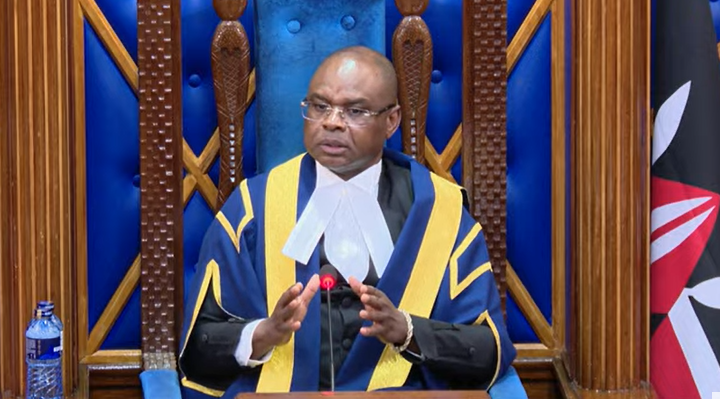
 Senate Speaker Amason Kingi/FILE
At least 30 counties are facing possible financial sanctions after the Senate initiated plans to withhold funds from devolved units whose governors have failed to appear before it to account for billions of shillings in public resources.
The move follows approval by Senate Speaker Amason Kingi for the preparation of a motion compelling the Controller of Budget to freeze funds to counties whose leaders continue to ignore summons by the Senate’s County Public Accounts Committee.
The development comes amid a month-long standoff between senators and county chiefs over accountability for public spending.
Sources within the Senate said the speaker is dissatisfied with the continued refusal by governors to appear before the committee to respond to audit concerns regarding the use of public funds.
“The speaker is not happy that governors refused to comply with his orders to appear before the committee as it looked into allegations raised in the CPAC reports,” a source familiar with the deliberations said.
Kingi subsequently directed the Senate’s Directorate of Legislative and Procedural Services to draft a motion targeting what he termed errant governors, saying their conduct undermines accountability and good governance.
Senate Majority leader Aaron Cheruiyot is expected to table the motion this week, setting the stage for possible financial sanctions against counties whose leaders have declined to appear before the oversight panel.
The motion comes as the committee prepares to table reports on 15 counties that had already appeared before the panel before relations between senators and governors deteriorated.
According to sources within the Senate Business Committee, the speaker insisted the oversight process must continue uninterrupted.
“We are not stopping out of malice,” Kingi reportedly told the committee during its deliberations last Tuesday.
“All we want is for the governors to come before the committee and explain how the funds allocated to them have been used. This is a key constitutional requirement.”
The move has intensified the standoff between the Senate and county chiefs, who have accused members of the County Public Accounts Committee of harassment, intimidation and political witch-hunts during accountability sessions.
However, senators dismissed the claims and instead accused governors of attempting to evade scrutiny over the billions of taxpayers’ money allocated to counties.
Governors have vowed not to appear before the committee until the speaker convenes a meeting to address their grievances.
Despite the concerns raised by the governors, Kingi maintained that county chiefs must continue appearing before the committee pending a meeting aimed at resolving the impasse.
However, most governors have stayed away from the sessions, prompting the Senate to consider tougher enforcement measures.
At least 30 governors have failed to appear before the committee to explain how their administrations spent public funds during the 2024–25 financial year.
CPAC chairperson Moses Kajwang' told the Senate the House has clear constitutional authority to summon governors to account for the use of public resources.
He cited Article 96 of the Constitution, which mandates the Senate to represent counties and protect their interests, including exercising oversight over national revenue allocated to county governments.
“Article 96(1) states that the Senate represents counties and serves to protect their interests, while Article 96(3) mandates the Senate to exercise oversight over national revenue allocated to county governments,” Kajwang' told the House.
The Homa Bay senator said the constitution further requires Parliament to consider audit reports and take appropriate action within three months of receiving them.
Kajwang' said the Senate exercises its oversight mandate in accordance with the constitution as well as key laws governing public finance and accountability.
He also cited Article 125, which grants Parliament and its committees the power to summon any person to appear before them to give evidence or provide information.
Under the same provision, parliamentary committees have powers similar to those of the High Court, including compelling the production of documents and examining witnesses under oath.
Kajwang' further pointed to a Supreme Court ruling that affirmed the Senate’s authority to summon governors to answer questions regarding county finances.
In the case of Senate versus the Council of Governors and others, the court ruled the Senate has wide latitude in ensuring county governments operate within accountability standards if the objectives of devolution are to be realised.
“The Senate has been granted considerable latitude in ensuring county governments operate within accountability standards,” Kajwang' said.
“There is no way the Senate can perform this important role without having the powers to summon a governor and require him or her to provide explanations regarding the management of county finances.”
He said the office ultimately answerable to the Senate in matters of county financial management is that of the governor.
Kajwang' said failure by governors and county accounting officers to appear before Senate committees undermines the constitutional oversight role of the House and weakens accountability in the management of public resources.
He warned that continued defiance of Senate summons risks eroding the principles of transparency and accountability enshrined in the constitution.
“The continued disregard of Senate invitations and summons sets a precedent that erodes the principles of transparency, accountability and respect for constitutional institutions,” Kajwang' said.
The senator also noted that Article 228 prohibits the controller of budget from approving withdrawals from public funds unless satisfied that such withdrawals are authorised by law.
The Senate’s latest move signals a possible escalation in the dispute between lawmakers and county chiefs, with the threat of financial sanctions now looming over counties whose governors fail to submit to parliamentary scrutiny.
INSTANT ANALYSIS
The Senate has escalated its standoff with governors by initiating plans to freeze funds for counties whose leaders have ignored summons to answer audit queries before the County Public Accounts Committee. Led by Amason Kingi and CPAC chairman Moses Kajwang', senators argue the move is necessary to enforce constitutional oversight. The dispute highlights growing tensions between the Senate and county chiefs, raising concerns about accountability in devolved governments while risking disruption of county services if funds are withheld.