 Education CS Julius Migos Ogamba/FILE
Read Also
Junior schools will continue operating within existing primary schools as part of the government’s strategy to ensure smooth implementation of the Competency-Based Education system.
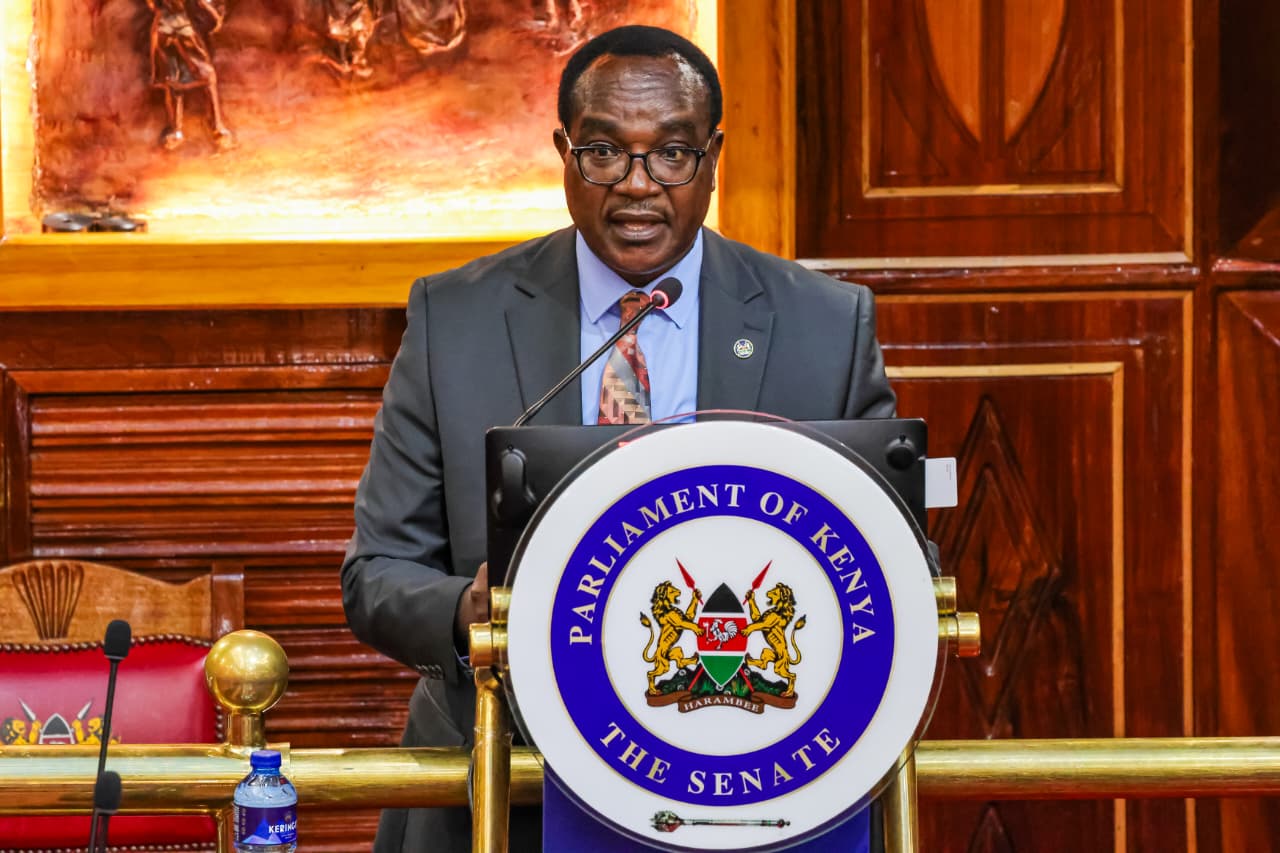
Education CS Julius Migos Ogamba said recommendations from the Presidential Working Party on Education Reform informed the arrangement.
The team conducted extensive consultations with stakeholders across the country, he said.
Ogamba was responding to questions by Nairobi Senator Edwin Sifuna when he appeared before the Senate plenary on Wednesday.
The CS said the majority of stakeholders supported hosting junior schools within primary institutions rather than establishing them as autonomous institutions or placing them in secondary schools.
According to the ministry, 93 per cent of submissions received during the review process recommended that junior schools be domiciled within existing primary schools.
Only five per cent of respondents preferred placing the institutions in secondary schools, while two per cent proposed constructing new schools specifically for junior learners.
The CS said the decision was influenced by several factors, including cost efficiency and the welfare of learners transitioning from Grade 6 to Grade 7.
“Junior school learners could experience psycho-social challenges integrating with older secondary school students,” the CS said.
“Additionally, using existing primary school infrastructure such as classrooms previously occupied by Standards 7 and 8 is more cost-effective than constructing entirely new institutions.”
The ministry noted that placing junior schools in primary institutions also reduces the distance learners travel to access education, an issue considered critical for vulnerable and marginalised children.
Under the current framework, primary and junior schools operate under a single head of institution and a unified board of management responsible for governance and administration.
The CS clarified that although junior schools operate separate financial accounts, this does not signify institutional autonomy.
Instead, the accounts exist for accountability purposes because the government allocates capitation funds differently for the two levels of education.
Primary school learners receive Sh1,420 per student annually, while junior school learners receive Sh15,042 per learner each year, necessitating separate financial reporting and audit processes.
However, the arrangement has sparked debate among stakeholders who argue that primary school heads may not have the training required to supervise graduate teachers deployed to junior schools.
Responding to the concerns, the CS said school heads are undergoing continuous training through programmes supported by the Teachers Service Commission to equip them with the necessary skills to manage institutions offering both primary and junior education.
The ministry has also introduced mentorship and coaching programmes to support newly deployed junior school teachers and enhance curriculum delivery.
In addressing another question raised by Tom Ojienda regarding the credibility of the 2025 Kenya Junior School Education Assessment, the CS dismissed claims that the results were manipulated or misreported.
He told the Senate that the ministry was not aware of any cases of irregularities in the assessment results, which were released by the Kenya National Examinations Council.
“The results released were accurate and were used to place learners in Grade 10, with a transition rate of 99 per cent,” the CS said.
The KJSEA is administered at the end of Grade 9 and forms part of the competency-based assessment system introduced under the new curriculum.
Unlike the former national examination structure, the assessment does not generate aggregate scores for ranking students.
Instead, performance is reported through four achievement levels—Exceeding Expectations, Meeting Expectations, Approaching Expectations and Below Expectations.
Each level is further divided into two bands to distinguish exceptional performance from average achievement.
The CS said the results are derived from multiple assessment components, including 20 per cent from the Kenya Primary School Education Assessment conducted in Grade 6.
Another 20 per cent from school-based assessments carried out in Grades 7 and 8, and 60 per cent from the final KJSEA examination.
To safeguard transparency and credibility in the assessment process, the government conducts pilot studies before implementing national assessments and deploys supervisors and invigilators during examinations.
Additional quality assurance measures include automated scoring for objective questions and independent examiners who mark structured questions under strict moderation guidelines.
Schools also use a Competency-Based Assessment portal to upload learner scores and supporting evidence of students’ work, which is then verified by officials from the examinations council.
The CS added that the ministry has intensified teacher training and stakeholder engagement forums to improve understanding of competency-based assessments and reduce misinformation.
INSTANT ANALYSIS
Education Cabinet Secretary Julius Migos Ogamba told the Senate that junior schools will remain within primary schools to ensure a smooth transition under the Competency-Based Education system. Responding to queries by Edwin Sifuna and Tom Ojienda, he said the arrangement is cost-effective and widely supported by stakeholders. He also dismissed claims of manipulation of the 2025 KJSEA results released by the Kenya National Examinations Council, affirming their credibility.