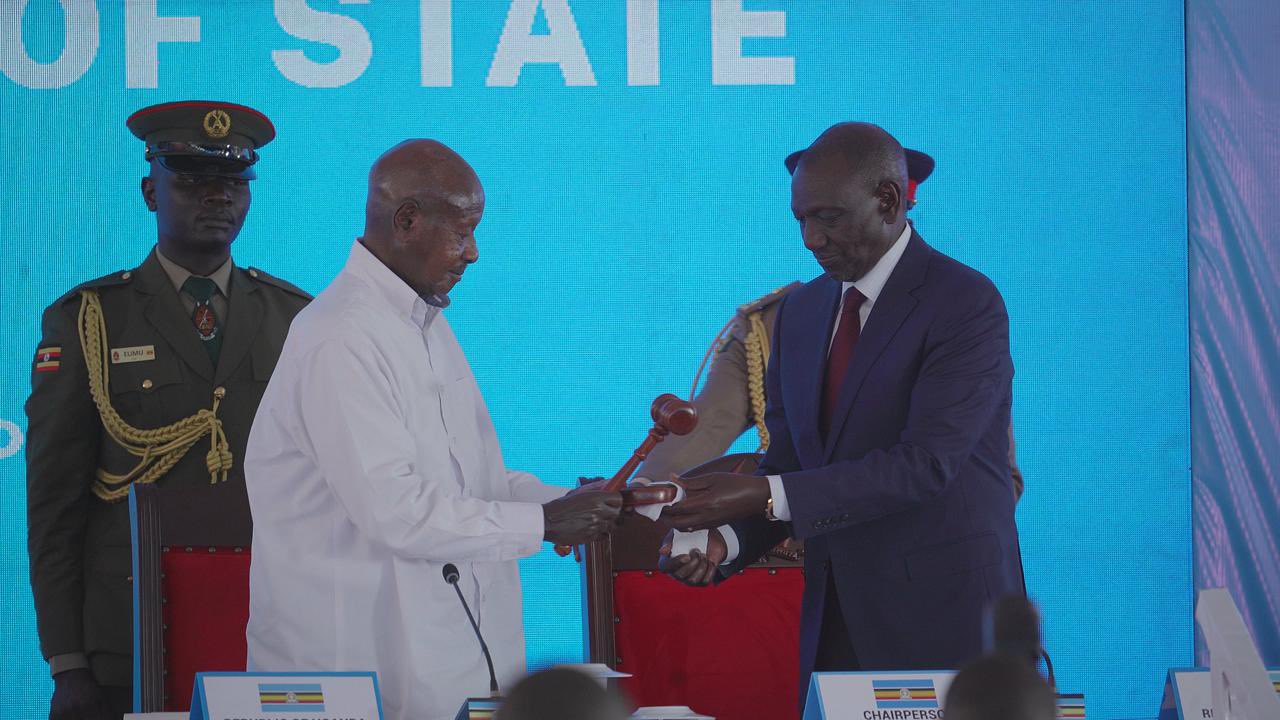
During the 25th
Ordinary Summit of EAC Heads of State on Saturday, leaders agreed to overhaul
how the community is funded and introduced relief measures to help partner
states clear mounting arrears.
The decisions mark one
of the most significant financial restructurings in the bloc’s history and are
intended to ensure predictable funding for regional programmes, institutions
and staff.
The new financing
model replaces an earlier framework adopted during the 23rd Ordinary
Summit.
In the previous one,
the community was to be funded through a 65 per cent equal contribution and 35
per cent assessed contribution formula, which factored in the economic strength
of each member state.
Advertisement
Advertisement
However, leaders
agreed to vacate that decision and adopt a 50:50 financing model instead.
Under the new formula,
50 per cent of the budget will be funded through equal contributions by partner
states, and 50 per cent will be based on assessed contributions tied to
economic capacity.
The summit directed
that partner states implement the new financing framework starting July 1, 2026.
Leaders instructed the
implementation should proceed “without fail and without further consultations
by the Council of Ministers”, signalling urgency to address the funding instability
that has plagued the community.
The move is expected
to distribute financial responsibility more evenly among the partner states
while recognising differences in economic size.
In a bid to unlock
immediate cash flow into EAC’s operations, the summit also approved a one-off
waiver on outstanding contributions owed by partner states.
Leaders agreed to
waive 50 per cent of all arrears owed by member states, citing economic
pressures currently facing the region.
However, the waiver
comes with a condition. That partner states must pay the remaining 50 per cent
of their arrears within two years, starting from March 7, 2026, when the
decision was adopted.
This move seeks to
incentivise countries to settle their debts while acknowledging the fiscal
challenges many governments are facing.
The EAC Secretariat in
recent years has struggled with delayed remittances, forcing the institution to
slow down programmes, postpone activities and face difficulties meeting
operational costs.
To prevent a recurrence
of the funding crisis, the summit also directed the EAC Council of Ministers to
finalise a schedule of sanctions for partner states that fail to meet their
financial obligations.
The sanctions
framework will take into account the new financing formula and is expected to
be presented at the 26th Ordinary Summit of EAC Heads of State next
year.
The sanctions regime
is meant to strengthen fiscal discipline among member states and ensure
predictable funding for the bloc.
Beyond financial
reforms, the summit also addressed persistent trade challenges within the
regional bloc.
End trade barriers
Leaders directed both
partner states and the Council of Ministers to resolve all outstanding
non-tariff barriers to trade within the community by June 30, 2026.
Non-tariff barriers,
including administrative restrictions, customs delays, and regulatory hurdles,
have long been cited by businesses as major obstacles to trade across EAC
borders.
By imposing a firm
deadline, the summit signalled a renewed push to deepen regional integration
and boost intra-regional trade.
The summit also
adopted a structural change affecting members of the East African Legislative
Assembly. Currently, EALA legislators are remunerated through the community’s
budget.
However, leaders
decided that after the end of the current assembly’s tenure in December 2027,
members serving in the regional parliament will instead be paid by their
respective national assemblies.
The decision is
expected to reduce the financial burden on the community while increasing
accountability of EALA representatives to their home countries.
The latest reforms
reflect growing concern among regional leaders about the sustainability of the
community’s finances.
Over the past decade,
the EAC has expanded both in membership and institutional responsibilities,
with the bloc now comprising eight partner states.
These are Kenya,
Uganda, Tanzania, Rwanda, Burundi, South Sudan, DRC and Somalia.
The expansion has
increased the scope of regional programmes and institutions, placing greater
strain on the bloc’s financial structure.
Outgoing secretary general
Veronica Nduva on Saturday said Burundi, Tanzania and Uganda on Friday had sent
some contributions after they were pushed to pay.
“This is after me
showing up in a bullish way or in a diplomatic way, urging or consistently
knocking on doors”.
“Every time, I have to
write a letter to a partner state asking them for money, then follow up through
phone calls and that is important, even for the next secretary general,” Nduva
said. Her term concludes in April.