Israel's military has issued a warning to Iran that it will continue pursuing every successor of the country's deceased supreme leader, Ayatollah Ali Khamenei.
In a post on X, the IDF's Farsi-language account said: "Iran's Assembly of Experts, which has not convened for decades, will soon gather in the city of Qom.
"We want to tell you that the hand of the State of Israel will continue to pursue every successor and every person who seeks to appoint a successor.
"We warn all those who intend to participate in the successor selection meeting that we will not hesitate to target you either. This is a warning!"
In a video shared by the Iran's state-affiliated Mehr news agency, a senior cleric says that the Iranian Assembly of Experts has nearly reached a decision about who should replace the late Supreme Leader Ayatollah Ali Khamenei, who was killed by US-Israeli strikes last Saturday.
The Assembly of Experts is a group of some 88 senior clerics - elected by popular vote - who are tasked with deciding Khamenei's replacement.
The agency reports Ayatollah Mohammad Mehdi Mirbagheri as saying that a "majority decision" had been reached, but that some procedural obstacles need to be resolved.
It is expected that the assembly will meet soon, and the Israeli military is threatening to "pursue every successor and every person who seeks to appoint a successor".
Tower struck in Kuwaiti City a government office
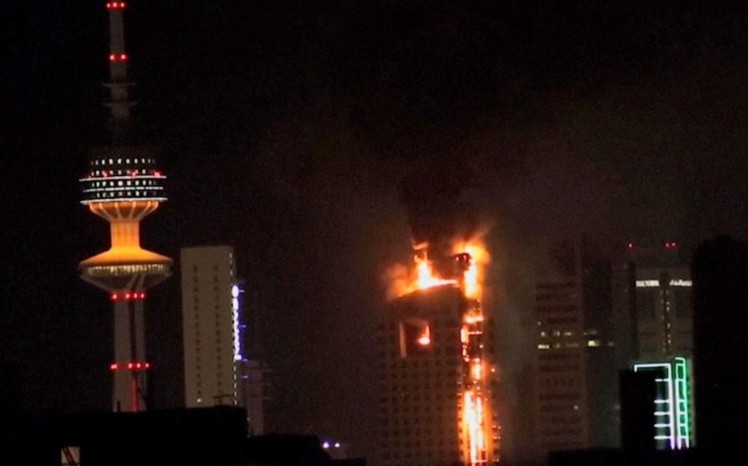
We can now bring you more details on the building that was set ablaze following drone strikes on Kuwait City in the early hours of Sunday morning.
It is a government site that is operated by the Public Institution for Social Security and the fire now appears to have been brought under control.
The department said earlier on social media that its main premises had been targeted "resulting in material damage to the building".
Flames tore through a Kuwaiti government building in the early hours of Sunday following more drone attacks on the Gulf state. The Public Institution for Social Security said its main site was targeted by strikes.
One man in Tehran tells BBC Your Voice that, as the war progresses, politics has taken a back seat.
"Our everyday lives have become about safety, food, communication and protecting family. Political debates that existed before the war fade in importance when people are under attack," he says.
"War forces people to confront the human cost," he adds. Before the conflict, people imagined war could remove the Iranian regime, but "the reality is very different" now the country is under fire, he says.
The internet blackout is making things more uncertain. "Authorities say it is for security reasons, but citizens view the internet as essential for communication and survival," he says.