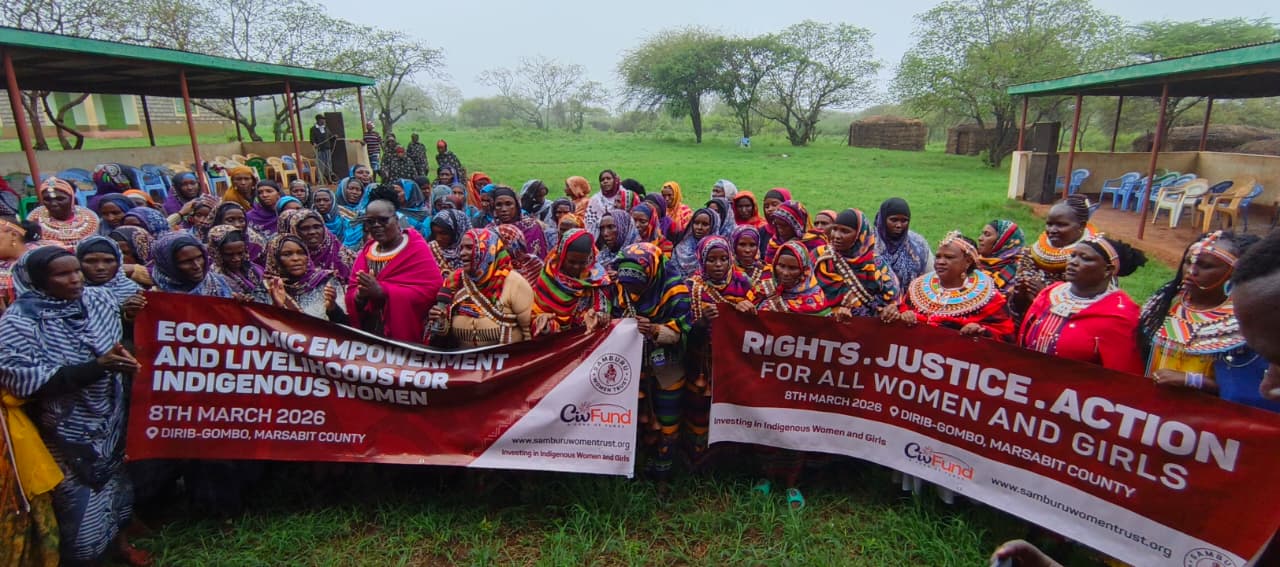
Different organisations marked the day under banners such as “Rights, Justice, Action: For All Women and Girls,” “Give to Gain,” and “Empowered Women, Thriving Communities.”
For many grassroots activists, these themes are best reflected in the life of Hellen Leisono, widely known as Mama Riziki. Her personal story mirrors the transformative power of empowering women at the community level.
Mama Riziki, from Samburu county, has become an inspiring example of how opportunity and support can enable women to rise into leadership despite limited formal education and social barriers.
Today, she serves as the chairlady of the Indigenous Women Investment Sacco, where she is one of the three signatories to the organisation’s accounts — a role that would have been almost unimaginable for many women in her community just a decade ago.
Yet Mama Riziki’s journey into leadership began from a difficult place.
Fifteen years ago, she says, she was chased away by her husband and left to fend for herself. In a largely patriarchal society, the future looked bleak.
But her life took a new turn about 10 years ago when she encountered Samburu Women Trust, a women-led organisation working to advance the rights of indigenous women and girls through leadership, governance and sustainable development.
Through SWT’s empowerment programmes, Mama Riziki gained skills, confidence and exposure that enabled her to rebuild her life.
Despite having no formal education, she has managed to educate her children up to college and Grade 9, learned basic financial literacy, and gained the confidence to speak publicly in Swahili.
“I am not educated, but SWT has offered me a platform for leadership,” Mama Riziki said in Swahili.
“SWT has facilitated inclusive leadership where, regardless of our education level or lack of it, they have held our hands.”
Her leadership journey has also been shaped by her compassion for vulnerable children.
Years ago, she rescued an abandoned newborn girl she found crying in the forest while collecting firewood. She took the child home and named her Riziki, meaning blessing. The act earned her the name Mama Riziki, the name by which she is now widely known.
Later, she intervened again to save another abandoned infant boy who faced being killed due to local beliefs. She adopted and raised the child herself.
The experience strengthened her resolve to advocate for the protection of vulnerable children in her community.
Mama Riziki says empowerment has also opened doors she never imagined possible.
Through programmes supported by SWT and indigenous women networks, she has travelled abroad, including visits to the US and Guatemala, where she interacted with women’s organisations from different parts of the world.
“I felt exposed to women organisations abroad. Even though I could not understand all the languages spoken, this was another type of education,” she said.
She now shares the lessons she learned with fellow women back home.
On this year’s International Women’s Day, Mama Riziki urged women to support each other and seek opportunities that enable them to lead.
“Women should join hands and support each other,” she said.
Her story, she added, proves that women can lead and transform their communities whether they are formally educated or not.
Speaking during the 115th International Women’s Day celebrations in Marsabit county under the theme “Give to Gain,” Indigenous Women Council chairperson Grace Lolim acknowledged the progress women have made in different sectors.
“We recognise the strides made by indigenous women in leadership in politics and community leadership,” Lolim said.
“Women should be empowered whether literate or illiterate. They have to be on the table when decisions are made. Economically, indigenous women should be empowered for self-reliance and freedom.”
Lolim said organisations working with grassroots communities have spent years building the capacity of women, and the results are now becoming visible.
“We have empowered women for the last 10 years by giving them knowledge. Now we are celebrating the outcome,” she said.
“We are seeing women receive awards and even Head of State commendations. We gave, and now we are gaining.”
“Even if they don’t know how to read and write, they can articulate issues better than someone who has gone to school. They have indigenous knowledge and the capacity to lead,” she said.
Women from different indigenous communities — including the Rendille people, Borana people and Konso people — gathered at the Artha Gadamoji Cultural Centre in Dirib-Gombo, Marsabit, to commemorate the day.
Participants noted that while progress has been made in advancing gender equality, many women, particularly from marginalised and indigenous communities, still face deep-rooted social, economic and political barriers.
“Strides have been made, but a significant number of women, especially from marginalised indigenous communities, continue to suffer economic, social and political discrimination,” the meeting noted.
Under the umbrella of the IWC, with support from SWT, the women called for stronger economic empowerment programmes and greater support from men in the fight for gender equality.
Women activist Nuria Gollo urged men to take a leading role in championing women’s rights and addressing harmful practices.
“Men should be in the frontline to advocate for women’s rights and help fight against female genital mutilation, early marriages and discrimination,” she said.
Resident Hassan Guyo also called for equal rights for women, noting their central role in society.
“Women are the reason society succeeds,” he said. “They are the incubator of the community.”
For Mama Riziki, the message of the day remains simple: when women are given the chance to lead, entire communities benefit.