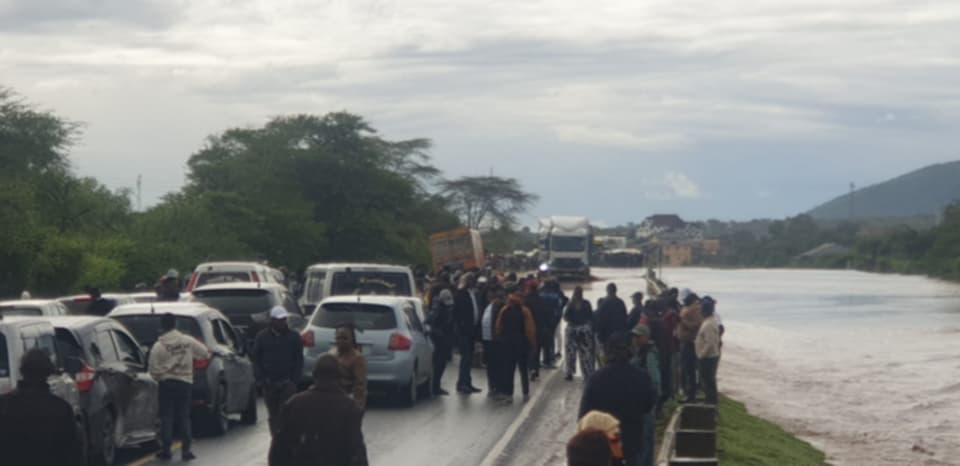
Transport was paralysed on Saturday along the busy Nairobi-Mombasa highway in Makueni County. The disruption followed flooding of the River Sultan Hamud, which cut off the highway and made movement impossible.
The river, located in the Sultan Hamud area, overflowed and submerged the bridge along the highway after a heavy downpour that hit the region on Friday night.
Traffic came to a complete halt, leaving several motorists and passengers stranded. Some vehicles were abandoned in the middle of the road.
Local authorities urged motorists to avoid the flooded sections until the road becomes passable. The situation caused heavy congestion on both the Nairobi-Mombasa and Mombasa-Nairobi lanes.
Authorities advised drivers travelling from Nairobi to Mombasa to divert via the Nairobi-Machakos-Wote-Makindu route. Those heading from Mombasa to Nairobi were also urged to use the same diversion for safety.
Several parts of the country experienced heavy rains on Friday evening, resulting in significant property damage, including vehicles and houses. Police reported that some lives were lost, particularly in Nairobi.
The Kenya Red Cross Society said on Saturday that, beyond Nairobi, flooding had been reported in Wang’chieng Ward, Kisumu County, after the Sondu-Miriu River burst its banks, affecting Kobala and Kobuya locations.
In a statement, the society said approximately 381 households were affected, with homesteads and farms submerged and about 56 hectares of farmland destroyed.
“Kenya Red Cross volunteers and Community-Based Disaster Response teams have been on the ground issuing early warnings to residents. No casualties have been reported so far,” the statement said regarding the Kisumu incident.
The County Government of Machakos has also issued a weather alert following the heavy rains. Through its Directorate of Emergency and Disaster Management, Governor Wavinya Ndeti’s administration warned of moderate to heavy rainfall as forecast by the Kenya Meteorological Department.
“The rains may cause flooding, overflowing rivers, and mudslides, especially in low-lying and hilly areas,” the Directorate said.
Hotspots identified include Athi River and its tributaries, areas at risk of riverbank overflow in Kinanie, Joska, Kamulu, and surrounding areas, Masinga Dam and Kiambere Dam downstream, hilly regions, and loose-soil areas prone to mudslides, as well as flood-prone drifts and low-lying depressions.
The Directorate advised residents near rivers and flood-prone areas to move to higher and safer ground. “Do not attempt to drive or walk through flooded roads or drifts,” it warned.