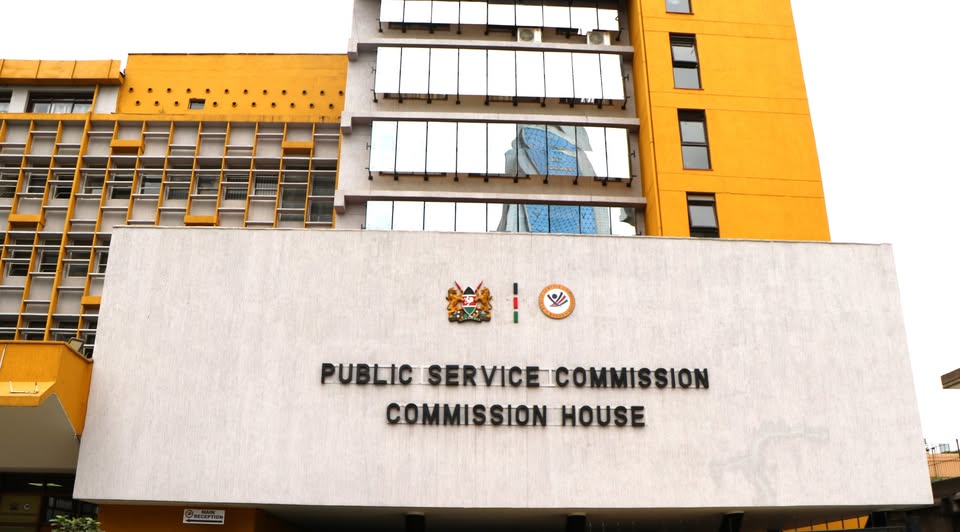
A new Public Service Commission report has laid bare how a few communities have dominated top government jobs, with the minority communities appearing to be edged out.
Despite the historical dominance, new employees have been drawn from the same communities, with the report concluding that the Kalenjin and Kikuyus are overrepresented.
Despite the overrepresentation, PSC highlighted that the two communities were the highest beneficiaries for the last year.
As of December 2024, there were 47,543 Kikuyus and 40,820 Kalenjins in the public service, being 20 per cent and 17.6 per cent, respectively.
The two communities dominated the 7,224 new employees hired across ministries, state departments and agencies in the period to December last year.
Of these, the Kalenjin community led with 1,250 appointments (17.3 per cent), followed closely by the Kikuyu with 1,208 (16.7 per cent).
The two communities also dominated the 8,447 new appointments that the Kenya Kwanza administration made in the period to December 2024.
PSC reports that the Kalenjin community is overrepresented, while Turkanas, Somali, Kamba, Luhya and Mijikenda are underrepresented.
President William Ruto has recently been accused of kicking out Kikuyus from the public service in favour of his Kalenjin brothers.The government rejects the accusation and says it emphasises merit and inclusion.
The constitution addresses the ‘Face of Kenya’, meaning the need for ethnic, regional and social diversity in public life. It mandates representation of all tribes in national and county governments, especially marginalised groups. Kenya has an estimated 46 ethnic communities.
At the Principal Secretary level, three communities, Kalenjin, Meru and Borana, were greatly overrepresented, with 26 communities completely locked out.
The Kalenjin community alone held 12 positions, followed by the Kikuyu, which has eight and the Meru, holding six posts.
Constitutional commissions and independent offices have 44 positions at the apex, but only 14 communities were represented.
The Kalenjin community held seven positions, while the Kikuyu held six, Luo five and Luhya six.
Borana community held two positions, which is nearly 400 per cent above their equitable share. The Gabra also held two. The Swahili held one.
PSC says the 44 positions could have given every community at least one seat. Instead, 32 communities got nothing.
Kikuyus and Kalenjins also dominated slots in commissions, boards of state corporations and councils, like the nursing council and so on.
Kikuyus were the majority with 756 representatives, followed by Kalejins at 621 out of the 3,841 positions.
Luhyas were 458, followed closely by Luos at 448, Kisiis at 326 and Kambas with 267 slots.
Public university councils have 278 positions, but only 20 communities were represented. More than half, that is 26, had no members at all.
The Kikuyu held 65 positions, followed by Luhyas at 38, Kalenjins at 37, with Kisiis at 34 and Luos holding 25 slots.
PSC concluded that of the 278 positions in councils of public universities, the 46 ethnic communities should get six members each.
State corporations and semi-autonomous government agencies had 1,936 board positions. Of these, 37 communities were represented.
Kikuyus dominated the list of board slots at 445, followed by 316 Kalenjins, while Luos held 207.
Luhyas followed closely at 197, Kamba (141) and Kisii, a distant sixth with 124 board members.
On the flip side, nine communities, including some of the country’s smallest and most marginalised, were completely locked out.
PSC says that had the positions been shared equitably, each of the 46 ethnic communities could benefit from 42 slots each.
Despite the possibility of each community getting 42 slots, nine communities received zero.
PSC wants the appointing authorities to act. “The appointing authority to promote equitable distribution of appointment opportunities among the 46 ethnic communities to facilitate a representative and inclusive public service,” the commission said.
While there were 248 CEO and vice chancellor positions across all public institutions, only 24 communities were represented.
The Kikuyu dominated with 53 positions, Kalenjin with 44, 30 from Luhya, Luo at 24, with Kisii and Kamba at 18 each.
Merus and Somalis held the next significant numbers with 11 and 12 representatives, respectively.
Even so, some 22 communities, being 47.8 per cent, had no representation at all in the posts of CEOs and VCs.
“The communities that were overrepresented were Kalenjin, Kikuyu, Kisii, and Swahili.”
PSC says the 28 positions they held in excess were adequate to cater for the 22 that missed out, without disadvantaging any.
As they dominate, some of the country’s smallest communities have been rendered completely invisible in the top echelons.
At least 22 ethnic communities have been completely locked out of top leadership positions in the country.
The Kenyan American and Dahalo communities had no representation anywhere. The Aweer/Waata, Dasenach, El Molo, Gosha, Kenyan European, Makonde, Walwana/Malakote, Gabra and Wayyu communities were entirely absent from technical and vocational education and training institutions.
Even where representation exists, it is often negligible. The El Molo had one person in training programmes, Dahalo two and Dasenach one.
The 2025 annual compliance report, which audited 511 public institutions, found that 47.8 per cent of the 46 ethnic communities had no representation at all.
This was in respect to the CEO and VC positions across constitutional commissions, independent offices, state corporations and public universities.
Article 232 of the Constitution requires the public service to ensure "adequate and equal opportunities for appointment, training and advancement at all levels.”
Article 250(4) says that appointments to constitutional commissions "shall reflect the regional and ethnic diversity of the people of Kenya." The report finds these provisions remain largely unfulfilled.
PSC has called for deliberate steps to correct the anomaly at university councils, Tvet boards and parastatals.
It further emerged that public institutions have defied orders to develop affirmative action programmes to address ethnic representation gaps by June 30, 2025.
A regulation that is to restrict hiring to achieve the balance is yet to successfully undergo the necessary approvals.
Even more tellingly, only 16 communities had any of their members serving as principals of Tvet institutes.
Kalenjins, Luhya and Kikuyu dominated the list of principals at 32 each for the first two and 31 for the Kikuyu community.
Luos had 18 slots, followed by Kambas at 16, Meru at 12 and Kisii at 11 out of the total of 169 positions.
This means that 65.2 per cent of communities were not represented in Tvet leadership, yet the institutions are meant to serve the entire nation.
Some 11 ethnic communities had appointments at Tvets in excess of their share, while a third ethnic communities were not represented in Tvet leadership positions.
In terms of overall staffing, Kisiis and Kalenjins were greatly overrepresented in the colleges, while the Luo and Luhya communities were overrepresented.
“The Maasai and Turkana were under-represented while the Kamba, Kenya Asians, Kenya Somali, Kikuyu and Mijikenda were grossly under-represented,” the report reads.
INSTANT ANALYSIS
For the communities locked out of the country’s top jobs, the constitution's promise of a public service that ‘has the face of Kenya’ remains a distant dream, and one that grows more distant with every appointment cycle that excludes them. Uncompetitive appointments, mostly done by politicians, are the bane.