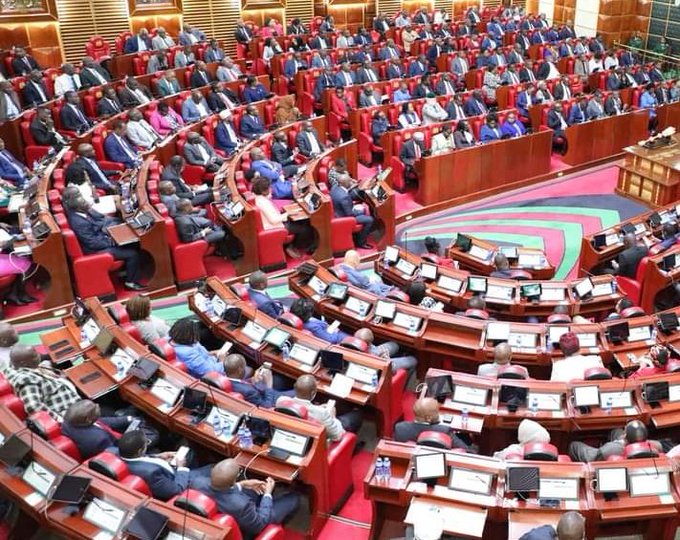
 MPs during a session in Parliament
The budget experts want Members of Parliament to raise Value Added Tax (VAT) from 16 per cent to 18 per cent.
The team argues that the move will help ramp up domestic revenue mobilisation to plug budget gaps.
The Martin Masinde-led PBO estimates the move will generate about Sh87 billion in extra revenue in the 2026/27 financial year.
In its latest budget options paper, the office says the
additional proceeds should be earmarked entirely for development spending.
They want priority given to settling verified pending bills owed to suppliers and contractors.
Sh475 billion was unpaid as of September 2025, choking small businesses, stalling projects, and causing pain to thousands.
PBO argues that the only way to break this cycle is to raise revenue specifically for clearing these arrears.
The experts say that for effectiveness, the money must not be mixed with the general pool of government funds.
“These resources are earmarked entirely for development expenditure, with a primary focus on the settlement of verified pending bills,” the office said.
Clearing the bills, PBO argues, would restore liquidity in the economy, unlock stalled projects, and boost public investment.
The report identifies the worst-hit sectors such as the State Department for Roads with pending bills of Sh130.4 billion.
Others as the Department for Higher Education which owes Sh73.3 billion, much of it to universities and the Department for Energy with Sh57 billion in unpaid obligations.
In addressing the pending accruals, experts say increased VAT could increase annual GDP by 0.5 per cent over the next five years.
Combined with other proposed measures, they hold that the total impact on GDP could reach 0.8 per cent.
Beyond the VAT hike, the PBO wants ministries to ringfence up to 10 per cent of their annual budgets to settle the arrears.
This would apply to all 66 MDAs that currently have unpaid obligations.
"This would make pending accruals clearance a formal part of budget formulation, rather than an afterthought,” PBO said.
For 38 of them, pending bills represent less than 10 per cent of their budget. Another 17 have arrears equivalent to between 10 and 40 per cent of their budget.
As such, setting aside 10 per cent annually would allow them to clear their debts within five years without disrupting services.
At least 10 MDAs have pending bills that exceed 50 per cent of their annual budget.
This means that even if they set aside 10 per cent each year for five years, they would still owe Sh75 billion by 2030.
The report recommends a direct bailout of Sh75 billion in the 2026-27 financial year to clear the said debts.
Executive Office of the President, the State Department for Roads, Energy, and Higher Education are the touted beneficiaries.
PBO is proposing a special Sh12 billion annually for Nairobi County for the next five years.
Besides tax hikes, experts want huge cuts on tax expenditures, which rose to Sh510 billion in 2023 from Sh240 billion in 2020.
VAT alone accounted for slightly over Sh330 billion, pointing to a long list of zero-rated and exempt goods and services.
“A legislative review should be prioritised for the removal of exemptions on goods that are not essential for basic consumption, vulnerable households or which do not primarily support commercial activities,” PBO recommends.
For the budget experts, VAT remains one of the most efficient tax instruments available to the government and has a predictable yield.
VAT is a consumption tax, meaning it affects everyone, especially low-income households who spend on goods and services.
However, for PBO, the exemptions and preferential treatments benefit a narrow group of taxpayers.
“Reducing tax expenditures is critical to strengthening fiscal sustainability,” the experts said, vouching for a leaner exemptions regime.
The VAT proposal comes when the National Treasury has assured Kenyans that the 2026 Finance Bill will not introduce new taxes.
Treasury’s focus is on compliance, sealing revenue leakages and efficiency, rather than raising tax rates. The Finance Bill of 2026 will give the true picture of the updated tax regime.
MPs face intense pressure from constituents already grappling with high cost of living, weak credit growth, and slow job creation.
Consumer groups and business associations have repeatedly cautioned that a higher VAT would be counterproductive.
Beyond taxation, the experts want MPs to rein in recurrent expenditure and ensure value for money in projects.
INSTANT ANALYSIS
Whether Parliament embraces the VAT hike or opts for alternative measures, the PBO’s message is that without stronger domestic revenue mobilisation and tighter spending discipline, fiscal pressures will persist. As a result, the government’s ability to deliver services and support sustainable growth will be limited.