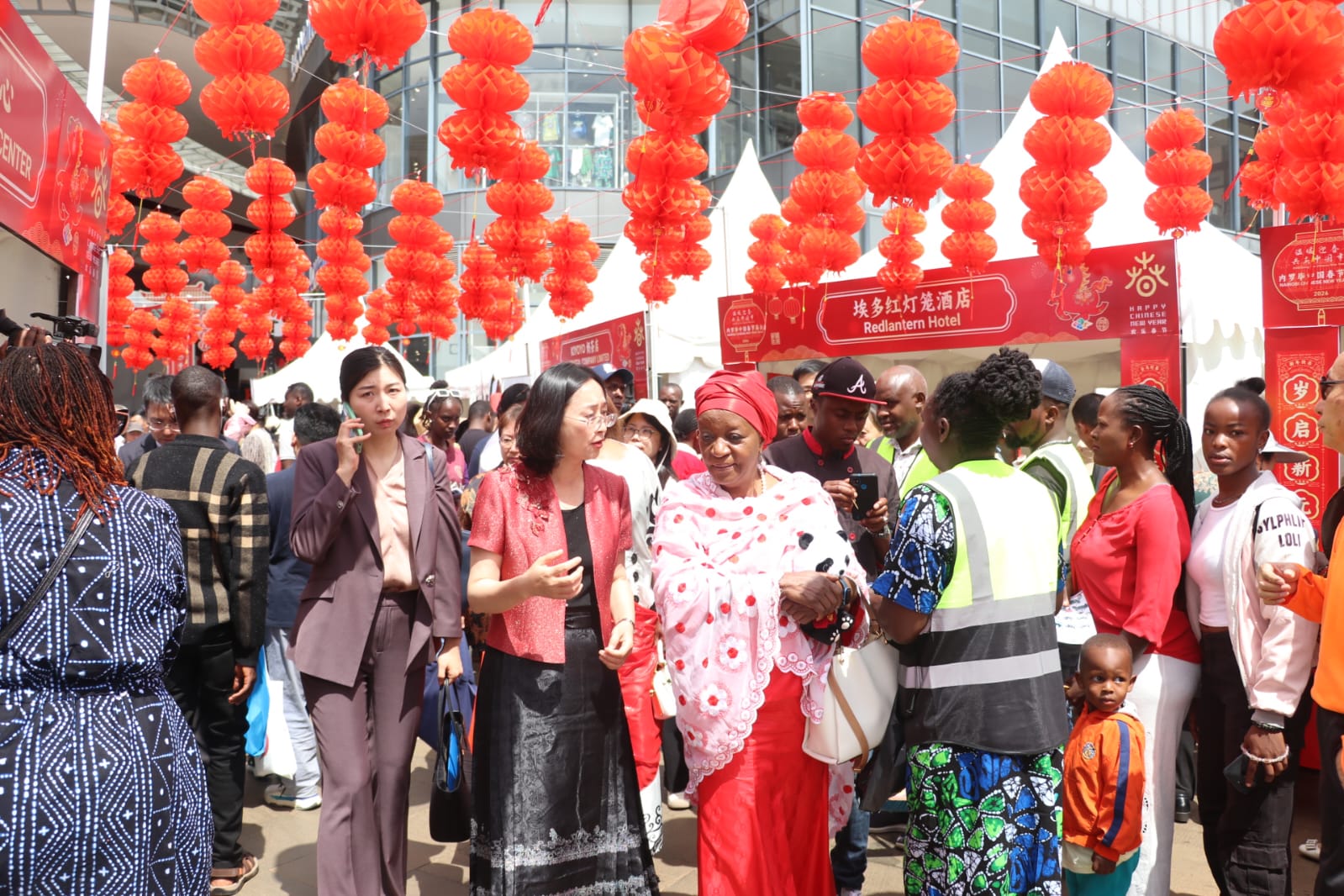
 Chinese Ambassador to Kenya Guo Haiyan and United Nations Office at Nairobi director-general Hawa Bangura during the Chinese New Year gala celebrations at the Two Rivers mall, Nairobi, on February 8, 2026.
Increasingly, it has become a moment of diplomatic reflection, and a time to pause and take stock of a partnership that has grown deeper, broader, and more people-centred over six decades. This year’s festivities in Nairobi carried that message clearly.
In her Lunar New Year remarks, Chinese Ambassador Guo Haiyan described the Spring Festival as a time of reunion, renewal and hope, values that she noted also define the trajectory of China–Kenya relations.
What began decades ago as a formal diplomatic engagement has matured into a multifaceted partnership spanning infrastructure, trade, education, culture and people-to-people exchanges.
For Kenya, the Lunar New Year has become an opportunity to reaffirm China’s place as a key development partner and a significant voice for the Global South.
President William Ruto, in his New Year message, extended greetings to the Chinese community and enterprises operating in the country, while underscoring Nairobi’s commitment to strengthening cooperation with Beijing across multiple sectors.
The symbolism matters.
Unlike traditional diplomatic anniversaries, the Lunar New Year is rooted in everyday life. It is marked not in conference halls but in homes, streets and community gatherings. The Spring Festival, a period known in China as Chunyun, is usually characterised by a travel rush.
In the weeks surrounding New Year’s Day, an estimated three billion passenger trips are undertaken across the country, thanks to China’s efficient railway system.
Airports, railway stations, and highways are normally pushed to capacity as hundreds of millions of workers and students embark on long journeys to their hometowns.
The voyages are driven by the culture of holding a family reunion dinner on New Year's Eve (which was marked on February 16). The public holiday in China generally lasts for nine days, from February 15 to February 23, 2026.
Even so, the celebration period extends 15 days, concluding with the Lantern Festival on March 3, 2026. The mass homecomings are the heartbeat of the holiday.
That grounding in ordinary experience gives the celebration a unique power to turn policy into shared moments and partnerships into personal connections.
Over the years, Lunar New Year galas in Nairobi have drawn growing crowds, featuring dragon and lion dances, acrobatics, calligraphy demonstrations and musical performances.
For many Kenyans, these events offer a first-hand encounter with Chinese traditions. For the Chinese community, they provide a bridge to local society. In essence, they together create a space where culture becomes diplomacy in action.
The soft power dimension aligns closely with the broader goals of the Forum on China-Africa Cooperation (Focac), which has increasingly prioritised people-to-people engagement alongside economic collaboration.
Under the framework, cultural exchanges, scholarships, tourism and youth programmes are seen as essential pillars of long-term partnership, and not mere optional extras.
President Ruto has echoed the approach, highlighting the importance of expanding cooperation beyond infrastructure and finance to include education, sports, innovation and cultural dialogue.
His administration views the exchanges as critical to building mutual understanding and ensuring that bilateral ties are felt at the community level, not just in boardrooms.
Ambassador Guo, for her part, has consistently framed the Lunar New Year as a reminder of shared aspirations: prosperity, harmony and development.
In her remarks, she linked the festival’s themes of renewal and collective progress to China’s ongoing collaboration with Kenya on development priorities, including industrialisation, trade facilitation and skills transfer.
The timing of the celebration also resonates with the diplomatic strategy. As global geopolitics grows more fragmented, both China and Kenya have emphasised multilateralism and South–South cooperation.
The Lunar New Year offers a natural platform for reinforcing the messages, and has seen leaders speak about solidarity, mutual respect and common development goals in a cultural rather than confrontational setting.
For Kenya, China remains a major trading partner and source of investment, with Chinese firms active in transport, energy, manufacturing and digital infrastructure.
For China, Kenya serves as a gateway to East Africa and a key partner in regional connectivity. Yet officials on both sides increasingly stress that the relationship must be about more than projects and interventions.
Lunar New Year thus represents a shift toward a more holistic partnership, that is, one that values cultural literacy alongside economic cooperation, and personal relationships alongside policy frameworks.
It reflects an understanding that diplomacy depends on trust built through everyday interactions, as is the case of Kenyan students studying abroad, Chinese and Kenyan tourists exploring new destinations, and artists collaborating across borders.
As red lanterns glow in Nairobi and messages of goodwill flow between Beijing and Kenya’s capital, the celebration underscores that diplomacy can be played out in shared meals and cultural performances, as well as in messages promising a common future.