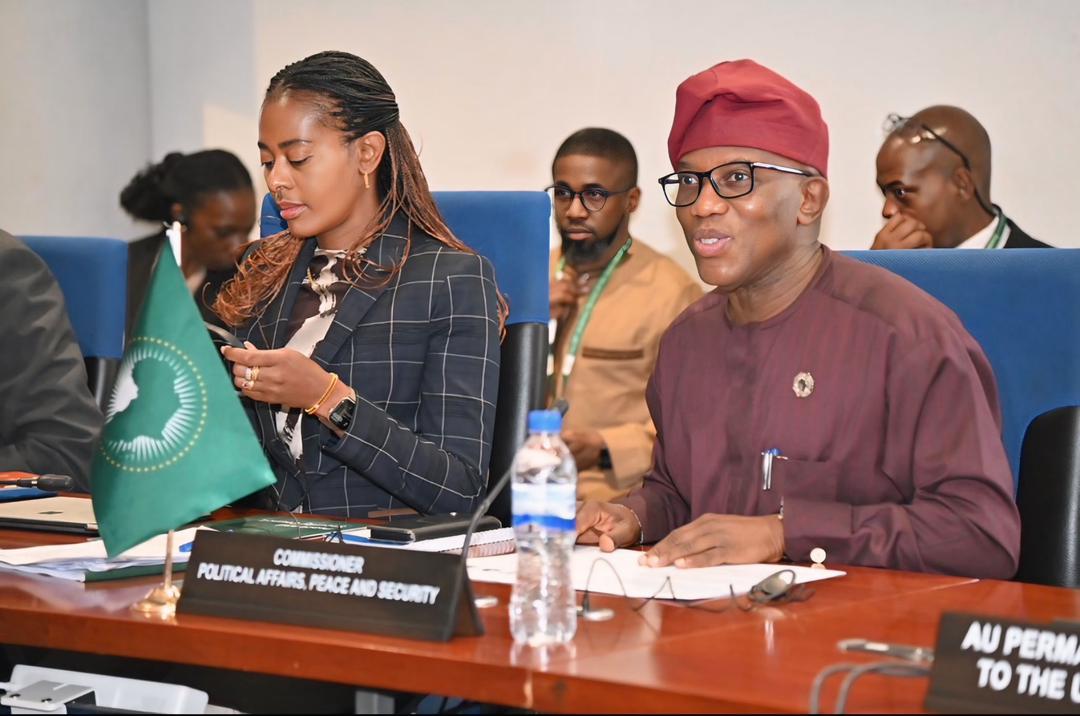
The African Union has renewed calls for immediate and permanent ceasefires in Sudan and the eastern Democratic Republic of Congo (DRC), with its top peace and security official outlining stepped-up diplomatic efforts following the 39th Ordinary Session of the Assembly of Heads of State and Government in Addis Ababa.
AU Commissioner for Political Affairs, Peace and Security Bankole Adeoye said African leaders had agreed on concrete measures to accelerate mediation and reinforce ceasefire initiatives in conflict-affected regions.
Speaking at AU headquarters, Adeoye confirmed that the AU mediator on eastern DRC, President Faure Gnassingbé, presented a detailed progress report to the Assembly on efforts undertaken since his appointment in April 2025.
According to the Commissioner, eight agreements have already been signed under the Doha and Washington processes.
Working in coordination with the East African Community and the Southern African Development Community, the AU is pressing for an immediate and permanent ceasefire in eastern DRC.
He called on all armed actors, including the M23 rebel group, to halt hostilities and create space for an inclusive inter-Congolese dialogue aimed at addressing the root causes of the conflict.
“Eastern DRC remains a top priority for the Union under its broader objective of silencing the guns across the continent,” Adeoye said, underscoring the AU’s long-standing peace agenda.
Turning to Sudan, the Commissioner described the crisis as the world’s most severe humanitarian emergency and reaffirmed the AU’s peace roadmap.
The framework focuses on securing a permanent ceasefire, guaranteeing humanitarian access, preventing regional spillover and promoting inclusive civilian political dialogue.
He welcomed collaboration with the United Nations Security Council, as well as regional partners including IGAD, the League of Arab States and the European Union.
A coordination platform has been established to align diplomatic initiatives and intensify engagement.
“The immediate objective is to stop all fighting and create conditions for lasting peace,” Adeoye said, noting that while discussions are under way on possible future peace support mechanisms, halting hostilities remains the urgent priority.
The AU Peace and Security Council, which met at ministerial level on February 12 ahead of the Assembly, reaffirmed its commitment to achieving a comprehensive and unconditional ceasefire in both theatres.
Addressing governance concerns, Adeoye reiterated the AU’s zero-tolerance policy on unconstitutional changes of government, noting that six member states remain suspended while political transitions are supported to restore constitutional order.
On global governance reform, he restated Africa’s demand for permanent representation on the UN Security Council in line with the Ezulwini Consensus, arguing that the continent’s 54 member states must have a stronger voice in international decision-making.
Adeoye concluded that despite mounting geopolitical tensions, the AU remains committed to African-led solutions, principled diplomacy and strengthening its peace and security architecture under Agenda 2063.