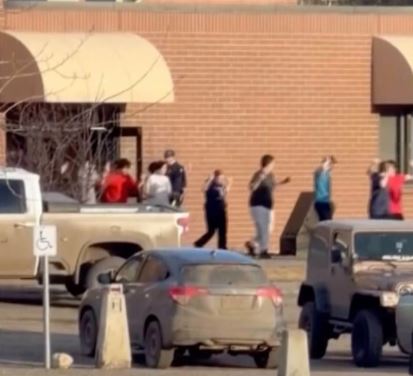
 This grab from video shows students exiting the Tumbler Ridge school after deadly shootings in British Columbia, Canada, on Tuesday
At least nine people were killed at a high school and a residential property in the Canadian province of British Columbia, police said Tuesday, in the country’s deadliest school shooting in decades.
Police found six people dead and dozens injured when they responded to reports of an active shooter at the school in Tumbler Ridge, a small rural town in the province’s northeast, around 1:20 p.m. Tuesday local time.
Another person died while being transported to hospital, the Royal Canadian Mounted Police (RCMP) said.
Two more people were found dead at a residence believed to be connected to the incident, police said in a statement.
The suspected shooter was found deceased at the school with “what appears to be a self-inflicted injury,” said police.
Tumbler Ridge is a town of about 2,400 people at the base of the Rocky Mountains in western Canada, about 680 kilometers from the US border. Mass shootings are extraordinarily rare in Canada, which has much stricter gun laws than the US.
The Tumbler Ridge massacre now stands among the deadliest violent incidents in the country since the 2020 Nova Scotia rampage, in which a gunman masquerading as a police officer killed 22 people and injured others over 16 hours — the deadliest in modern Canadian history.
Before that, Canada’s most infamous mass shooting was the 1989 École Polytechnique massacre in Montreal, where 14 women were murdered in an explicitly antifeminist attack, prompting a national reckoning on gun policy and violence against women.
UNDERSTANDING THE “MASS SHOOTING” PHENOMENON
Global research shows that, while mass shootings represent only a small fraction of total gun violence, their rarity does not diminish their psychological and social impact.
In the United States, for instance, thousands of mass shootings have been documented since the 1960s, with an average of more than 500 incidents annually in recent years.
Patterns observed in public mass shooting data suggest that perpetrators often share certain social or psychological attributes, and many cases involve individuals in crisis in the weeks before the attack. But experts also caution against oversimplifying causes—multiple factors, including cultural, societal, personal, and environmental influences, can converge in unpredictable ways.
Worldwide, mass shootings occur in a wide range of settings—schools, workplaces, places of worship, public gatherings—and no region is entirely immune.
A global overview indicates that countries such as Russia, Yemen, the Philippines, and Uganda have recorded public mass shootings, though the United States accounts for a disproportionate share relative to population size.
GLOBAL COMPARISONS: THE UNITED STATES AND BEYOND
The United States remains an outlier in the frequency of mass shootings. Analysts point out that the U.S., while representing less than 5 % of the global population, accounts for more than 30% of public mass shootings worldwide.
American mass shootings have included some of the deadliest in modern history: the 2017 Las Vegas Strip attack that killed 60 concertgoers, the 2016 Pulse nightclub shooting with 49 deaths, and countless school shootings including Columbine, Sandy Hook, and Marjory Stoneman Douglas.
Even as some data suggest a recent decline in the rate of mass killings in the U.S., the sheer scale of the problem means that a significant number of people—one in fifteen adults—report having witnessed a mass shooting in their lifetime.
According to the Small Arms Research project, there are 121 firearms for every 100 residents in the US, compared with an estimated 35 guns per 100 residents for its northern neighbor. School shootings of this scale are almost unheard of.
In 1989, a gunman murdered 14 women at École Polytechnique in Montréal, in a massacre that prompted a national reckoning about violence against women and led to tighter gun laws.
Canada has stricter gun laws than the US, making mass attacks like this far less likely there.
It is illegal to purchase an assault-style rifle in Canada—the class of weapons used in several of the deadliest school shootings in the US.
Late 2025 notable shootings
Beyond North America, mass shootings have struck Europe and Africa in recent years. In Austria in 2025, a school shooting claimed 11 lives, and in Serbia in 2023, a spree killing in multiple villages left nine dead and more injured.
South Africa – Saulsville, Gauteng (December 6, 2025): Multiple gunmen opened fire in a bar/shebeen, killing at least 12 and injuring 13, including children.
Australia – Bondi Beach (December 14, 2025): A mass shooting in Sydney’s Bondi Beach area prompted national mourning with remembrance events. School/University shootings and other incidents in the U.S. (2025):
Data show numerous mass shootings across the U.S. last year as part of broader gun violence trends, although totals were lower than in recent peak years.
Examples from 2025 documented elsewhere
Graz, Austria – School Shooting (June 10, 2025): 10 people killed and more than 30 injured at a secondary school before the shooter died by suicide.
Toronto Pub Shooting (March 7, 2025): Three gunmen wounded 12 people during a pub attack in Scarborough, Toronto.
Uppsala, Sweden (April 29, 2025): A shooting at a hair salon killed 3 people during celebrations.
Las Vegas Gym (May 16, 2025): Two fatalities and three injuries in a mass shooting at a fitness club.
Anaconda, Montana, U.S. (August 1, 2025): Four people were killed in a bar shooting before the suspect was captured.
In the U.S., organizations tracking mass shootings reported hundreds of incidents where four or more people were injured or killed in single events during 2025—though overall counts were lower compared to earlier peaks.
Despite some declines, mass shootings continued to occur frequently as part of broader gun violence patterns. The incidents occasionally ignite debates on the gun ownership saga, especially in the US.
Officials have failed to find a solution to the issue, which has been largely blamed for the trend in most places.
WHY THIS MATTERS: SOCIAL IMPACT AND POLICY DEBATES
Mass shootings provoke intense debate around firearm laws, mental health support, community preparedness, and societal resilience.
Globally, mass shootings persist as a complex social phenomenon driven by a mix of cultural, policy, psychological, and situational elements. Understanding and addressing them requires not only data and policy action but also community resilience, early intervention systems, and sustained public discourse.
In Canada, the Tumbler Ridge tragedy has reignited discussions about how a country with relatively low gun ownership compared to neighbours can prevent future violence.
Prime Minister Mark Carney described the incident as “devastating” and pledged federal support for victims and families, while British Columbia officials emphasised the need for healing and resources to support survivors.
In the U.S., policymakers grapple with balancing Second Amendment rights with public safety goals, leading to periodic legislative efforts on background checks, red-flag laws, and school safety measures—often amid fierce political division.
Beyond legislation, experts refer to mass shootings as a public health issue, recommending community interventions, threat assessment programmes, and deeper research into the social conditions that precede violence.