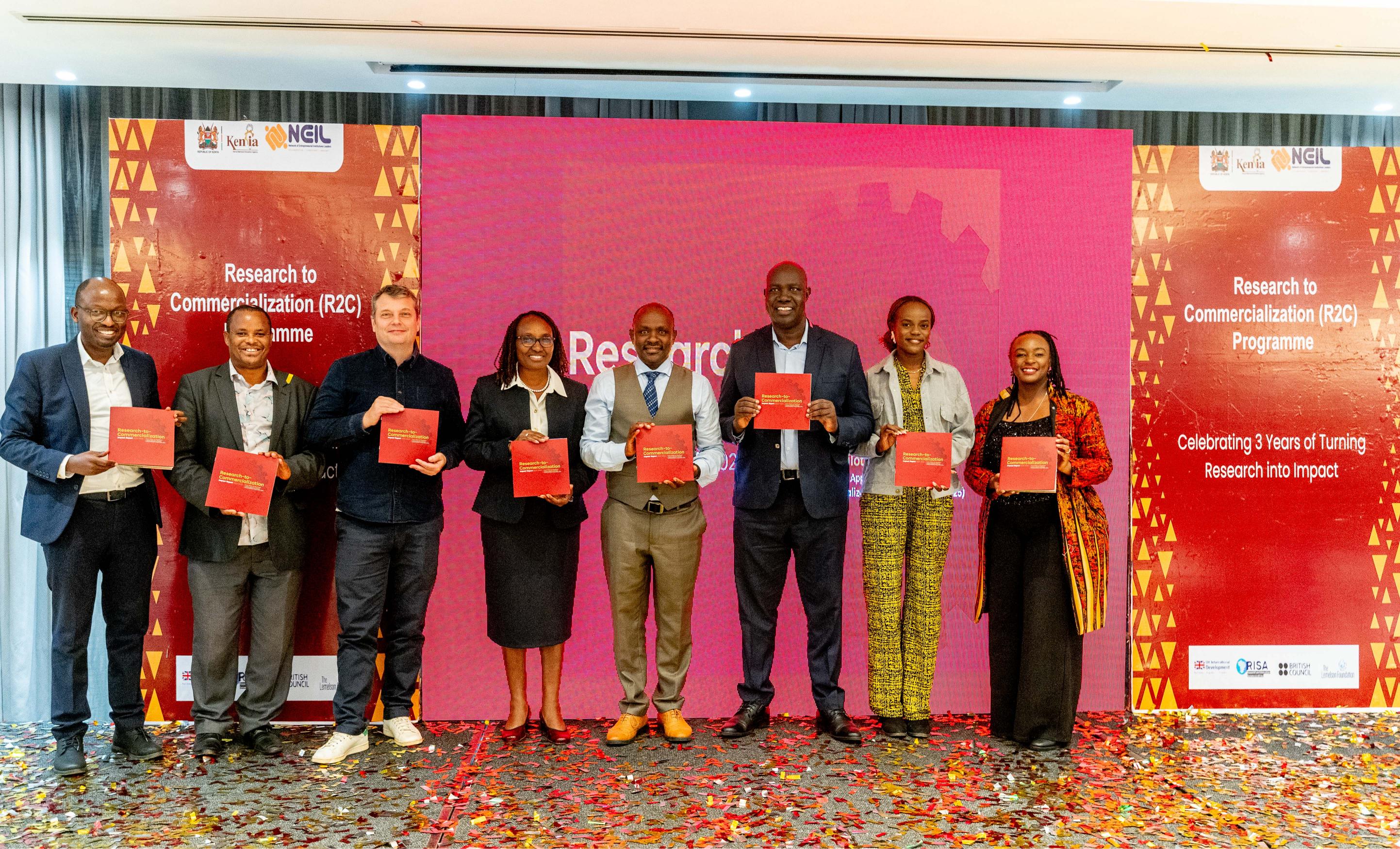
Kenyan universities are set to spend over Sh600 million to push academic research beyond journals and into the marketplace.
This is in a bid to turn locally developed innovations into businesses, jobs, and solutions for everyday challenges.
Kenya National Innovation Agency (KeNIA) chief executive Dr Tony Omwansa says the Research-to-Commercialisation (R2C) Programme has already mobilised Sh605.6 million in capital and supported the creation of 438 jobs.
Some 76 per cent of those jobs are held by women.
For decades, Kenyan universities have produced high-quality, locally relevant research, yet much of it has remained trapped in laboratories and academic papers, with limited impact on industry, job creation, or household livelihoods.
According to UNESCO Institute for Statistics, Kenya spends an estimated 0.8 per cent of its GDP on research and development, one of the higher levels in sub-Saharan Africa, but well below the global average of about 2.3 per cent.
The R2C Programme seeks to address this disconnect by linking researchers to funding, industry partners, and markets, enabling ideas to be developed into viable products and businesses.
“These results are not one-off wins,” Omwansa said. “They reflect systemic change, predictable pathways that link universities, markets, and finance within a coherent national system.”
Mark Lawler, Team Leader of the Research and Innovation Systems for Africa (RISA) Fund, noted that earlier investments largely raised awareness but failed to build durable institutional systems.
“R2C’s evidence is clear: investing first in leadership alignment and governance reform unlocks sustainable commercialisation pathways and delivers greater value for money,” he said.
Findings by the World Intellectual Property Organization (WIPO), cites weak institutional frameworks as a key barrier to research commercialisation in developing economies.
Historically, commercialisation efforts in Kenya were uneven, and Technology Transfer Offices (TTOs) often lacked authority and resources. Intellectual property policies were weak or underutilised, and commercialisation was treated as a peripheral, project-based activity rather than a core university function.
“R2C helped shift commercialisation from an abstract concept to an operational function within universities,” said Stephen Gugu, co-founder and director at Viktoria Ventures. “By engaging national actors as system stewards, the programme aligned institutional reforms with Kenya’s emerging innovation architecture.”
In total, 25 universities strengthened their research-to-commercialisation systems, 39 research-based innovations were supported alongside 15 female innovators, and 12 ventures transitioned to scale reaching more than 10,000 customers.
“Kenya is ready to move from isolated pilots to national commercialisation pipelines driven by leadership, sustained by institutions, and reinforced by markets and finance,” said Joseph Murabula, the CEO of the Kenya Climate Innovation Center.
He said the next step is anchoring these models within the public sector to ensure long-term ownership and replication.
The R2C Programme (2022–2025) was an initiative of KeNIA, implemented by Viktoria Ventures under the RISA Programme, and funded by the UK Foreign, Commonwealth and Development Office.