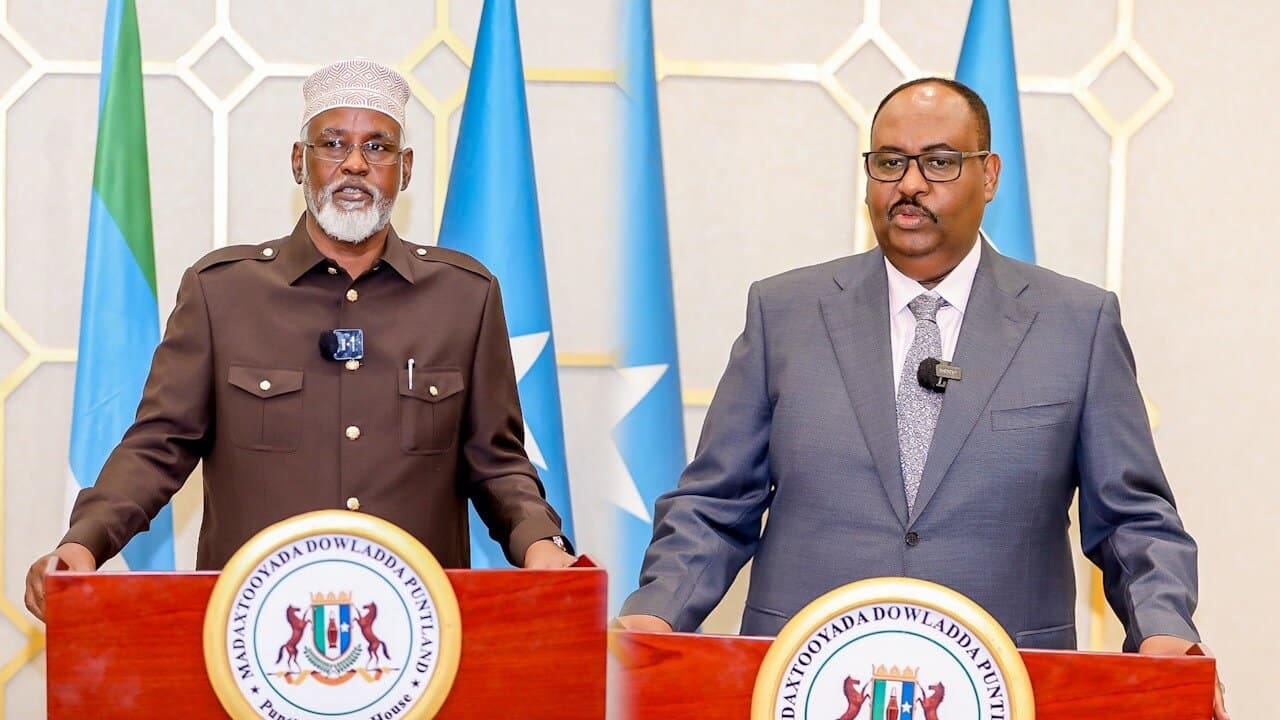
A regional policy expert has defended Somalia’s decision to limit the number of troops accompanying the presidents of Puntland and Jubaland during visits to Mogadishu, describing the move as essential to safeguarding national security, strengthening governance, and enhancing investor confidence in the capital.
Muhammad Alsharawi, a policy analyst specializing in governance and security in fragile states, said the federal government faces difficult trade-offs as it works to consolidate authority while projecting stability to citizens and international partners.
“Somalia is in a tough spot where it must maintain security and at the same time attract investors and international partners,” Alsharawi told local media.
He said achieving that balance requires strict adherence to agreed rules and centralised security arrangements.
“That means making tough decisions, enforcing agreed rules, and ensuring that security arrangements are predictable and centralised,” he added.
The decision by federal authorities followed concerns over compliance with established security protocols governing visits by leaders of federal member states to Mogadishu.
According to officials familiar with the matter, the protocols were agreed upon in advance and allow visiting leaders to travel with limited personal protection units rather than large, heavily armed contingents.
Officials indicated that the size and composition of the security details accompanying the Puntland and Jubaland presidents exceeded the agreed limits. While authorities emphasised that the issue was handled through coordination rather than confrontation, security agencies raised concerns about overlapping command structures and the potential implications for public order and command unity in the capital.
Analysts note that large and highly visible armed deployments by regional forces can inadvertently reinforce perceptions of insecurity, potentially undermining public confidence in national institutions and discouraging economic engagement.
The federal government has reiterated that it bears full responsibility for securing national political meetings and ensuring the safety of visiting federal leaders, regional officials, and opposition figures.
Officials have urged all stakeholders to rely on national security institutions and established frameworks, rather than parallel or ad hoc arrangements that could complicate coordination.
Alsharawi’s remarks come amid heightened tensions following a statement by the Jubaland State Government condemning what it described as an irresponsible and hostile decision by the Federal Government of Somalia to deny an aircraft carrying the Jubaland president’s advance delegation access to Mogadishu’s airspace.
In a statement issued on Sunday, Jubaland said the aircraft, which departed from Sayid Mohamed Abdille Hassan International Airport in Kismaayo, had been officially communicated to the Civil Aviation Authority, the conference organizing committee, and federal security agencies before take-off.
The flight was carrying members of the advance delegation and part of the security detail for Jubaland President Ahmed Mohamed Islam, widely known as Ahmed Madobe.
According to the statement, as the aircraft approached Aden Adde International Airport in Mogadishu, it was abruptly ordered to return to Kismaayo.
Jubaland officials said the directive was issued without verification that the aircraft had sufficient fuel to make the return journey safely.
“This action reflects a significant lack of responsibility and a hostile decision that jeopardized the lives of the advance delegation,” the statement said.
Jubaland further claimed that two civilian aircraft carrying passengers were also denied entry into Mogadishu’s airspace on the same day, warning that such actions risk creating confusion and heightening insecurity within Somalia’s already fragile aviation and security environment.