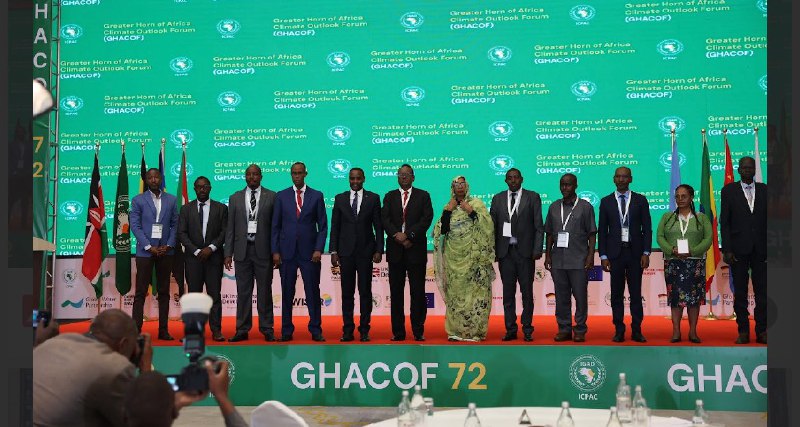
The Intergovernmental Authority on Development (IGAD) Climate Prediction and Applications Centre (ICPAC) has cautioned that the Greater Horn of Africa will experience varied rainfall patterns and generally warmer-than-average temperatures during the March to May (MAM) 2026 season, calling for heightened preparedness among governments and humanitarian actors.
In a statement on Tuesday following the 72nd Greater Horn of Africa Climate Outlook Forum (GHACOF 72) held in Nairobi, ICPAC said there is a 45 per cent probability of wetter-than-normal rainfall over much of the region, including most parts of Uganda, Rwanda, Burundi, Tanzania, central to western Kenya, Ethiopia, South Sudan, northern Somalia and Djibouti.
“A 40 per cent probability of near-normal rainfall is indicated over western and eastern South Sudan, north-eastern and south-western Kenya, most parts of Somalia, coastal Tanzania, and isolated areas of Uganda and Ethiopia,” the statement said.
However, ICPAC warned that drier-than-normal conditions are expected over coastal parts of Kenya, even as other areas receive enhanced rainfall, underscoring the uneven distribution of seasonal rains.
The regional climate body also noted that the onset of rains is expected to be normal to early over most parts of the Greater Horn of Africa, but delays are forecast over localized areas of Ethiopia, South Sudan and Somalia.
Despite the seasonal outlook, ICPAC cautioned that dry spells may still occur in areas forecast to receive near-normal or above-normal rainfall, while wet spells could affect areas projected to receive near- or below-normal rainfall.
On temperatures, the outlook indicates that warmer-than-average conditions are expected over most of the region, with higher probabilities over Sudan, Djibouti, Tanzania, and parts of Ethiopia, Somalia and Kenya.
Cooler-than-average conditions are forecast over parts of central to northern Ethiopia.
ICPAC urged member states and partners to act on the advisory, saying governments should “actively use the ICPAC regional seasonal outlook alongside national and sub-national forecasts” issued by meteorological agencies.
The centre also called for close monitoring of updated seasonal, sub-seasonal and short-range forecasts to support timely planning and decision-making.
“Preparedness and anticipatory actions should be scaled up to minimise potential flood and drought impacts, protect lives and livelihoods, and safeguard critical infrastructure,” the statement said.
ICPAC added that it will continue providing regular regional updates, while National Meteorological and Hydrological Services will issue detailed, country-specific forecasts and advisories.