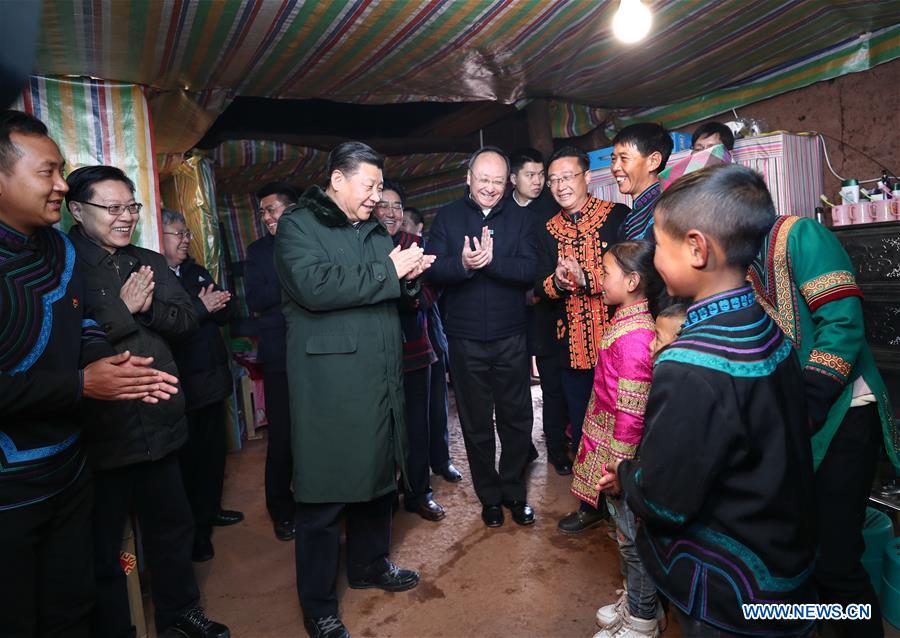
 Xi Jinping listens to a girl's singing at the home of an impoverished family as he visits Sanhe Village of Sanchahe Township in Zhaojue County of Liangshan Yi Autonomous Prefecture, southwest China's Sichuan Province, Feb. 11, 2018. (Xinhua/Ju Peng)
In China’s political architecture, the people are a central pillar, so much that the country itself is named the People’s Republic of China (PRC).
People-centered development is a key tenet of the Communist Party of China, a lesson that Kenya could also borrow in its polity.
In China, the whole party is under a strict code to apply people-centered philosophy of development.
President Xi Jinping, as reflected in his Vol 5 of Governance of China series, has been reiterating this fact.
“We should make sustained and steady efforts, do all we can within our capacity, and make more notable and substantive progress towards this goal,” he said.
The interventions by China have an element of being deliberate about making life easier for the people.
It is what saw the hardships of residents of rural Shaanxi, where Xi lived and worked for seven years, turned into better lives.
The Chinese leader himself said he was elated to see the modern day Yan’an bustle with “bumper harvests, better transport, and many other momentous changes.”
During a recent visit, he reminisced how villagers, in the past, “sowed much but reaped very little.”
It was a hard life, Xi noted. But today, the farmlands have been turned into forests with apple trees dotting its slopes.
“The adults have jobs and stable incomes, the children receive a proper education, and the elderly enjoy medical insurance,” Xi’s book reads in part.
“These changes in Northern Shaanxi reflect what’s happening throughout the country,” the president’s book adds.
For China, the focus today is to have all people enjoy a more fulfilling life, the country having defeated absolute poverty.
CPC, the book shows, is regarded as a party ‘from the people and one that serves the people’.
“As the governing party, in China, the CPC acts for the benefit for the people and in their best interests.”
As such, the administration doesn’t just give ‘empty talk’ – which is viewed as harming the country more than make it flourish.
CPC interventions are all rounded, from environmental conservation to responding to health emergencies.
Its philosophy is also oriented towards caring for the elderly, which is seen is a “traditional virtue of the Chinese nation”.
Xi once told grassroot officials that they “must bolster eldercare programs and industries, and boost eldercare institutions.”
“In particular, we must ensure the basic living standards of those elderly who subsist on government support is part or in full, who are of advanced age, and who suffer from functional impairments,” he said.
Most recently, the Chinese leader directed that the party must “pay close attention to issues of greatest concern to the people”.
Employment, income growth, education, medical care, housing, government services, childcare, eldercare, personal and property safety are prioritised by the party.
In the May 2024 meeting in Jinan, the CPC leader directed that the party “carry out projects that benefit the people, win their appreciation, and align with their wishes”.
Sports is not left behind. CPC commits to people-centered sports programs and an integrated national fitness and health initiatives.
China’s CPC has an elaborate structure, straddling the grassroots all the way to the national level.
Party committees and governments at all levels have a cardinal call to ensure a people-centered approach to civil affairs.
They are under a call to reinforce people-centered projects, and guarantee basic living standards for those in need.
As such, China, through embassy in Nairobi, has been on the forefront in champion people-to-people exchanges.
The arrangement has seen more than 2,000 Kenyans get scholarships to study in China.
Media practitioners have had a chance to live and work in China, cover its press activities, and participate in the development discourse.
Dozens of teachers from Kenya have been flown to various Chinese universities to learn Mandarin and return to teach it in Kenya.
Under the people-centered development approach, Kenyans have travelled to Beijing to study railway engineering, most of whom are currently operating the Standard Gauge Railway.
China also played a central role in helping Nairobi solve its traffic jams nightmare that had made JKIA less attractive to tourists.
A journey from the airport to Westlands that used to take over an hour or so, has been reduced to 30 minutes through the Nairobi Expressway.
Unlike China, Kenyan political party system bestows the responsibility of serving the people on the party that forms government.
Those left out of the power matrix, if not in an alliance with the ruling regime, usually take a back seat and call themselves ‘government in waiting’.
UDA, following the deal President William Ruto signed with his Chinese counterpart in April last year, is in an exchange program with CPC.
Several UDA officials have travelled to China to benchmark on the ideals.
Among the lessons is on how to govern better and carry out development that touch people’s lives.