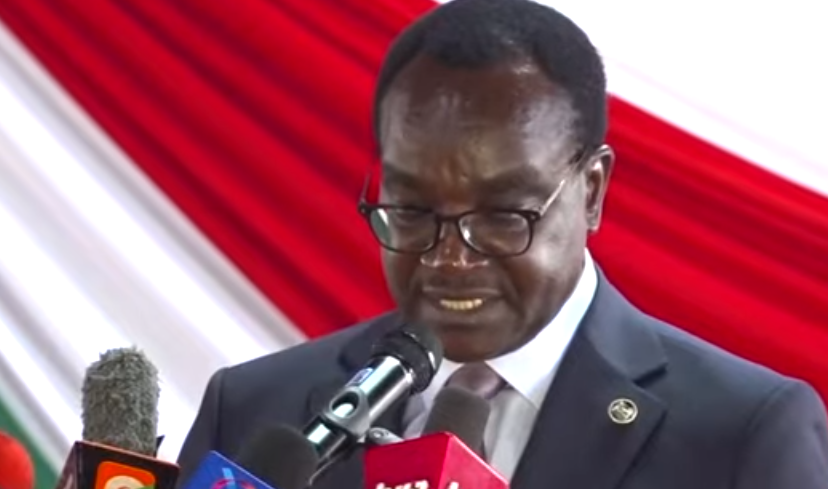
 Education CS Julius Ogamba/SCRENGRAB
For the second year in a row, female candidates have outnumbered their male counterparts in the Kenya Certificate of Secondary Education (KCSE) examinations, with fourteen counties recording significantly higher female participation in 2025.
This trend reflects the continued progress in bridging the gender gap in access to secondary education across the country.
Data from the Ministry of Education shows that, nationally, female candidates accounted for 50.46 per cent of the 993,226 candidates who sat the KCSE, while male candidates represented 49.54 per cent.
While the national trend favours girls, some counties demonstrated particularly high female candidature, highlighting regional variations in gender participation.
Vihiga County led the list, with female candidates making up 55.90 per cent of the total entries compared to 44.10 per cent males.
Elgeyo Marakwet followed closely, where 55.06 per cent of candidates were female against 44.94 per cent male. Kisumu recorded 53.87 per cent female candidates compared to 46.15 per cent male candidates, while Kiambu had 53.23 per cent females to 46.77 per cent males.
Kwale County reported 53.19 per cent female candidates and 46.81 per cent male, and Nairobi had 52.90 per cent female candidates against 47.10 per cent male.
Kakamega recorded 52.47 per cent females to 47.53 per cent males, while Meru had 52.22 per cent female candidates compared to 47.78 per cent male candidates.
Isiolo County posted 52.21 per cent female candidates versus 47.79 per cent male, and Uasin Gishu had 52.14 per cent females to 47.86 per cent males.
Other counties with a significant female majority included Machakos (51.87% females), Kitui (51.74% females), Busia (51.72% females), and Tharaka Nithi (51.57 per cent females), showing that girls continue to dominate entries in several regions.
Education Cabinet Secretary Julius Ogamba, during release of the results in Eldoret on Friday, noted that the government’s investment in infrastructure, teacher recruitment and policy reforms has played a key role in ensuring more girls complete secondary education and transition to higher levels.
The data also highlights regional variations in gender participation, underscoring the need for targeted interventions in counties where male candidates still dominate.
CS Ogamba emphasised the importance of continued community engagement, policy support and resource allocation to ensure equitable access for all learners, regardless of gender.
In addition to the counties with significant female majority, twenty-three counties recorded near-perfect gender parity in the 2025 KCSE examinations, reflecting balanced participation between boys and girls.
These counties include Lamu (49.11% males: 50.89% females), Marsabit (49.15%:50.85%), Embu (49.24%:50.76%), Tana River (49.25%:50.75%), Laikipia (49.27%:50.73%), Kisii (49.31%:50.69%), Baringo (49.34%:50.66%), Migori (49.48%:50.66%), Trans Nzoia (49.82%:50.18%), and Nandi (49.89%:50.11%).
Other counties with near-equal gender representation include Kajiado (49.99%:50.01%), Taita Taveta (50.27%:49.73%), Kericho (50.38%:49.62%), Siaya (50.45%:49.55%), Kilifi (50.53%:49.47%), Bomet (50.59%:49.41%), Nyeri (50.71%:49.29%), Nyandarua (50.71%:49.29%), Murang’a (50.92%:49.08%), Nakuru (50.95%:49.05%), Kirinyaga (50.98%:49.02%), Bungoma (51.24%:48.76%) and Makueni (51.48%:48.52%).