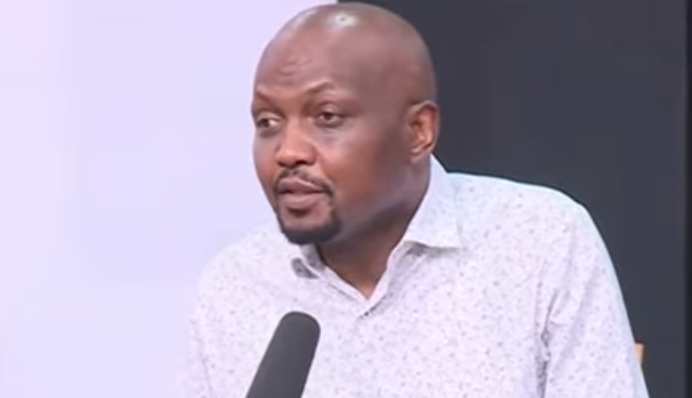
 Former Presidential Advisor Moses Kuria/SCREENGRAB
Former Presidential Adviser Moses Kuria has reflected on the formative role played by the late businessman and former Lugari MP Cyrus Jirongo in shaping student activism and political consciousness during Kenya’s transition to multiparty democracy in the early 1990s.
Speaking during Jirongo’s memorial service held at the Christ Is the Answer Ministries (CITAM) in Nairobi on Saturday, Kuria traced his political awakening to the turbulent period of the Moi era, when university campuses were hotbeds of dissent and agitation against one-party rule.
Kuria said the year 1992, which marked Kenya’s first multiparty elections, was widely referred to among student leaders as “the Jirongo year,” a reflection of the late politician’s growing influence and visibility at the time.
He noted that for young activists navigating the risks of political engagement, proximity to Jirongo carried deep political meaning.
“For those of us who were young students at the advent of multipartism in 1992, when we were student leaders, it was easily called the Jirongo year,” Kuria said.
“We used to gossip about each other, especially those who claimed to be radical and opposed to the government, but were seen with Jirongo. We knew what that meant at the time.”
According to Kuria, Jirongo’s presence in political circles during the 1990s shaped the thinking and ambitions of many young leaders, even those who were openly critical of the government of then President Daniel arap Moi.
He said Jirongo’s determination and boldness left a lasting imprint on a generation that would later find its way into mainstream politics.
“Our entry into politics was shaped by this man,” Kuria said, describing Jirongo as a figure who understood power, influence, and the art of political engagement during a highly restrictive period.
Kuria recounted that his relationship with Jirongo later evolved beyond admiration from afar into close professional interaction.
He said he worked alongside Jirongo and John Nyongesa, offering strategic advice, particularly in managing communication around Jirongo’s numerous legal and political challenges.
He added that Jirongo remained deeply involved in political consultations even in later years, including during the formation of the One Kenya Alliance, before political paths eventually diverged.
Despite taking different directions, Kuria said Jirongo remained resolute and ambitious, refusing to scale down his vision even as circumstances became increasingly complex.
Kuria described Jirongo as a man of fortitude and determination, whose defining trait was “thinking big.”
He recalled Jirongo’s rejection of short-term gains, saying the late politician believed wealth and opportunity should circulate rather than be hoarded.
“He did not want ‘jam ya pesa,’” Kuria said, explaining that Jirongo believed money should keep moving — that one opportunity must end for another to begin.
Beyond reflection, Kuria also called for thorough investigations into the circumstances surrounding Jirongo’s death, stressing that seeking the truth should not be interpreted as assigning blame.
He said clarity was essential for closure, both for the family and the public.
The requiem mass was attended by Jirongo’s family, close friends, business partners, and several political leaders.