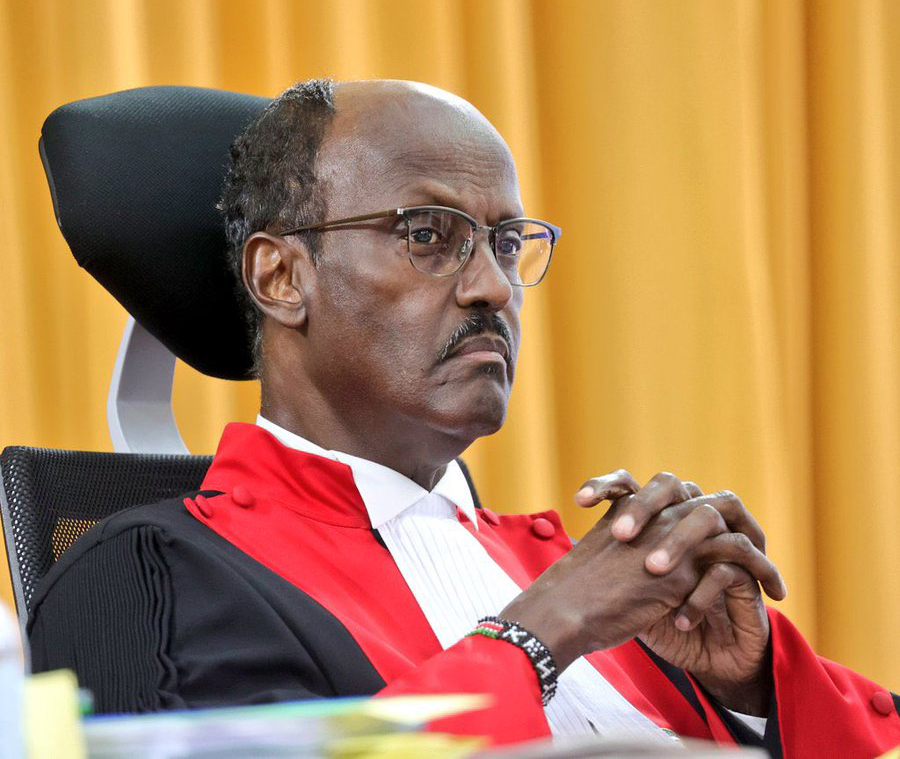
 Justice Mohammed Ibrahim
Justice Mohammed Khadhar Ibrahim, a founding judge of Kenya’s Supreme Court and one of the country’s most soft-spoken yet influential jurists, died on Wednesday in Nairobi after a long illness. He was 69.
Colleagues remember him for his quiet presence on the bench: thoughtful, measured, and guided by deep faith in the constitution.
His passing, just weeks before his scheduled retirement in early 2026, closes a professional chapter that began before multi-party democracy got its footing and matured alongside Kenya’s modern legal transformation.
Born on January 1, 1956, Ibrahim grew up in Garissa before moving to Nairobi for further education.
In 1982, he became the first Kenyan-Somali admitted as an advocate of the High Court, a milestone that opened doors for lawyers from marginalised Northern communities.
Before joining the Judiciary, he built a reputation as a lawyer committed to civil liberties and public interest cases, taking on matters involving detention without trial and minority rights.
His judicial career began in 2003 with his appointment as a High Court judge.
Over the next eight years, he served at stations including Eldoret, Mombasa, Meru and Milimani, where his firm grasp of commercial and administrative law earned him respect from the bar and bench.
The turning point came in 2011, when Ibrahim was appointed to the inaugural Supreme Court formed under the 2010 constitution.
Those early years were defining for Kenya’s constitutional order.
The new apex court faced the first presidential election petition in 2013, then again in 2017, and later in 2022.
Ibrahim participated in those landmark decisions, shaping jurisprudence on electoral justice and strengthening judicial independence.
Justice Ibrahim also chaired the Judiciary Committee on Elections, helping set guidelines for preparedness and dispute resolution, and served on the Judicial Service Commission, where colleagues noted his insistence on integrity, fairness and accountability in judicial appointments and discipline.
His judgments and dissents reflected a jurist who valued restraint, reasoned deliberation and fidelity to constitutional values.
Lawyers often remarked that Ibrahim listened more than he spoke, and when he delivered a line of questioning, it was deliberate and pointed.
News of his death prompted tributes from across Kenya’s public institutions.
President William Ruto described him as “a steadfast defender of constitutional order,” while Chief Justice Martha Koome called him “a jurist of humility, intellect and unwavering commitment to justice.”
Former Chief Justice David Maraga praised him as a colleague whose quiet courage and conviction strengthened Kenya’s judiciary during turbulent political seasons.
To younger lawyers, Ibrahim represented a path in which dignity and calm could coexist with firmness on principle.
His story, from northern Kenya to the Supreme Court, expanded the imagination of what was possible for those from historically underrepresented communities.
Justice Ibrahim is survived by his wife and four children.
As Kenya reflects on his legacy, many remember a man whose soft voice and gentle manner never obscured the force of his convictions: that the rule of law must anchor national life, and that justice, once promised in the Constitution, must be lived in practice.