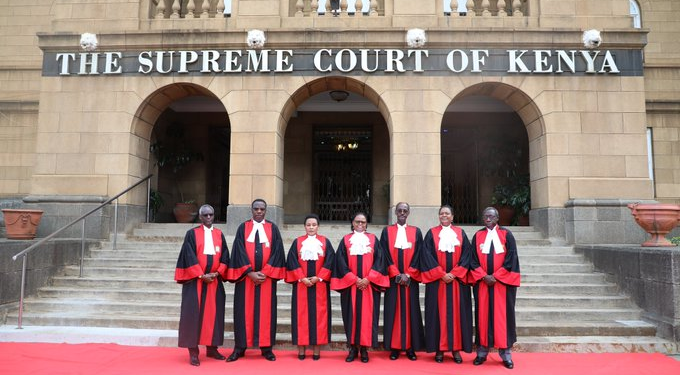
 Supreme court judges/FILE
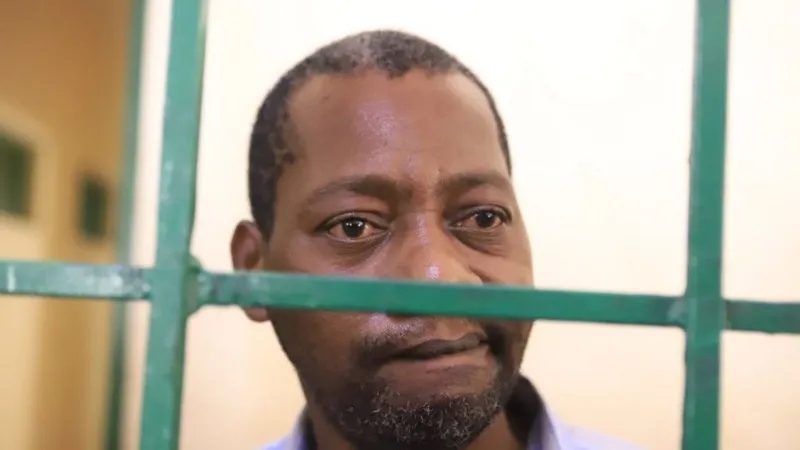
Following the death of Supreme Court Judge Ibrahim Mohammed, a huge vacuum has been left in the Judiciary.
Sources close to the family say Justice Mohammed had been taken to India for specialised treatment, but doctors later advised that he be returned home to Kenya for his final days.
Before joining the Bench in 2011, he had already distinguished himself as a trailblazing advocate, human rights defender and public-spirited lawyer whose work shaped constitutional litigation and access to justice.
His passing has not only triggered mourning within the legal fraternity but has also raised an important constitutional question: what happens when a judge of Kenya’s highest court dies while in office?
The Supreme Court of Kenya sits at the apex of the country’s judicial hierarchy and is established under Article 163 of the Constitution of Kenya, 2010.
It is the final court of appeal and the ultimate interpreter of the Constitution.
By law, the court is composed of the Chief Justice, who is the President of the Supreme Court, the Deputy Chief Justice, who serves as the Vice-President, and not fewer than five other judges.
This means the court must ordinarily have a minimum of seven judges to be fully constituted, although it can still sit with a quorum of five judges in most matters.
"The Supreme Court shall be properly constituted for the purposes of its proceedings if it is composed of five judges," Article 163 (2) states.
The Supreme Court’s mandate is narrowly but powerfully defined as per the Supreme Court Act.
It hears presidential election petitions, advisory opinions at the request of national and county governments, and appeals involving constitutional interpretation or matters of general public importance.
Its decisions bind all other courts, tribunals and authorities.
As such, the death of a sitting Supreme Court judge is not only a personal or institutional loss but a constitutional moment that affects the functioning of the justice system at the highest level.
When a Supreme Court judge dies in office, the position immediately falls vacant by operation of law.
Unlike retirement, resignation or removal through a tribunal process, death creates an automatic vacancy, requiring no further legal determination.
In the first stage, the Judiciary formally notifies the Judicial Service Commission (JSC).
JSC is the constitutional body mandated under Article 171 of the Constitution to oversee judicial appointments, discipline and administration.
The vacancy is then formally declared, setting in motion the recruitment process to fill the seat.
In the immediate aftermath, the Supreme Court continues to function, provided it meets the quorum requirements.
However, practical implications may arise depending on the stage of proceedings.
The Supreme Court Act, for instance, anticipates situations where a judge who had participated in the hearing of a case dies before writing or delivering the judgment.
Section 25 of the Act provides that “where a judge presiding over a matter is not able to deliver a judgment on account of death, suspension, removal from office, retirement or infirmity, which occasions a lack of the prescribed quorum of the Court, the Chief Justice may substitute such judge.”
In rare circumstances, a matter may need to be re-heard if the loss of a judge materially affects the bench that heard the case, particularly where the numbers fall below the constitutional threshold.
Administratively, the Judiciary flags the vacancy to ensure continuity of operations.
The Chief Justice, as head of the Judiciary under Article 161, plays a central role in reconstituting benches and reallocating judicial responsibilities.
There is no provision for an “acting” Supreme Court judge; vacancies can only be filled through a substantive appointment process set out in the Constitution and relevant statutes.
The process of replacing a deceased Supreme Court judge is elaborate and deliberately insulated from political interference.
The JSC is required to publicly declare the vacancy and invite applications from qualified candidates.
To qualify, one must have at least 15 years’ experience as a superior court judge or as a distinguished legal practitioner, academic or public servant with extensive legal expertise.
The Commission then shortlists candidates, conducts public interviews and evaluates their integrity, competence and temperament.
Once the JSC settles on a nominee, it forwards the name to the President.
Under Article 166 of the Constitution, the President formally nominates the candidate and submits the name to the National Assembly for vetting and approval.
"The President shall appoint the Chief Justice, the Deputy Chief Justice, and all other judges, in accordance with the recommendation of the Judicial Service Commission," it states.
The parliamentary process includes public participation and scrutiny by the Justice and Legal Affairs Committee.
If approved, the President appoints the judge, who is then sworn in by the Chief Justice before assuming office.
There is no constitutional timeline within which the vacancy must be filled, but prolonged delays can have institutional consequences.
An understaffed Supreme Court may face heavier workloads for remaining judges and potential delays in hearing complex constitutional matters.
In politically sensitive cases, such as presidential election disputes, the full complement of judges is often viewed as critical to public confidence in the court’s legitimacy.
Justice Ibrahim Mohammed’s death also highlights the security of tenure afforded to judges.
Under the Constitution, judges serve until the mandatory retirement age of 70, unless they resign, are removed through a tribunal or die in office.
This security is intended to safeguard judicial independence by ensuring judges are not easily removed for political or other improper reasons.
Death, while unavoidable, is the only circumstance that abruptly ends judicial service without any procedural safeguards.
As Kenya mourns Justice Ibrahim Mohammed, the constitutional order provides a clear and structured pathway to ensure continuity at the Supreme Court.
Through the JSC, the Judiciary and Parliament, the process of filling the vacancy will unfold in the open, guided by the Constitution.