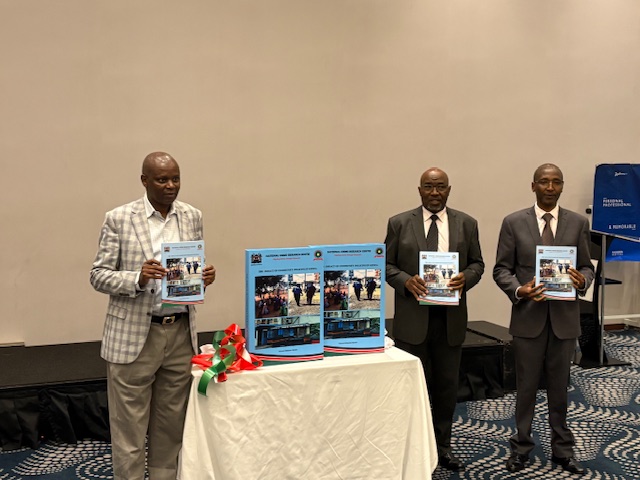
Police officers are being encouraged to adopt a collaborative approach to enhance the effectiveness of the National Police Service (NPS)-led community policing, according to two recent state reports.
The reports, Impact of Community Policing in Kenya by the National Crime Research Centre (NCRC) and Advancing Ethical and People-Centred Policing in Kenya: Lessons Learnt, Best Practices, Challenges, and Strategic Recommendations by MIDRIFT Human Rights Network, were officially launched on Thursday in Nairobi.
Joseph Omondi, Executive Director of MIDRIFT Human Rights Network, said the report reflects the organisation’s five-year collaborative work with the police across 19 stations in seven counties: Nairobi, Nakuru, Elgeyo Marakwet, West Pokot, Uasin Gishu, Baringo, and Kisumu.
Vincent Opondo, Assistant Director of Research at the NCRC, said the centre assessed the impact of NPS-led community policing in 11 counties, including Nairobi, Mombasa, Machakos, Kisumu, Nakuru, Nyeri, Uasin Gishu, Bungoma, Garissa, Turkana, and Isiolo, where community policing initiatives are ongoing.
The reports note that some members of the public continue to view the police with suspicion, highlighting challenges in trust and collaboration.
They recommend a multi-sectoral and coordinated approach to strengthen community policing.
The NCRC report found that while community policing has improved cooperation between the police and communities—through increased information sharing, engagement in identifying security needs, and involvement in addressing local crime risk factors—public trust in the police has not been fully strengthened.
According to the report, 50% of respondents said community policing had not influenced their trust in the police, 33% reported an increase in trust, and 17% said their trust had decreased.
Opondo noted that the implementation of the community policing strategy alongside the Nyumba Kumi initiative created overlaps that sometimes led to duplicated efforts.
“The National Police Service–Community Policing has since integrated Nyumba Kumi as a strategy, but this information is not widely known. Many members of the public still perceive Nyumba Kumi as separate from the NPS-Community Policing programme,” he said.
The report highlights challenges that continue to affect community policing, including systemic issues within the service. Recommendations include strengthening accountability, improving officer welfare, and fostering cross-sector collaboration to address ongoing challenges.
Community policing was first introduced in Kenya in 2005 to encourage partnerships between the NPS and various stakeholders, including local communities, human rights organisations, religious institutions, the media, and the private sector.
The aim was to build trust and share responsibility for national security.
Through its collaboration with 19 police stations, MIDRIFT has reported some progress, such as the establishment of police accountability forums involving agencies like the Independent Policing Oversight Authority (IPOA) and the Ethics and Anti-Corruption Commission (EACC), improvements in service delivery, and initiatives to reduce the trust gap between police and communities. Gender desks introduced at stations have also facilitated more survivor-focused services, leading to an increase in related case reporting.
Omondi noted that while progress has been made, challenges remain, including weak accountability platforms at the station level, corruption, and the mental well-being of officers.
“Addressing these issues is important for enabling police officers to perform their duties effectively and with the right mindset,” he said.