

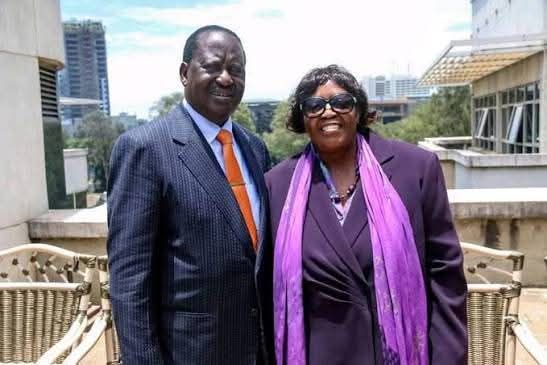
 Siblings: Raila Odinga and Beryl Odinga in a past picture. They died forty days apart./FILE
Though she rose to impressive heights in her career, becoming the first African mayor of a Zimbabwean city, Beryl Odinga’s life was nearly cut short by a destructive relationship that shadowed her young adulthood.
Her late brother Raila Odinga recounts in his 2014 memoir Flames of Freedom that had he not intervened, his sister might have succumbed to depression as her former husband, Otieno Ambala, tightened control over her life and attempted to take their children from her.
Beryl passed away on Tuesday while receiving treatment at Nairobi West Hospital.
Her family announced her death with deep sorrow, depicting a family in sustained mourning, having suddenly lost Raila barely a month ago.
"While we are deeply saddened by her demise and the immense void left in our lives, we take solace in the belief that she is safe in the Lord's arms and are thankful for the invaluable gift of the time we were privileged to share with her and for the profound impact she had on all who knew her," her sister Ruth Odinga announced.
Beryl’s relationship with Ambala began shortly after she completed her A-levels in December 1972.
Ambala, then a successful businessman and Howard University economics graduate, pursued her at a time when he was also building a political profile.
According to Raila, the Odinga family suspected early on that Ambala was motivated less by affection and more by the political influence he believed he could derive from the Odinga name as he sought the Gem parliamentary seat.
Beryl, then young and swept off her feet by the attention and romance, dismissed these concerns, and the family eventually consented to the marriage. The couple later had two children, Auma and Chizzy.
Ambala went on to win the parliamentary seat and was appointed an assistant minister by President Daniel arap Moi. His rise in politics coincided with growing turbulence in the marriage.
Raila writes that Ambala’s behaviour became increasingly abusive, prompting Beryl to leave their home.
Despite her move, Ambala continued to pursue and intimidate her, pushing her into a state of fear and distress.
Concerned for her safety, Raila secured air tickets for Beryl and her children to flee to Zimbabwe in 1980, shortly after the country gained independence.
For a brief moment she found refuge there, but her peace was short-lived.
Ambala soon discovered her whereabouts and followed her to Harare.
At the time, Kenyan law required women to obtain their husband’s consent to hold a passport.
Ambala applied this law to his advantage, writing to immigration authorities to withdraw his approval for Beryl’s passport.
This action rendered her an illegal immigrant in Zimbabwe and set the stage for a legal battle.
Ambala’s lawyers argued that her lack of documentation made her unemployable and unfit to care for the children. The court ruled in his favour, granting him custody.
Raila’s biography describes how the situation escalated; Ambala, empowered by his political position, lodged complaints with the Kenya High Commission in Harare, branding Beryl an illegal immigrant.
Isolated and stripped of her legal status, she was compelled to return to Kenya without her children, who Ambala had already taken back.
Raila recounts that Ambala had boasted that Beryl would only leave the country again if she knelt before him, a declaration that deeply angered Raila.
Determined to help his sister regain her freedom, he quietly sought alternatives. He reached out to trusted contacts in Uganda to inquire whether Beryl could obtain Ugandan travel documents.
Through these efforts, she was issued a Ugandan diplomatic passport. Raila arranged a discreet route for her travel, allowing her to leave Kenya through Dar es Salaam and re-enter Zimbabwe without attracting suspicion.
When news reached Ambala that Beryl was once again in Harare, he reacted with fury but was powerless to reverse the situation. With her Ugandan documentation, Beryl was no longer under his jurisdiction. This marked the first time she was truly out of his reach.
Beryl integrated in Zimbabwe, becoming a citizen and mamking history as the first Mutare city clerk.
Ambala’s own life ended abruptly in 1985. He reportedly suffered a heart attack at Kodiaga Prison, where he was being held after his arrest in connection with the death of former MP Horace Ongili Owiti, who had defeated him for the Gem parliamentary seat in 1983.
Instant analysis
Beryl’s journey reflects both personal resilience and the difficult circumstances she endured. Her achievements in Zimbabwe, culminating in her historic tenure as town clerk, stood in contrast to the turmoil of her early marriage.







