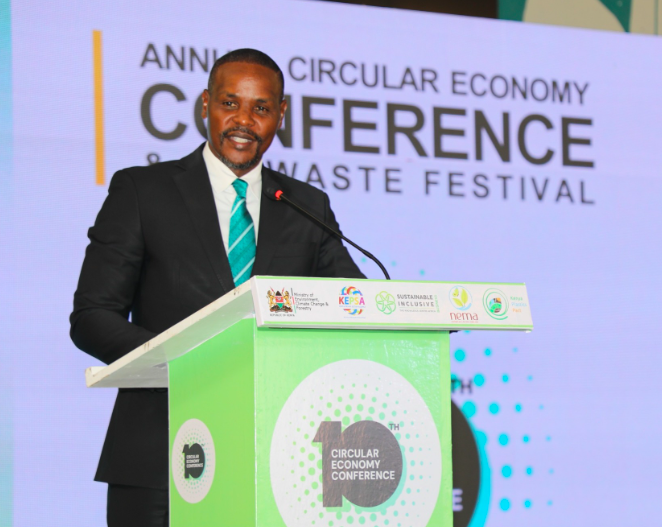
 Environment PS Festus Ng'eno makes remarks during a circular economy event at Nairobi Street Kitchen/Handout
Kenya’s rapidly growing population and urbanisation will generate immense volumes of waste, posing serious risks to human health and the environment if not managed properly, Environment PS Festus Ng’eno has warned.
Currently, each citizen produces an average of 0.5kgs of waste daily, totaling approximately 27,500 tonnes nationwide, of which 60 per cent is reportedly mismanaged, Ng’eno said.
The PS highlighted the dangers of plastic pollution and e-waste, emphasising that poorly managed waste exacerbates environmental degradation and threatens biodiversity.
His remarks came during the 10th Kenya Private Sector Alliance Circular Economy Conference at Nairobi Street Kitchen, which focused on transitioning Kenya to a circular and climate-resilient economy.
The two-day conference, organised by KEPSA Foundation and Sustainable Inclusive Business Kenya (SIB-K), explored policy readiness for Extended Producer Responsibility (EPR), innovations in biodegradable packaging, sustainable waste solutions, financing for waste infrastructure, and the economic opportunities presented by green startups.
Ng’eno said Kenya’s current linear economic model— “take, make, dispose”—is resource-intensive, environmentally unsustainable and leaves the economy vulnerable to external shocks, including global price fluctuations and climate variability.
He said adopting a circular economy, which prioritises reuse, repair, recycling, and extended product lifecycles, is essential for national development and environmental sustainability.
The ministry is spearheading a strategy to embed circular economy principles across national value chains, going beyond conventional waste management to promote prevention, resource efficiency and regeneration of natural systems.
Ng’eno said this approach would reduce environmental harm, drive sustainable growth and enhance resilience to climate and economic shocks.
National Environment Management Authority director general Mamo Mamo called on citizens to take responsibility for waste management, stressing that while the state can provide policies and infrastructure, environmental stewardship is a collective obligation.
He said waste should be treated as a valuable resource rather than a burden.
The conference attracted key stakeholders, including KEPSA CEO Carole Kariuki, representatives from Denmark, the Konrad Adenauer Stiftung, Sustainable Inclusive Business Kenya and other policy and private sector leaders, who underscored the importance of multi-sector collaboration in addressing Kenya’s waste management crisis.
INSTANT ANALYSIS
Kenya faces a growing waste management crisis driven by rapid urbanisation and population growth, with 60 per cent of daily waste mismanaged, according to Environment PS Festus Ng’eno. The linear “take-make-dispose” economic model exacerbates environmental degradation, plastic pollution and e-waste challenges while leaving the economy vulnerable to global shocks. Transitioning to a circular economy—emphasising reuse, repair, recycling and resource efficiency—offers systemic benefits, including reduced environmental harm, strengthened resilience and new economic opportunities through green entrepreneurship. Effective implementation requires multi-sector collaboration, robust policies and active citizen participation, highlighting that sustainable development hinges not only on government initiatives but also on collective responsibility and behavioural change.