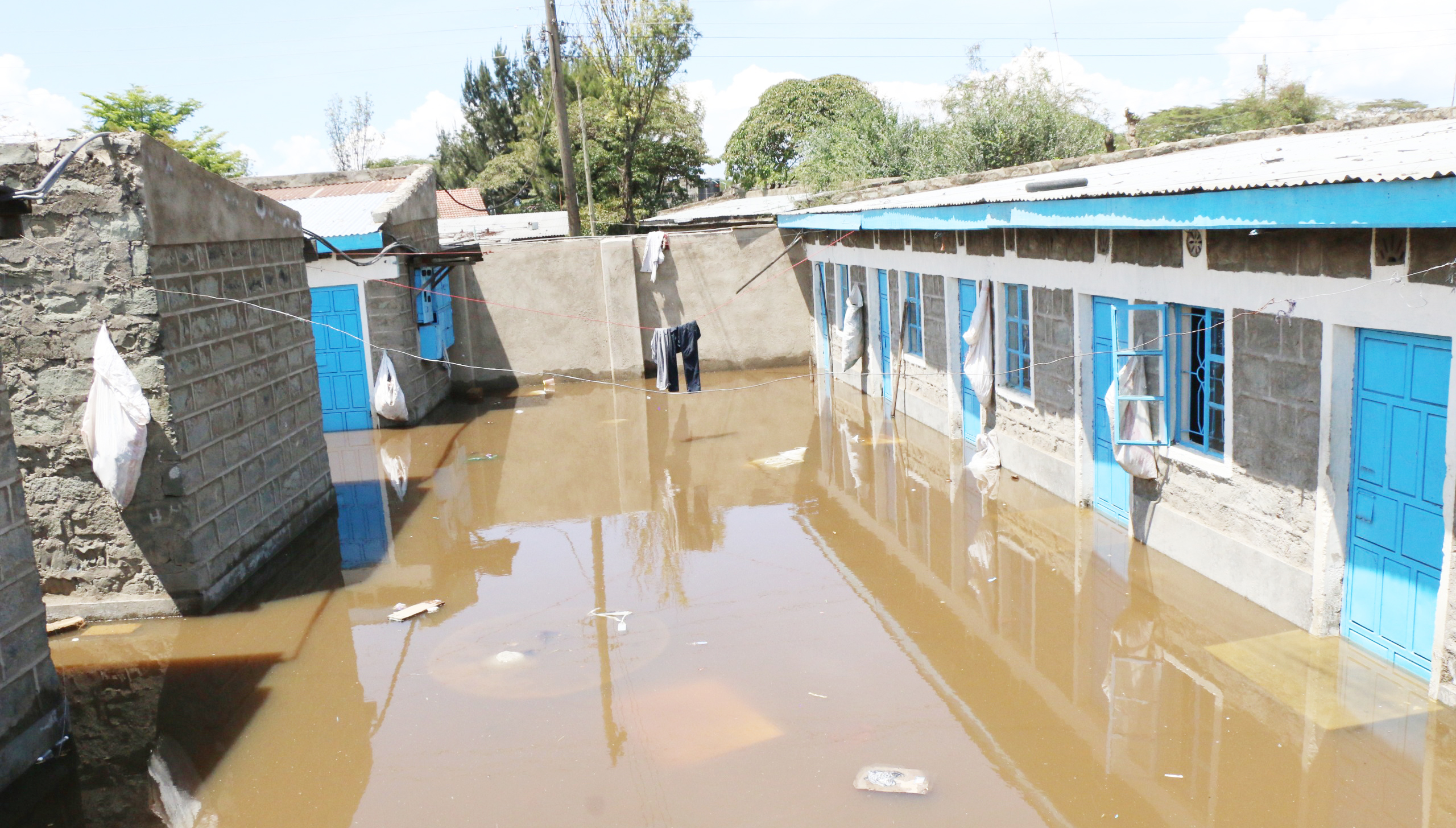
Seated on an old water jerrycan on dryish land, Jeremiah Karanja watches as a group of kids run through a section of flooded tarmac road that once joined Naivasha town and parts of Kihoto estate.
Apparently concerned by the overflowing raw sewage from one of many nearby flooded latrines, the minors splash the murky waters as they scream and laugh.
Next to one burbling latrine is the large home that Karanja constructed 12 years ago and his family has always known it as home.
The four-bedroom house is flooded by the rising waters of the lake; small frogs call it home and mosquitoes. The smell of sewage and stagnant water is nauseating.
Overcome by emotion as all his dreams literally evaporate, the father of four is escorted by a relative to a waiting van for Kayole estate along the Nairobi-Nakuru highway. There he will find some refuge.
“He is too emotional to talk and suffering from depression as he invested millions in this home and now it’s all under water and he only managed to rescue a few household items,” a close friend says.
Kihoto village in Naivasha is home to hundreds of unemployed and low-income residents.
And as Karanja is escorted away, grandmother Jane Muthoni tightly holds her grandson’s hand as she walks through the murky waters to a nearby pick-up loaded with her personal effects.
After every few steps, she stops and looks back at her home where she lived with her tenants for 18 years.
At times, the surging high water around her legs nearly sends her sprawling, but quick action by her grandson and passing boat operator rescue the situation.
“I moved to Kihoto estate back in 2007,” she tells the Star, her face blank.
“Then I first constructed my house and later, using a loan, I expanded and had eight rental houses.”
The 68-year-old woman was among the last to leave the flooded estate as she had vowed not to relocate from the place has known as home for years.
“My daughter who lives in Karati village has forced me to relocate to her home but I know it’s a matter of weeks before the water recedes and I am back home,” she says hopefully.
But her hopes of ever returning to the estate are dampened as the water levels continue to rise, flooding more homes and infrastructure.
For many families in Kihoto estate, this has been the darkest year in their lives.
The Nakuru government has said more than 4,000 families have so far been displaced and property worth millions of shillings destroyed.
The tourism and horticulture sectors have not been spared and a number of hotels and farms are under water.
A section of fuel pipeline from Nairobi to Nakuru is submerged. Many camping sites have been swamped and so is the multimillion-shilling Wildlife Research and Training Institute (WRTI) wetland research centre.
Churches, ECDE centres, a police post and landing beaches have not been spared as hippos and vandals take over parts of the vast estate.
As 60 per cent of the estate is under water, most of the latrines have flooded, forcing the health department to declare a humanitarian crisis.
What concerns residents and scientists is the source of the rising water levels, as the lake’s catchment area has not recorded unusually heavy rains in the last couple of years.
Prof Patrick Omondi, director of WRTI, said the current flooding phenomenon has confused many scientists who have seen it happen in the past.
In contrast with 2021 when the area recorded heavy rains leading to a rise in water levels, the region has recorded only average rainfall in the last two years.
“In those two years, the water levels have been rising gradually but this changed last month when the intensity rose flooding more homes,” he says.
Omondi says the lake has been reclaiming its territory but calls for urgent studies to explain the current super flooding situation that has also been recorded in other lakes in Rift Valley.
“Lake Naivasha has been expanding by 30 metres every month and the same has been recorded in other lakes like Nakuru and Baringo,” the scientist says.
“We are calling on all experts, mainly geologists, to interrogate this phenomenon further as the situation has raised more questions than answers,” he says.
As the situation worsens, the research institute is working closely with KWS to relocate affected wild animals to Nairobi National Park and the Naivasha Game Sanctuary.
Conservationist Bernard Waweru says for years, water levels in the lake have fluctuated. He cites 1968 and 2021 as the years when it rose to the highest levels.
“In 2021, around 200 families were displaced and when the levels receded, these families and others returned, only for the crisis to worsen this year and flood nearly the whole estate,” he says.
Waweru says most of the displaced have been living and farming along the riparian land, saying it’s time for strict demarcation.
“Currently, the water levels have surpassed the gazetted lake’s boundary and flooded homes kilometres away and the current situation is worrying.”
Wild animals that graze around the riparian land have been displaced and pushed to nearby estates and major roads and this is another looming danger. They include hippos, crocodiles, buffaloes and other animals.
Nakuru Governor Susan Kihika terms the flooding a national disaster requiring the support of national and county governments.
The county has formed a multi-departmental team to identify all affected persons and support those who need to be relocated.
“The county has offered transport to all the affected persons and we are profiling those displaced as we seek ways of supporting them,” she says.
Kihika says the county is working with the national government to seek a lasting solution to the problem and avoid a similar calamity in future.
Nakuru Senator Tabitha Karanja criticised the county government for moving in too late as families suffered.
Last month, Lands and Housing CS Alice Wahome said the ministry was keenly following the matter and had formed a multi-agency team to probe the situation.
“I have tasked the Director of Survey to first establish the lake boundaries after reports indicated some of the houses had encroached on the riparian land,” she said.
And while displaced persons consider their next move, the plot owners and tenants want the High Court to declare the flooding a national disaster.
Petitioner’s said the flooding had caused a humanitarian and environmental crisis, thus exposing them to disease outbreaks and wildlife attacks.
“The petitioners have been rendered homeless and displaced by the continuing rise of water levels in Lake Naivasha which has submerged their homes and essential infrastructure,” the petition read.
The petition was filed by Dr Peter Mbae, Washington Ndirangu, Stephen Kimani, Tabitha Wangui and Marques Kariuki on behalf of residents.
“The flooding crisis constitute to a national disaster and we are seeking orders to have the respondents embark on evacuation of all affected families,” they told the court.
And as the affected families relocate, vandals have invaded the estate, carting away effects left by the fleeing families.
Village elder Sam Mbuthia says the youths are vandalising doors, windows, sinks and electric wires in the night.
“Apart from hippos and mosquitoes that have turned the abandoned houses into their homes, youths are stealing what has been left behind and we are asking police to intervene,” he says.