

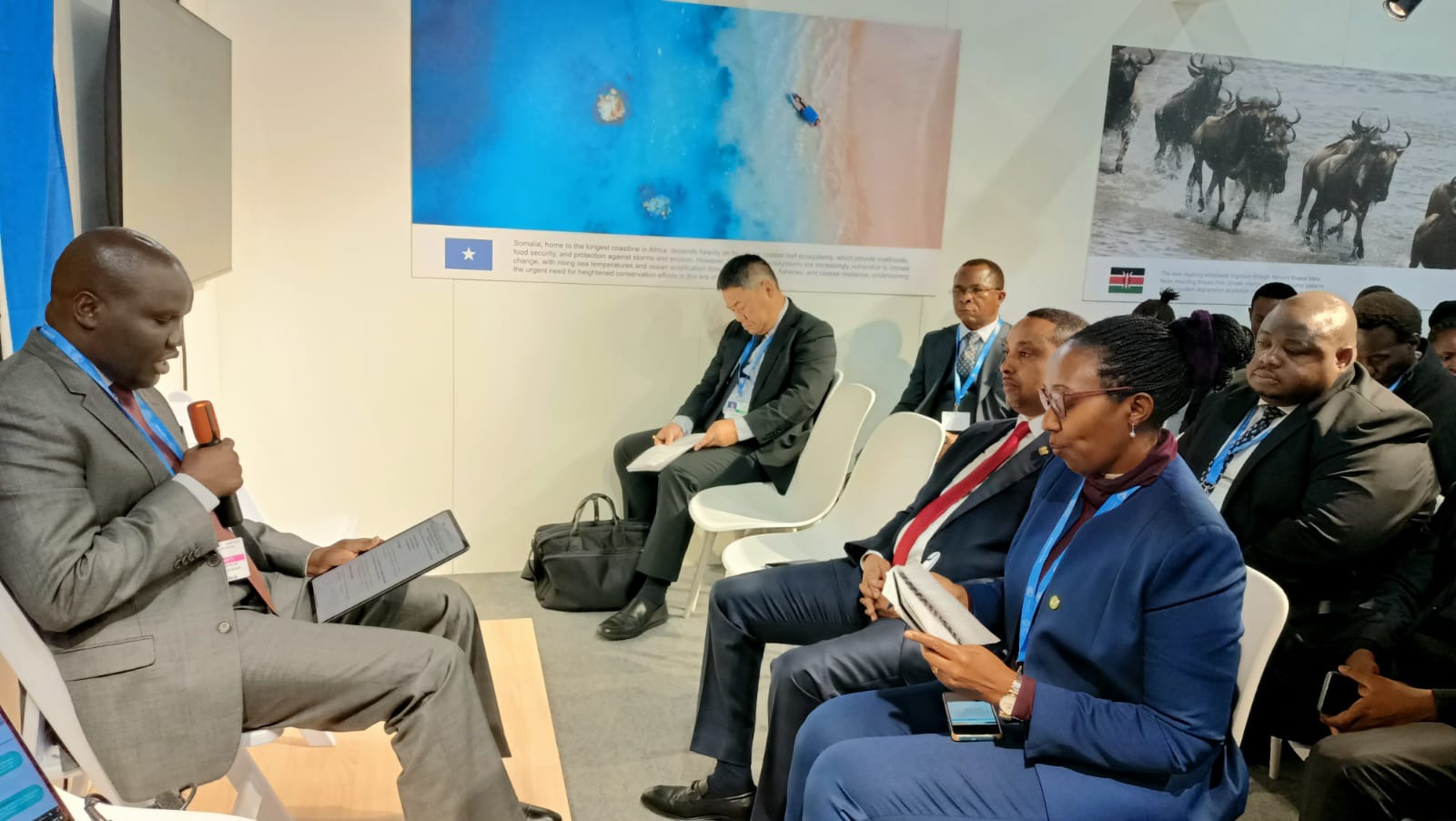
 EAC Deputy Secretary General in charge of Infrastructure, Productive, Social, and Political Sectors, Hon. Andrew Ariik during a past meeting/FAITH MATETE
The East African Community (EAC), in collaboration with the Lake Victoria Basin Commission (LVBC), will participate in the 30th Session of the United Nations Climate Change Conference (COP30) in Belém, Brazil.
The global summit, taking place in the Amazon region, a symbol of biodiversity and environmental protection, will mark a major moment for advancing climate action and sustainable development.
Representing all eight Partner States, the EAC delegation will attend the conference with a unified regional position that reflects shared priorities and the community’s collective commitment to addressing climate change.
Ahead of COP30, the EAC, with support from the German Development Cooperation, held a regional experts’ meeting to shape key messages that will ensure the region speaks with one voice at the global climate summit.
EAC Deputy Secretary General in charge of Infrastructure, Productive, Social, and Political Sectors, Hon. Andrew Ariik, will lead the regional delegation to Brazil.
Ariik said COP30 is a defining moment for East Africa to show that regional cooperation is key to building climate resilience.
He added that their united position ensures Partner States speak with one voice on the global stage.
The regional position focuses on four main priorities, scaling access to climate finance for Least Developed Countries and vulnerable communities, advancing Nature-based Solutions to enhance resilience and protect livelihoods, strengthening transboundary water cooperation in shared basins such as Lake Victoria and Lake Tanganyika, and accelerating the implementation of nationally determined contributions through regional coordination and technical support.
A key highlight of the EAC’s presence at COP30 will be the unveiling of the Preview Edition of the Lake Victoria State of the Basin Report 2025, developed by the LVBC with support from GIZ.
The report provides detailed insights into the ecological health, socio-economic trends, and governance of the Lake Victoria Basin, which is home to more than 45 million people across five Partner States.
It also demonstrates how German Technical and Financial Cooperation have come together, using data from the Water Information System financed by BMZ through KfW, under the Lake Victoria Basin Integrated Water Resource Management Program Phases 1–3, worth 60 million euros.
This collaboration has helped LVBC fulfill its role of coordinating the sustainable development and management of resources within the Lake Victoria Basin.
Speaking on behalf of the Federal Ministry for Economic Cooperation and Development, Julia Kronberg, Head of Development Cooperation in Tanzania and the EAC, said Germany is proud to partner with the East African Community in promoting data-driven climate action.
She said the report will help guide the financing of green and sustainable infrastructure projects, cross-border water management, and climate change adaptation measures that address real needs and challenges.
LVBC Executive Secretary Dr. Masinde Bwire said the State of the Basin Report provides evidence-based insights that are critical for policy and action.
He noted that it strengthens transboundary cooperation and supports communities who depend on Lake Victoria for their livelihoods.







