The passing of Raila Odinga has struck Kenya like the sudden silence that follows a thunderstorm — deafening, sobering and deeply unsettling.
For more than four decades, his voice dominated Kenya’s public life — alternately as an agitator, liberator, prophet and villain, depending on who was listening. Now, that voice is gone. Yet, in a profound irony, his silence speaks even louder.
Therein lies the duality of Raila’s demise. It is at once an ending and a beginning — the extinguishing of a political sun and the rising of a myth that will outlive all who spoke his name.
The former Prime Minister’s death closes one of the longest political chapters in Kenya’s history. He embodied a generation that believed politics could still redeem the soul of the nation.
From the dark cells of Nyayo House to the triumph of the 2010 Constitution, he represented resistance in its purest form — the stubborn belief that Kenya could be better, fairer, freer.
Yet, his death also liberates the idea of Raila from the limits of the man himself. In life, he was constrained by the realism of power — by betrayal, by fatigue, by human frailty.
In death, he ascends into symbolism. Like Dedan Kimathi before him, or Nelson Mandela after Robben Island, he becomes a moral archetype — the eternal dissident who refused to bow to the machinery of impunity.
In Luo and Luhya cosmology, death is never final. A great man’s spirit is believed to dwell among the living, guiding his lineage and community.
The rituals surrounding his funeral — the bulls, the dirges, the public lamentations — were not mere theatrics. They were a reaffirmation of Raila’s continuing presence in the moral imagination of his people. Now, as the circle completes, the Kenyan nation weaves myth and memory into political inheritance.
But beyond the symbolism lies the politics — raw, uncertain and unforgiving. Raila’s death has reopened the tectonic fault lines of Kenyan politics. For decades, he was both a bridge and a barrier — a rallying point for reformists and a lightning rod for establishment anxieties. His absence creates a vacuum that no single figure seems ready to fill.
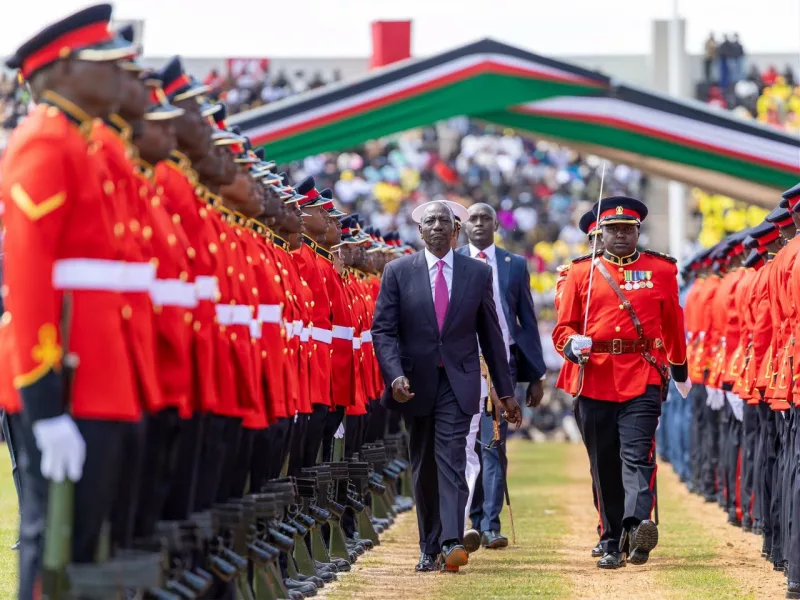
For President William Ruto, the loss is double-edged. On the one hand, the opposition loses its unifying centre. On the other, Ruto loses the one man whose presence legitimised his own balancing act.
In courting Raila through the idea of a “broad-based government,” the head of state sought not just cooperation, but co-optation — the symbolism of unity that transcends partisanship. With the former ODM leader gone, that project collapses into uncertainty.
The next elections may no longer be fought along familiar binaries of ‘Raila vs Ruto,’ but along unpredictable coalitions shaped by ambition rather than ideology.
The tragedy for Kenya is that even in death, Raila remains the measure of our democracy. His life story is intertwined with our national conscience — every struggle for justice, every cry against exclusion, every dream of devolution bore his fingerprints. Whether one loved or loathed him, his consistency forced the country to confront its contradictions.
There was also a deeply human duality about him. The same man who could electrify crowds with fiery defiance could sit quietly among fishermen in Bondo, listening, smiling faintly and saying little. He was at once the philosopher and the populist; the reformer and the reluctant insider; the rebel who wanted order.
Raila’s political life was a long walk between betrayal and belief. The system jailed him, vilified him and stole from him. Yet he never lost the faith that politics could still serve the people. That resilience, more than any single electoral victory, is his true legacy.
We are not merely mourning a man; we are interrogating the nation he leaves behind. Have we become the democracy he fought for, or have we simply perfected the art of managing dissent? Do our institutions reflect the spirit of 2010, or have we returned to the complacency of one-man rule cloaked in constitutional niceties?
The duality of Raila’s demise, then, lies not in his mortality but in our response to it. His death challenges us to decide whether we will canonise him in nostalgia or continue his unfinished struggle for justice and inclusion. The real tribute to him is not in statues or streets bearing his name, but in a politics that listens, includes and redeems.
In a sense, the former premier never belonged entirely to politics. He was a cultural moment — the kind of leader history produces once in a generation to remind nations of their moral possibilities.
His life was the bridge between Kenya’s colonial ghosts and her democratic hopes. His death, therefore, is both requiem and rebirth: the end of an era and the birth of a myth.
Raila is gone, but Kenya’s conversation with him continues. In our frustrations with power, in our yearning for justice, in our defiant hope for a better tomorrow — we shall still hear his voice. And that is the paradox — that even in death, he remains the conscience of the nation that could not ignore him.