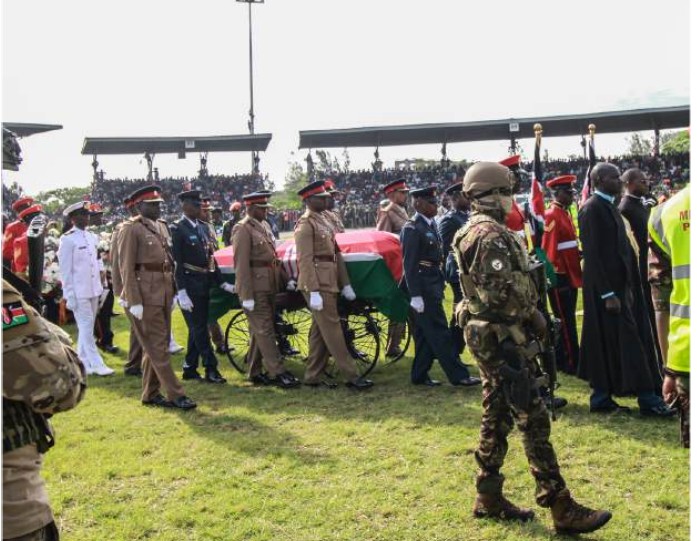
The country has just come from two long weeks of national mourning for one of her quintessential icons of liberation, Raila Odinga.
The enigma has been celebrated as foremost nationalist and pan-Africanist par excellence. Across the globe and within the breath and length of the country, the ODM leader was eulogised as a unifying pillar of the nation.
He dared dream where many recoiled in fear. Kenyan leaders from both sides of the political divide put aside their differences to eulogise him as the true face of justice and liberty. His leadership developed networks that transcended tribes and regions.
Delegations from organisations, communities, families and regions continue to pour in their numbers at Opoda farm and Kang’o ka Jaramogi, the burial site.
The ODM party and the government under the broad-based arrangement provided the largest and most visible representation at the funeral. Almost all the speakers agreed that the best tribute to give Raila was to emulate his nationalist ideals.
Opinion was unanimous that while he never achieved his desire to be the president of Kenya, he was able to influence government policies more than any of his political peers.
His patriotism made him put aside his personal interests for the good and unity of the nation. He championed inclusivity and justice for all without any bias. Within the region, he was not only a conciliator but also an influencer of democracy and justice.
Many prodemocracy crusaders looked up to him as their mentor. He was always called upon to broker peace and negotiate amicable solutions in political disputes. Such was the case in Côte d'Ivoire, Mozambique, South Africa, South Sudan and the Democratic Republic of the Congo.
It was quite unfortunate that it would be during Raila’s mourning period that key national leaders resorted to spewing tribal vitriol. The jingoist fervour reared its ugly head at a time of solemn farewell to a gallant son of the nation.
To add salt to injury, the champions of ethnic balkanisation chose to use his name and reputation as the basis for fanning tribal hatred.
Politics in Kenya has generally been organised along ethnic lines since the colonial period. As the nation geared up for Independence, Africans were allowed limited political organisation and representation through regional political parties.
At Independence, the dominant parties of Kanu and Kadu were both formed and organised on the basis of tribes and regions.
However, during the one-party system era under Presidents Jomo Kenyatta and Daniel Moi, the tribe emerged as the single most important vehicle to state power.
From 1966 onwards, government and state operations were designed with the Luo ethnic community as the strategic target. Interestingly they were targeted not as key partners in government but as dangerous elements and opponents of the state.
Every effort was made to isolate and marginalise them from the centre of government institutions. Inadvertently, these deliberate actions had the consequence of radicalising many political leaders from the region.
It did not help matters that the community had a critical mass of intelligentsia immediately post-independence. From the political realm, government operatives became sensitive to Luos occupying key positions in institutions of governance.
Systematically they were removed from the leadership of academic, security and financial institutions of the country.
The return of multiparty democracy in 1992 did entrench and formalise the tribal cleavages. Parties emerged along ethnic and regional lines.
The political fault lines of yore came into play once again but this time with more vigour and resoluteness. The 1992 presidential election was a life and death competition among the three leading political tribes of Kenya.
President Moi of the Kalenjin went all out to protect his community’s interests by retaining power at all costs. Kenneth Matiba and Mwai Kibaki sought to restore the lost glory of the Kikuyu hegemony.
The community was ruing the misfortune of allowing Moi to succeed Kenyatta upon his death. Jaramogi Oginga Odinga hoped to redeem his Independence debt.
It will be recalled that as Kenya approached Independence, claims were made that Jaramogi turned down the British offer to form government. He instead insisted that Kenya would only gain genuine uhuru with Kenyatta as her leader.
Kenyatta appointed him his first vice president before they bitterly fell out after the infamous Limuru Kanu conference of 1966.
Other scholars, however, opine that this narrative was an M15 intelligence spin to hoodwink the Kikuyu extremists that Kenyatta was a national leader, hero and freedom fighter. Subsequent events after 1966 consolidated tribal jingoism.
Upon his return from exile, Raila joined the opposition forces under the behemoth of Ford. The movement would succumb to ethnic bigotry and state machinations to split into Ford-Kenya and Ford-Asili. He cast his lot with the radical and socialist-leaning Ford-Kenya under the chairmanship of his father Jaramogi.
The rest of the conservative group joined the entrepreneur and gradualist Matiba. Soon after the death of his father, Raila broke ranks with his comrades and formed NDP.
The new party was premised on social democracy as its ideology. He sought to bring into his fold political and social leaders of diverse backgrounds and from across the country.
Raila was intentional in his philosophy to rid the country of tribalism. He took bold steps to bring down the ethnic boundaries by reaching out to his erstwhile political enemies and comrades who later turned into regime apologists.
His made deliberate efforts to unite the country: merge his party with Kanu; join Kibaki in Narc; form the grand coalition government; shake hands with Uhuru Kenyatta; and form the broad- based government with President William Ruto.
He saw the tribes as custodians of the nation’s cultural heritage but not as bastions of ethnic chauvinism. His party ODM was the best example of the fruits of his life struggles in membership and leadership constellation.
The surge of ethnic bigotry and jingoism being propagated during Raila’s funeral is a dent in the country’s national consciousness.
Leaders must be called out to halt the unnecessary drift toward inflammatory political rhetoric. Nyeri Governor Mutahi Kahiga set the ball rolling by insinuating that the death of Raila was good riddance. He suggested formation of the broad-based government was the former Prime Minister’s strategy of alienating the Kikuyus from government.
His contention that the new government was equal to the inclusion of Luos and the exclusion of Kikuyus from government is baseless but fodder for tribal animosity.
He knows that this is not true and the facts point otherwise. Yet he brazenly makes such declarations to appeal to raw base emotions of his tribe for political expediency. The hatred that public pronouncements foment will certainly lead to political tensions that easily erupt into violence.
Kahiga’s counterpart in Homa Bay, Governor Gladys Wanga, response continues in the same spirit. She brings in former Deputy President Rigathi Gachagua into the fray and declares that he is not welcome.
She treats Kahiga as speaking on the behest and behalf of Gachagua by virtue of ethnic affiliation. By default, Wanga is entrapping the Kikuyus around Gachagua by gaslighting them. The net effects of these activities are a siege mentality and ethnic jingoism.
The country has been on this road before and the consequences are well known and recorded for historical reference.
The worst scenario being the 2007 post-election violence, but it can still be worse than that. Kenyans must reject this invitation to glorify tribal politics and refuse to follow such leaders into the political abyss.