Mangroves/FILE
A scientist has raised concern over the loss of sea grass within Lamu county.
Grace Waiguchu, in a study, cited coastal development, pollution, climate change, over-fishing, destructive fishing and invasive species as some of the threats facing sea grass.
“Within the last 10 years between 2011 and 2021 there was 12.56 per cent of seagrass loss in Lamu, representing a loss of 1.2 per cent per year,” she said.
Her study was titled ‘ Spatio-temporal changes on sea grass in the intertidal areas of Lamu, Kenya.’
The overarching objective of the study was to assess the status of seagrass information, distribution and perception of key drivers of seagrass cover change between 1994 and 2021 in Lamu seascape.
It evaluated the tools and techniques used to study seagrass in Kenya and assessed the status and decadal patterns of the spatial coverage of seagrass in Lamu seascape.
The study also evaluated community perception of key drivers of seagrass cover change in Lamu county.
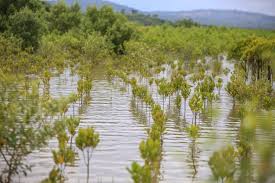
She said within Lamu, nine species of mangroves identified and another nine species of seagrass.
Waiguchu was among scientists who presented their studies during the second International Wildlife Scientific Conference that took place at Lake Naivasha Resort between September 23 to 25.
The theme of the conference was: “Innovations in Wildlife Conservation Science and Practice for Socioeconomic Development.”
Researchers, conservation practitioners, policymakers, community leaders and international partners met to exchange knowledge, present cutting-edge scientific findings and deliberate on solutions for sustainable biodiversity conservation and human development.
Sea grass are marine flowering plants found in shallow coastal waters.
They are submerged plants found in littoral coastal zones between 0 and 50 meters globally.
They are key ecosystems providing habitat, Biodiversity hotspots, support fisheries, coastline protection, water quality, carbon sequestration. Waiguchu said there are 72 described seagrass species belonging to six families globally.
She pointed out that12 Species are described in Kenya.
Waiguchu said globally, sea grass meadows have experienced a net loss of 5,602 kilometer square since 1880 with the Tropical Indo-Pacific, including Kenya showing slow but consistent decline.
“Effective monitoring is necessary to understand impacts on fisheries, shoreline stability, and resource sustainability, but existing studies have used diverse and inconsistent methodologies,” she said.
Waiguchu said Lamu county’s development due to projects such as Lamu Port-South Sudan-Ethiopia-Transport (Lapsset) Corridor project highlights the need for localised and updated sea grass maps to guide conservation efforts.
She said conservation managers lack accurate, localised data on sea grass extent and distribution to inform effective conservation practices.
Waiguchu said there are challenges in monitoring submerged aquatic vegetation using remote sensing. She said the water column complicates spectral reflectance and introduces heterogeneity.
Waiguchu said there were technical and logistical challenges She said there are 25,488 hectares of sea grasses in Lamu seascape; represented by 11 species.
“The most extensive meadows are found within Kiunga Marine National Reserve. The most dominant species is Thalassodendron ciliatum that occurs as single or mixed stands,” she said.
Waiguchu identified the hotspots of losses and degradation of seagrasses in Lamu as Shakani and Ndau seascape in Kiunga, and Fua, Wange, Kilindiyatu, Siyu in Pate seascape. She said the major drivers of seagrasses in Lamu are human mediated; particularly poor fishing activities and climate change.
“Continuous pressure on seagrass ecosystems is likely the cause of decline and failure to protect them leads to unhealthy marine ecosystems,” she said.
Waiguchu said fluctuations in seagrass cover is attributed to variability of both natural factors and anthropogenic factors such as climate change, global warming and increased sedimentation over the years as well as destructive fishing and boating activities.
She said combining local ecological knowledge with scientific data can improve understanding and provide better solutions for mitigating threats to coastal ecosystems.