Few motorists pause to consider the long, intricate journey each drop of fuel takes before reaching their tank.
Behind every fill-up lies a tightly coordinated supply chain that starts at the Port of Mombasa and winds its way to petrol stations nationwide.
The Kenya Pipeline Company (KPC) is at the centre of this critical national operation, ensuring security of supply for millions of Kenyans and neighbouring countries.
The journey begins when giant oil tankers dock at the Mombasa Oil Terminal, carrying thousands of barrels of refined petroleum products such as petrol, diesel, kerosene and jet fuel.
Through heavy-duty pipelines stretching across the jetties, the cargo is transferred into KPC’s storage tanks.
KPC operates a pipeline network of 1,342 kilometres, capable of handling approximately 14 billion litres of petroleum products annually.
The line runs from Mombasa through Makindu to Nairobi, Nakuru, Eldoret and Kisumu.
KPC transports close to 8 billion litres of petroleum products, through this line of which 60% is consumed locally and the other 40% in the transit markets of Uganda, Rwanda, Burundi, South Sudan and Eastern DRC.
But the fuel does not immediately flow into the pipelines. First, it undergoes rigorous quality checks.
Laboratory experts at KPC test every batch for impurities, ensuring it meets international safety and performance standards.
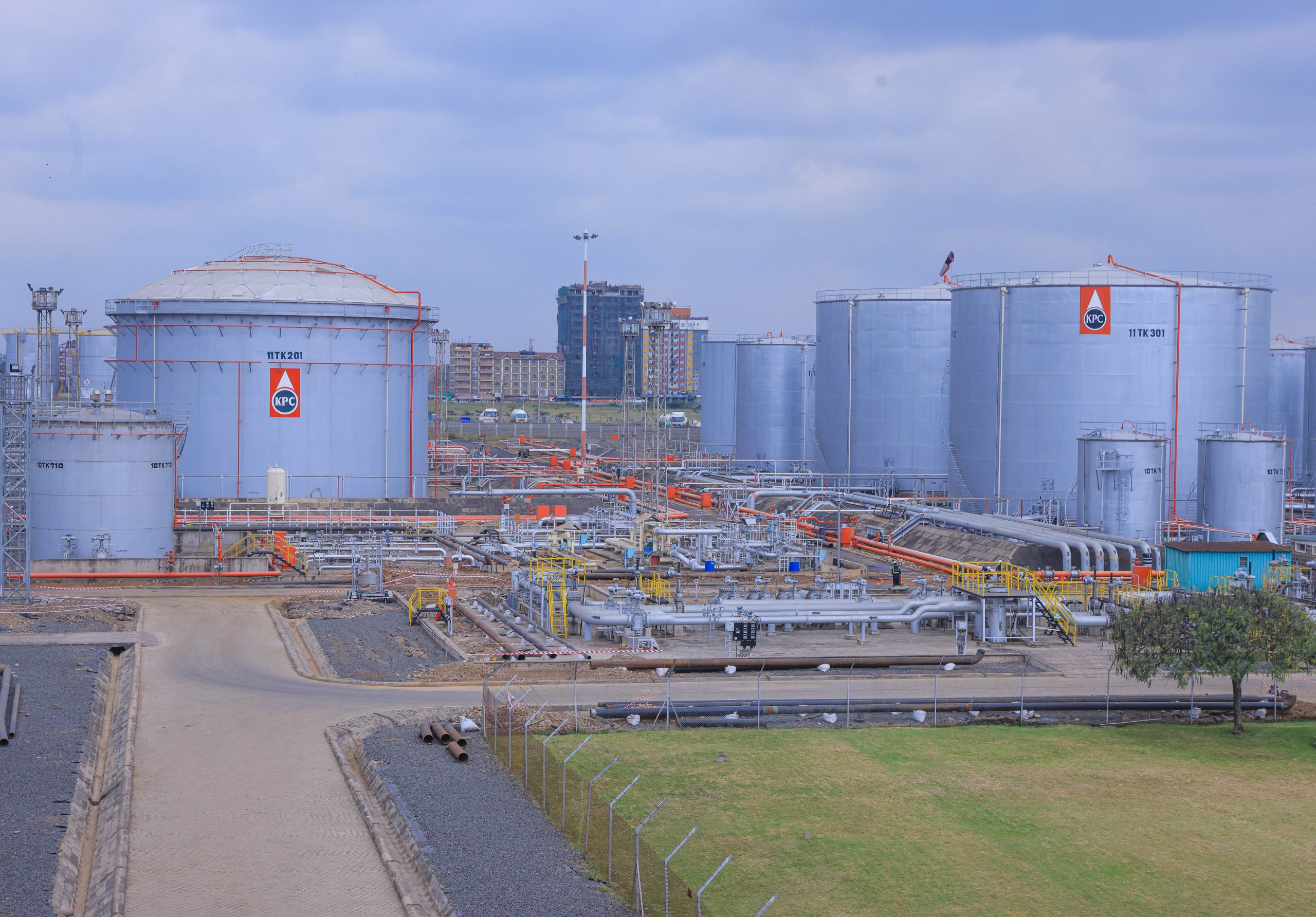
Each product is stored in dedicated tanks, petrol in one, diesel in another, and jet fuel in its own facilities.
Settling is also key. Diesel and petrol must sit for at least three hours, while jet fuel requires a minimum of 24 hours to allow natural condensation to release water content.
This water is then drained before the fuel moves forward.
“In these products you can’t avoid water, but our systems ensure it is drained out so that only pure fuel flows to the next stage,” explains Terminal Manager, pump station (PS) 14, Francis Kiptoo.
There are several pump stations (PSs) for fuel storage.
PS 9 is the one located at JKIA, while PS 10 is the Nairobi terminal.
Once cleared, the fuel begins its journey inland via a vast network of pipelines managed by KPC.
Using a combination of gravitational flow and powerful pumps, the product moves from Mombasa to Nairobi, stopping at key pump stations in towns such as Mtito Andei and Makindu.
At each pump station, engineers monitor flow rates, pressure levels and integrity of the pipes to ensure uninterrupted movement.
The system is controlled both on-site and remotely from Nairobi’s central control room, where technology and human oversight meet.
Screens display real-time data showing how fuel is flowing from the port to the capital and beyond.
“The process is like a relay,” says Magdalene Muthama, who is in charge of operations at the control room.
“Once we start a pump in Mombasa, the pressure determines when the next pump along the line kicks in, all the way until the product reaches Nairobi.”
Feeding the marketers
At Nairobi’s storage terminal, the fuel is held in massive tanks before being distributed to oil marketing companies such as Vivo Energy (Shell), TotalEnergies, National Oil Corporation and Oryx.
These firms have depots directly connected to KPC’s facilities, allowing smooth transfers.
From there, fuel is loaded into road tankers that fan out across the country, delivering to retail petrol stations and industries.
A similar arrangement is replicated in Nakuru, Eldoret and Kisumu, where KPC operates depots that serve western Kenya and neighbouring countries.
Most motorists do not know that the petrol or diesel they buy at a station has passed through KPC’s system.
“We can never afford to blink because our responsibility is ensuring that Kenyans and the region never run out of fuel,” says KPC Operations manager Ongoya Wangaki.
Safety and standards
Safety underpins the entire operation.
KPC follows strict international standards, from offloading at the port to testing in laboratories and monitoring pipeline flow.
Tanks are product-specific to prevent mixing, while any irregularity detected along the line triggers immediate checks.
The company also invests heavily in security to protect the infrastructure from vandalism and theft, given its critical role in powering the economy.
The pipeline system stretches not only to Nairobi but also to Kisumu and Eldoret, supporting regional trade by supplying Uganda, Rwanda, South Sudan and parts of the Democratic Republic of Congo.
By the time a motorist fills up at a station in Kisumu, Nakuru or Nairobi, that litre of fuel has been shipped across seas, tested, stored, pumped hundreds of kilometres through underground pipelines, and finally trucked to the station.
It is a delicate balance of engineering, safety, technology and human expertise.