
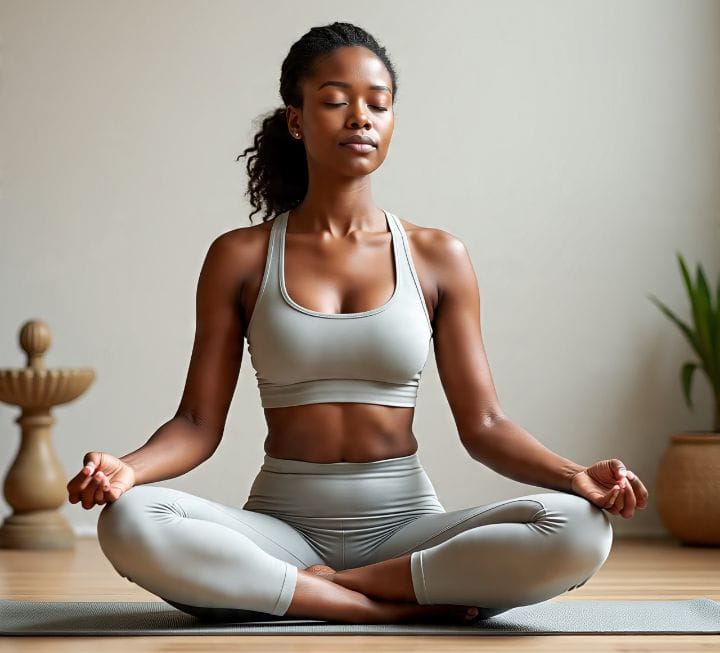
Across city rooftops, quiet studios, and leafy suburban gardens, a new rhythm is taking hold, one of stretches, deep breaths, and meditative stillness.
In a quiet corner of Muthaiga, 38-year-old Ryan Waweru leaned back with a wry smile, almost amused at where life had led him. Yoga, he admitted, was never part of his plans.
“When my wife was alive, I could never resist teasing her about her yoga obsession,” Waweru said.
His wife would wake before dawn, mat unfurled on the balcony, moving through poses with a serenity he secretly envied but openly mocked.
He often wondered how standing on one leg and stretching could be considered exercise. A gym enthusiast, he could not imagine swapping dumbbells for yoga poses.
“Yoga, to me, was a dance of the delicate-minded, an indulgence, not a workout,” Waweru stated.
But life has a way of humbling even the strongest. When his wife passed away suddenly, his world collapsed. The gym, once his sanctuary, felt hollow.
Muscles could not erase the ache in his chest, nor could hours on the treadmill outrun the shadow that settled over his life. Six months of grief passed in a blur of muted mornings and sleepless nights.
“I was trapped in a darkness so thick I felt like I was gasping for air every second,” Waweru expressed.
One morning, as golden sunlight spilt into the living room, he saw his daughter attempting a pose he remembered his wife doing daily.
Tiny, earnest, and slightly wobbly, she stretched her arms like wings, her balance precarious but determined. The sight struck him like a spark.
His chest tightened, not in pain, but in a strange, unfamiliar surge of life.
“For the first time in months, I felt hope stir inside me,” Waweru remarked.
He sat beside his daughter quietly, watching her movements with a mix of amusement and awe. When she noticed him, she smiled proudly, happy to be imitating her mother.
That evening, he went online, reluctantly at first, searching for videos that could teach him the movements his wife had loved.
“The first attempt was clumsy,” Waweru admitted comically.
He toppled over more times than he could count, muscles groaning in protest. But something was intoxicating about the stillness, the focus, the control.
By the end of the week, he could move through basic sequences without falling. By the end of the month, he noticed more than flexibility; his mind felt clearer, his breathing steadier, his chest lighter.
“The physical strength of the gym was one thing, the quiet resilience of yoga was another, and I was hooked,” Waweru said.
“More than that, yoga became a bridge to my wife,” he added.
As he inhaled, stretched, and held poses, he could almost feel her presence, whispering encouragement through the motion of his body.
Every sunrise practice became a silent conversation with her memory, a ritual that mended the invisible threads of his shattered heart.
Saturday mornings became sacred. Together with his daughter, he laid their mats side by side, moving in unison through flows that were once his wife’s signature.
Laughter erupted whenever they stumbled, pride swelled when they held a balance, and quiet reflection followed each session.
“These mornings became the highlights of my week, far more cherished than any boardroom victory,” Waweru said.
Yoga had transformed from an absurdity he had mocked into a lifeline, a bridge to his daughter, and the heartbeat of his own resilience.
Watching his daughter stretch into a pose she once learned from his mother, he cannot help smiling through tears he no longer tries to hide.
“I am grateful for the strange, wonderful gift of balance, both on the mat and in life,” Waweru emphasised.
Across town, a different journey into stillness took shape. The clamour of Nairobi traffic raged just outside, but inside a quiet studio in Westlands, 26-year-old Catherine Mueni sat cross-legged on her mat, a serene smile playing on her lips.
With a voice laced with certainty, she revealed that yoga was always the path she was meant to follow.
“For the longest time, I had lived life like it was a script someone else had written for me,” Mueni said.
Day in and day out, she woke early, beat Nairobi traffic, sat at her desk all day chasing deadlines, and dragged herself back home to a dinner of instant noodles.
Then, she would scroll endlessly on her phone until sleep claimed her.
“The cycle repeated itself with clockwork precision, but without the joy of purpose,” Mueni expressed.
Her friends’ lives seemed colored with purpose. One had discovered photography and travelled frequently. Another had become a baker with orders months in advance.
Even the quietest person in her group had taken up marathon running.
“The daily stale scent of office air-conditioning and the constant hum of dissatisfaction in my chest overwhelmed me,” Mueni remarked.
One night, sprawled on her couch with noodles in one hand and her phone in the other, she stumbled on a short advert, ‘New Yoga Studio Opening in Nairobi, Find your center.’
She was about to swipe past it when the image of people stretching gracefully in sunlit rooms stopped her. Something stirred inside her, curiosity, maybe.
“That night, instead of falling asleep to meaningless memes, I went down a rabbit hole on the internet,” Mueni recounted.
She read about yoga’s history and its connection to body, mind, and breath. She learned that it was not just about stretching, but about presence, about stillness in a noisy world.
For the first time in years, she felt a spark.
“Without overthinking, I ordered a yoga mat online that very night,” Mueni stated.
The delivery guy raised an eyebrow when she signed for it, barefoot in worn-out pyjamas. But for her, it was no ordinary package; it was a possibility, wrapped in cardboard.
Her embarrassment during her first studio session almost sent her packing. She wobbled in downward dog, toppled during tree pose, and nearly collided with her instructor.
But lying in the final resting pose, eyes closed, she felt something she had not felt in years, peace.
“On the sweaty floor, a calm, steady peace whispered, stay,” Mueni said.
“From that day, I never looked back,” she added.
Yoga became her daily ritual. Her body grew stronger, her mind quieter. She walked with a lighter step, smiled at strangers, and even laughed more at herself.
Her friends noticed too, the new Mueni glowed without needing anyone’s approval.
Then, one morning during her session, she realised she did not deserve to work in an environment that drained her energy.
The realisation was as clear as the Nairobi sunrise streaming into the studio.“Within weeks, I quit my draining job,” Mueni voiced.
As if the universe had been waiting, she soon landed a new role, better pay, kinder colleagues, more space to breathe.
Looking back, she believes yoga did not just teach her poses, it aligned her life. She finally understood what it meant to live with purpose.
“And in every stretch, every breath, I know, I have found my center,” Mueni reiterated.
Yet, amid the buzz of mindfulness and meditation, not all Kenyans have embraced yoga. In the crowded streets of Kabete, 34-year-old David Otieno said he has always equated movement with purpose.
Growing up, his world revolved around football, sprinting across dusty pitches, leaping for headers, and the raw thrill of physical exertion.
Strength, for him, had always been tangible, muscles that ached after hard work, sweat that stung the eyes, the exhilaration of competition.
Yoga, he thought, belonged to a different universe, a realm of slow stretches, quiet breathing, and introspective calm that seemed alien to someone who thrived on action.
“My first encounter with yoga four months ago was the result of a friend’s insistence,” Otieno said.
He had entered the studio in worn gym shorts, expecting to mock the practice and leave quickly.
But as the instructor asked the group to close their eyes and focus on their breath, he realized he was ill-prepared for stillness.
His mind raced, his legs trembled, and he repeatedly glanced at the clock.
“By the end of the session, I left with a pounding headache and a bruised ego,” Otieno expressed.
“That session justified my presumptions, yoga is intangible and almost fragile for me,” he added.
While others spoke of mindfulness and inner peace, he wrestled with impatience and frustration. “It is simply that yoga does not resonate with my body or instincts,” Otieno emphasized.
Meanwhile, in the leafy suburbs of Nairobi, 29-year-old Aisha Hafsa said yoga does not fit in her world of deadlines, litigation, and relentless pressure.
As a corporate lawyer, her life demands precision, speed, and the ability to think on her feet. Yoga, for her, has always seemed like an indulgence she cannot justify.
“It feels like a performative ritual reserved for those with time to chase tranquility in sunlit studios while the rest of the world moves on,” Hafsa expressed.
Curiosity eventually drew her to a free yoga workshop a year ago, advertised as a stress-relief escape. Arriving early, mat and towel in hand, she immediately felt out of place.
Her body refused to mirror the fluid movements around her, and when instructed to embrace stillness, her mind wandered to client emails, court filings, and the relentless tick of her schedule.
“The calm, meditative space that promised serenity instead became a source of anxiety,” Hafsa remarked.
For her, yoga was not just physically awkward. It symbolized a world demanding patience and mindfulness her life did not allow.
In the buzz of yoga studios and wellness trends, Otieno and Hafsa remain observers rather than participants, content in their own definitions of balance, confident that fulfillment can take many forms.
Practicing yoga is not about twisting yourself into a human pretzel; it is about creating a space where body, breath, and mind can finally sit at the same table.
According to Devi Aashvi, a yoga instructor, the best way to start is simple.
“Show up on the mat, even if it’s just for ten minutes,” Aashvi said.
“Consistency matters more than perfection,” she added.
Do not chase advanced poses you see on Instagram. Focus on how your body feels in each moment. If a stretch feels too intense, ease out. If your balance wobbles, smile through it.
“Yoga is a conversation with yourself, not a competition,” Aashvi advised.
Breath is your anchor. Syncing movement with steady inhales and exhales transforms simple stretches into powerful moments of clarity.
“And remember, the mat is only half the story,” Aashvi insisted.
The calm and mindfulness you cultivate should spill into your daily life, whether in Nairobi traffic or a stressful work meeting.
Approach yoga with curiosity, not expectation. Some days will feel energizing, others sluggish. That is okay.
The beauty lies in showing up, listening, and allowing growth to unfold naturally.
“Over time, you’ll notice not just stronger muscles, but a stronger sense of presence in everything you do,” Aashvi remarked.
Across Nairobi’s skyline, from rooftops kissed by sunrise to tucked-away studios humming with quiet breath, yoga continues to weave itself into the city’s story, embraced passionately by some, questioned by others.
For a grieving father, it became a bridge to memory and resilience. For a young woman, it lit the path to rediscovering her purpose. And for skeptics, it remains a practice they watch from the sidelines, choosing different rhythms for balance.
Whether on the mat or off it, one truth endures, in the restless chaos of modern life, everyone is searching for their own stillness. Yoga, for those who dare to stay, offers one powerful way to find it.






