
A House team has shot down a proposed law which was aimed at streamlining the transition of power following the election of a new president.
The National Assembly Security Committee has recommended that the Assumption of the Office of the President and Transition of Executive Authority Bill, 2025, be rejected in its entirety.
The move deals a significant blow to President William Ruto’s administration’s efforts to legislate stricter transition protocols.
The Bill, formally introduced in Parliament in February, sought to, among others, stage a 90-day moratorium on payments, hiring of staff and contractual commitments ahead of voting.
To curb misuse of public funds during the transition period, Ruto’s administration sought to stop payments for supplies and contracts of more than Sh50 million.
Accounting officers are also prohibited from making or authorising payments above Sh50 million without Treasury approval.
In the proposed law, state officers are barred from entering into commitments with suppliers and contractors 90 days before the presidential election.
The legislation further posits that public officers are barred from entering into contracts on behalf of the government.
International obligations binding the government are also prohibited, with those in breach poised for hefty fines of up to Sh10 million.
The government-backed legislation, sponsored by majority leader Kimani Ichung’wah, only allowed “necessary commitments”, with ready budgets.
In further measures, CSs and PSs were not to be allowed to make fresh appointments of public officers during the electioneering period.
Cabinet members and PSs are also barred from travelling outside Kenya without express and prior written approval of the head of Public Service.
Ministries, departments and agencies would be required to issue handover reports by July 15 of the election year.
MDAs were to disclose bank accounts and their reconciled balances, policies, ongoing programmes and projects and human resource matters.
The staff data was to include their establishment, pay, achievements, training, performance appraisal and ongoing disciplinary matters.
Also to be stated were assets, pending bills, ongoing acquisitions, procurements and disposal of assets.
Ongoing court cases and related liabilities are also to be disclosed, as are planning matters, including performance contracts and work plans.
Ruto’s team said the proposed law aimed “to seal gaps and ensure smooth and more unified presidential transitions in Kenya”.
The security committee—led by Narok West MP Gabriel Tongoyo—after reviewing the bill, said the existing transition law is sufficient, hence no need for amendments.
“The Assumption of the Office of President Act is an elaborate and comprehensive law that adequately provides for the assumption of office of the President,” the committee said.
“Accordingly, a new law is unnecessary and amendments to the existing law ought to have been proposed to cure any gaps noted during implementation of the current Act,” the report reads.
The proposals are due for consideration by members in plenary and may see the day or be overturned, for which the government would have its way.
The committee, in further recommendations, said the limitations on expenditure during the transition period are equally unnecessary.
“Limiting expenditure for money already appropriated by Parliament through an Appropriation Act may affect spending on critical functions such as security, healthcare and disaster management,” the committee said.
The panel further argued that there exist procedures in the constitution and statute for appointment, removal and placement of Attorney General, Cabinet Secretaries, Principal Secretaries and secretary to the Cabinet.
In the proposed dispensation, accounting officers are to continue holding office until a new one is appointed in their place.
The Bill further expressly provides that the absence of the outgoing president wouldn’t affect the swearing-in and also expanded the transition committee to include nine nominees by the president-elect, besides the designated state officers.
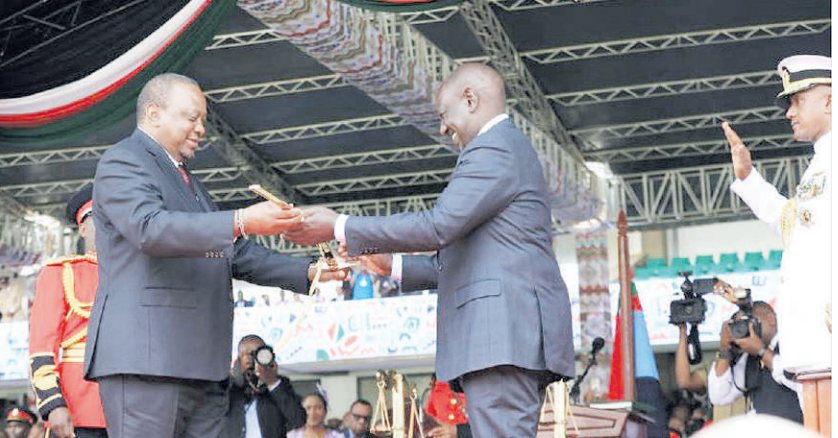
The President’s takeover from his predecessor Uhuru Kenyatta in 2022 was marred by claims of sabotage.
Ruto’s team at that time complained that they were denied the treatment deserved of a president-elect, including access to security briefs.
They further claimed that the transition team was not heeding the then-President-elect’s requests.
They alleged that the government printer was blocked from churning out the gazette notice detailing Ruto’s election.
At that time, key members of the committee, including then Interior CS Fred Matiang’i, were not seeing eye-to-eye with Ruto (then as DP).
Instant Analysis
MPs drew the conclusion after receiving submissions from the Kenya Law Reform Commission, the Attorney General, Chief Registrar of the Judiciary, Office of the Deputy President, Inspector General of Police, the Interior department, and the Parliamentary Affairs department. The agencies largely supported the proposed law, suggesting improvements.





