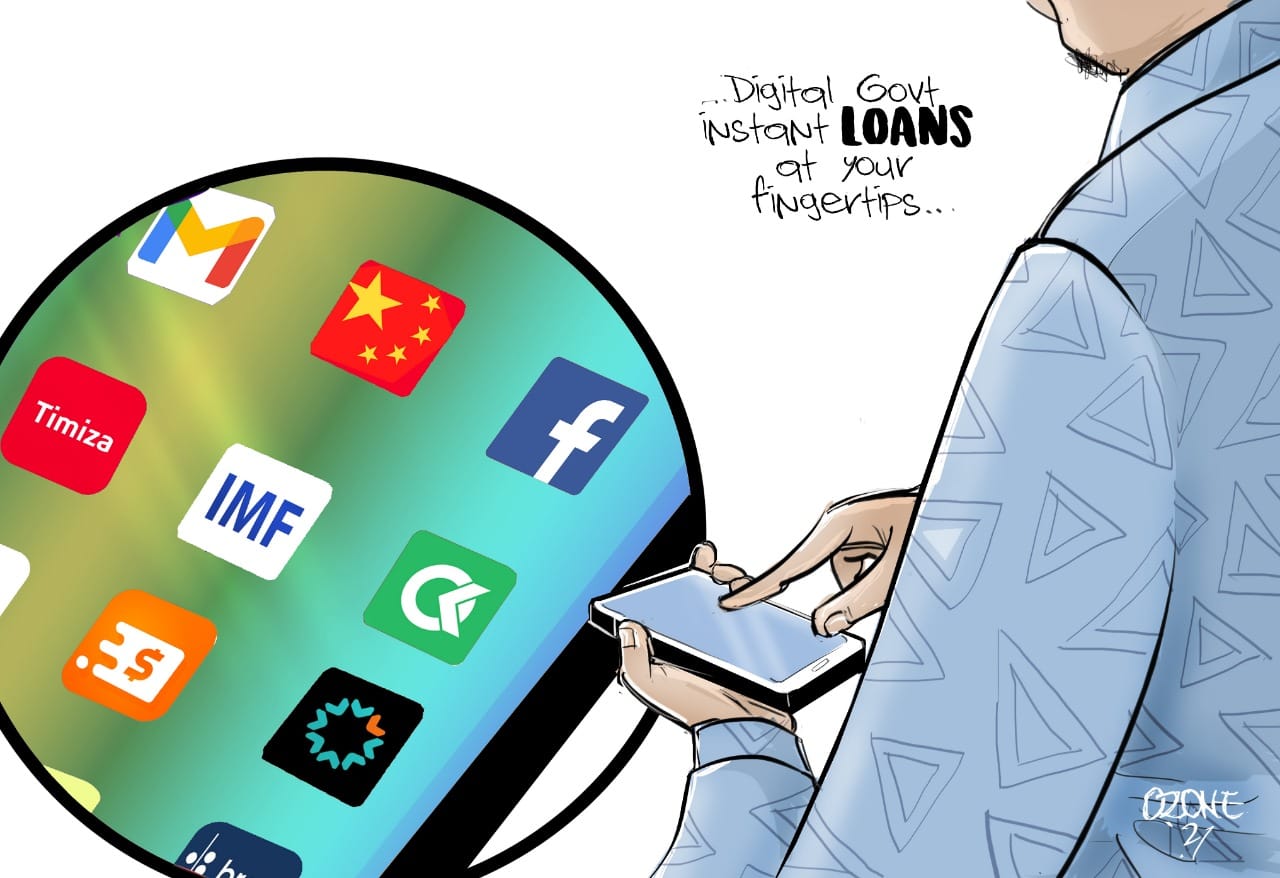
HOUSEHOLDS in Kenya are surviving on loans, with one in every six unable to repay, while 30 per cent borrow from Peter to pay Paul as the tough economy bites.
The disturbing statistics contained in the FinAccess Household Survey come in the backdrop of another study, by the Food Security and Nutrition Working Group for East and Central Africa Region, that shows many families can hardly afford three square meals.
The nutrition survey indicates at least six million Kenyans are unable to afford essential food and non-food expenditures.
Joel Agevi, 39, of Kangemi, Nairobi, works as a security guard with a local security firm. His monthly pay of Sh25,000 is barely capable of running his home budget for a month.
“My salary can barely survive a day at the bank. Last month for instance, I spent almost 80 per cent on school fees and hospital bills. I had to subscribe to a number of digital lending apps to borrow for food, rent and transport,’’ Agevi told the Star.
“Life is getting tougher every day. My family needs at least Sh450 to afford basic needs per day, an amount I can’t raise. I have borrowed from every digital lending app that I have come across. Credit rating agencies have blacklisted me. I have no more options.”
For Janet Kerubo, relocating from Lower Kabete to a low-cost house in Kawangware has not eased her financial pressure.
“I owe local shopkeepers too much. Debt books are pilling. I hope to get a higher paying job as my Sh16,000 monthly wage is way too small for my family of three," she said.
Kerubo's financial predicament is symptomatic of the challenges more than 50 per cent of Kenyan households face borrowing from shopkeepers and friends to keep afloat from pay cheque to pay cheque.
A report by Financial Sector Deepening Kenya (FSD) shows 48 per cent of households borrowed from friends and relatives to buy basic needs while 52 per cent bought food on credit from shopkeepers between March and May last year.
The debt distress in households is so severe liabilitiesin the country have increased significantly from Sh413 billion to current over Sh1 trillion, with non-performing loans hitting an average of 17 per cent.
Digital lenders have been faulted for their predatory and extortionate interest rates, in addition to violations of consumer rights.
The average interest rate for a 30-day digital loan varies between 20 to 40 per cent, depending on the perceived risk profile of the borrower.
"Somebody borrows Sh3, 000 for instance and the lender expects him to pay double amount of the money. This at times brings lots of conflicts in terms of loan repayment or recovery," financial analyst, Daniel Ogachi, said.
Net borrowing by Kenyan consumers has continued to rise, with as many households spending on their daily needs instead of investments, highlighting the growing cash crunch caused by a wobbly economy.
In an ideal world, everyone would be able to pay for food, housing and other necessities with their pay cheque.
“A lot of Kenyan families are using cash from payday loans and digital lenders to be able to afford their daily supplies,” said Jijenge Credit CEO Peter Macharia.
Jijenge Credit Limited vets applicants for secured loans in which loanees hand in their title deeds and log books.
The surge in credit access, especially among under 35s, is unmatched by financial literacy, leading many borrowers into avoidable debt and default, according to new findings.
According to a report by credit rating agency, TransUnion, the risks are especially high for first-time borrowers unaware of how loan defaults, late payments, or even small borrowing decisions significantly affect their future credit access.
“Credit, when used wisely, can be a powerful enabler, opening doors to education, entrepreneurship and personal growth,” said TransUnion CEO Morris Maina, "But without a solid foundation in financial literacy, we risk seeing many young people excluded from future economic opportunities because of poor credit decisions made today.”
As of last year, about 14 million Kenyans were listed as active borrowers on Credit Reference Bureaus (CRB).
The data, which was compiled by Metropol CRB, included both individual and business borrowers, with the number of individuals listed having significantly increased, particularly after Covid-19 pandemic.
The report shows that a total of 19 million people have been listed in the CRB database, which is about 66 per cent of the adult population.
Overall credit consumption grew in 2024, reaching 64 per cent, up from 60.8 per cent in 2021, though the pace of growth slowed. This increase may be attributed to the rise of app-based digital loans and mobile money credit.
With high mobile money penetration and a growing number of digital credit providers in Kenya, these platforms provide a convenient and accessible way for adults to secure loans.
Savings dropped from 74 per cent in 2021 to 68.1 per cent in 2024, as household prioritised basic needs.
The Hustler Fund, a government digital financial inclusion product launched in November 2022 to improve financial access to finance for personal, micro, small, and medium-sized enterprises (MSMEs) in Kenya, has also seen a high default rate, even as the government maintains that will not lead to the fund being scrapped.
Official data indicates that the usage of hustler fund loan services was at 28.9 per cent of the population in 2024.
This represents 8.1 million of the adult population with 35.4 per cent of the urban population being users of hustler funds financial service while rural folk account for 24.2 per cent of the users.
About 31.8 per cent of the adult population that use hustler funds are male while 26.1 per cent are female with 35.8 per cent of users being in the highest wealth quintile, while 18.7 per cent of the users are in the lowest wealth quintile.
Majority of the users of this facility (39.4 percent) are within the 26-35 age bracket, while the age group above 55 years has the least users, reflecting 11.2 per cent of the population.
Cooperatives and MSMEs CS Wycliffe Oparanya has however maintained that Hustler Fund remains progressive in deepening financial inclusion and rehabilitating credit behaviour.
He announced that nine million borrow regularly and over five million, showcasing good borrowing tendencies, repay in time and therefore earning eligibility to be graduated to higher loan limits on the current bridge product, where they can access up to Sh150,000 depending on their Hustler Fund credit scores.
“The Fund is today disbursing a daily average of Sh68 million on a personal loan product and about Sh27 million on the bridge,” the CS said, “We are currently institutionalising the credit score to take it to the market and encourage the market to adopt credit rating as opposed to the conventional collateral.”
According to the Old Mutual Financial Services Monitor report (2024), many Kenyans are resorting to loans to sustain their livelihoods, with business investments (44 per cent) and daily expenses (44 per cent) being the primary reasons.
Other reasons include purchasing essential items or services (26 per cent), covering unexpected emergencies (24 per cent), and paying off debt (14 per cent). A smaller percentage take loans to lend money (6 per cent) or finance special celebrations (1 per cent).
As Kenyans turn to borrowing for survival, the government insists that the economy is at a better place and that the cost of living has eased.
This, even as growth slowed down in 2024, with real GDP growing by 4.7 per cent compared to 5.7 percent in 2023, according to the Economic Survey 2025, mainly reflecting deceleration in growth in most sectors of the economy.
However, leading indicators of economic activity point to improved performance in the first quarter of 2025. The projected overall growth of the economy in 2025 has however been revised to 5.2 per cent from 5.4 percent, on account of higher tariffs on trade.
The resilience of key service sectors and agriculture, expected recovery in growth of credit to the private sector, and improved exports, are expected to support the pickup of growth in 2025.
Implementation of the Bottom-Up Economic Transformation Agenda (BETA), improved agricultural productivity, and greater macroeconomic stability are expected to drive growth.
However, there are also potential risks, such as global trade disputes, market volatility, and extreme weather conditions.
While the monthly inflation has been dropping, the annual inflation rate in the country, as measured by the Consumer Price Index (CPI), was 4.1% in July 2025, according to the Kenya National Bureau of Statistics (KNBS)
The increase was primarily driven by rising costs in the food and non-alcoholic beverages, transport, and housing, water, electricity, gas, and other fuel categories.
Monthly inflation rate was 0.1 per cent, indicating a slight increase in prices compared to June 2025, this is still a measure of inflation, not a decrease in the cost of living.
The annual inflation rate of 4.1 per cent is a significant indicator of the overall increase in the cost of goods and services over the past year.
"Food inflation has eased slightly mainly driven by lower cereals and sugar prices inflation, but edible oils price inflation remains elevated," CBK governor Kamau Thugge said in his recent Monetary Policy Committee statement.