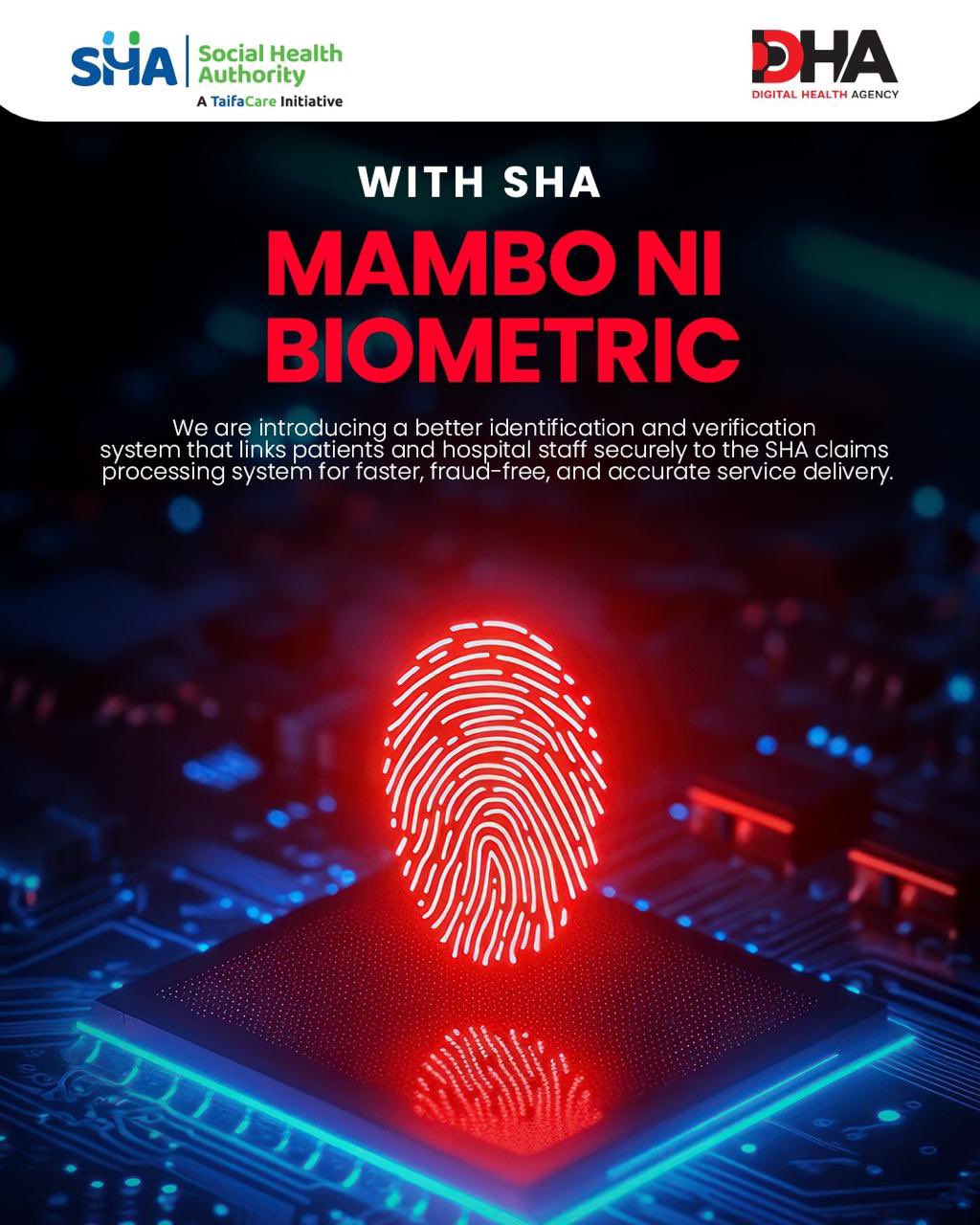
 Launch of Biometric Health Identification./SHA
For 56-year-old Margaret Achieng’ from Kisumu, a simple hospital visit used to come with a lot of stress—carrying a file, waiting in long queues, and worst of all, remembering a code sent to a mobile phone she barely understood.
“I lost out on treatment once because I couldn’t retrieve an OTP on time,” she recalls. “They told me I had to go back and get another code, and I just gave up.”
But those days, she says with a smile, are over.
Margaret is among the more than 25 million Kenyans who have registered under the new biometric health identification system launched by the government. Now, all she needs to access treatment is her fingerprint.
On Monday, Health Cabinet Secretary Aden Duale announced a game-changing policy, officially scrapping the use of One-Time Passwords (OTPs) for health service approvals under the Social Health Authority (SHA).
For years, OTPs—codes sent via SMS for authorizing treatment—were meant to streamline patient access. But in reality, they created delays, confusion for the elderly and illiterate, and opened the door to widespread fraud.
“Many patients didn’t even understand what an OTP was,” says a doctor at KUTRRH.
“We had cases where family members misused them, or patients were denied services because they couldn’t verify their codes.”
Now, patients like Margaret can verify their identity with a fingerprint scan at the facility—no phones, no passwords, no paperwork.
“It gives you dignity,” she says. “You don’t have to beg someone to help you with a phone.”
The biometric Identification method is just one piece of a larger digital transformation in Kenya’s health sector.
The launch also included a geo-fenced app for health professionals (Practise360), a National Product Catalogue, and a Health Information Exchange (HIE) that links hospitals and counties in real time.
According to the Ministry of Health, these systems will not only make healthcare more accessible but also cut down on double billing, fake prescriptions, and medical fraud that have long plagued public health institutions.
For patients, this means more transparency. “Now, I can log into the AfyaYangu app and see every treatment I’ve received and every claim made on my behalf,” says Brian Otieno, a 29-year-old boda boda rider in Nairobi. “It feels like I finally have control.”
Another major shift is happening in how medicines are dispensed. Under the new system, hospitals will only be reimbursed for drugs they actually give to patients—not just those they prescribe.
“If a patient doesn’t get their medicine, the hospital doesn’t get paid. That’s a game changer,” says Duale.
Patients who are turned away without medication are now encouraged to report to SHA by dialling 147.
“This means no more being told, ‘we’re out of stock’ while someone else bills your name,” says Brian.
While the rollout currently covers Level 4 to 6 hospitals, efforts are underway to bring Level 2 and 3 facilities—including rural clinics and dispensaries—into the system.
For communities in remote areas, this will be transformative.
“In Turkana, people travel hours for treatment,” says Sister Agnes Chebet, a nurse at a mission hospital and who was t KUTRRH for a visit.
“Biometric ID will help ensure those who sacrifice to reach care are not turned away or defrauded.”
The new system also offers a layer of protection for vulnerable groups. By eliminating impersonation and fake claims, more funds can go toward actual treatment.
“For years, ghost patients drained public resources,” says health economist Dr. Kevin Lumumba. “These reforms could save billions.”
The Ministry is also working on a Track-and-Trace system for pharmaceuticals to ensure every tablet, vial, and injection reaches the intended patient, not the black market.
Back at KUTRRH, Margaret watches as her records are instantly pulled up on a screen following her fingerprint scan.
“I didn’t need my ID. I didn’t need a folder. I just needed to be me,” she says, softly.
For millions of Kenyans like her, the transition to biometric, app-driven, and transparent healthcare is not just a tech upgrade—it’s a restoration of dignity, trust, and access.
As Margaret walks out of the hospital, she sums up the promise of Kenya’s digital health revolution in just a few words:
“I feel seen.”
Kenya Launches Biometric Health ID and Digital Health Reforms to Boost UHC
Kenya’s journey toward achieving Universal Health Coverage (UHC) took a major leap forward on Monday with the launch of a suite of digital health tools designed to improve service delivery, enhance accountability, and streamline patient care.
In a landmark move set to redefine how health services are accessed and billed in Kenya, the government officially ended the use of One-Time Passwords (OTPs) for medical service approvals at all public, private and faith-based Level 4, 5 and 6 Hospitals.
Speaking at the Kenyatta University Teaching, Referral and Research Hospital (KUTRRH), Health Cabinet Secretary Aden Duale unveiled four critical pillars of the Digital Superhighway, including Biometric Health Identification, the Health Professional App (Practise360), a National Product Catalogue, and a fully operational Health Information Exchange system.
Duale said the launch of the biometric health identification method and digital health will revolutionise patient experience and tackle long-standing issues of fraud and inefficiency in the health sector.
“Effective immediately, the Social Health Authority (SHA) will only recognize biometric verification and the newly launched Practise360 app for pre-authorizing medical services,’’ Duale said.
This shift marks the end of OTPs—codes often abused through unauthorized sharing, fake claims, and systemic loopholes.
“The days of OTP manipulation are over,” declared Duale.
“We are putting an end to shortcuts, ghost billing, and fraudulent authorizations. With biometrics and geo-fenced verification through the Practise360 app, only legitimate services delivered by legitimate professionals will be reimbursed.”
Practise360, a mobile app now available to all licensed healthcare workers, uses geo-location and facility-specific tagging to ensure that authorizations for treatment are only made within approved settings.
Health professionals can now view, approve, and manage claims directly on their devices, with every transaction digitally logged.
“This will restore trust, professionalism, and accountability in our health system,” said Duale.
“These innovations are not just technical upgrades—they are foundational reforms that will safeguard the integrity of our health system and ensure that every Kenyan receives dignified, affordable, and quality care.”
Under the Biometric Health Identification, all beneficiaries of the Social Health Authority (SHA) will be identified via biometric data—eliminating the need for physical documents and drastically reducing cases of fraud.
Practise360, a geofenced mobile application that allows healthcare professionals to manage patient authorizations and claims within their designated facilities.
The app replaces the outdated OTP-based system, closing loopholes that allowed unauthorized billing.
“This app will professionalize our workforce and ensure only legitimate, in-facility services are billed,” said Duale.
To address growing concerns over substandard and counterfeit medicines, the Ministry of Health launched a mandatory National Product Catalogue integrated with the Pharmacy and Poisons Board.
All pharmaceutical suppliers must register certified products within 30 days or risk deregistration.
“The government will only reimburse drugs that are actually dispensed to patients,” warned Duale, urging citizens to report denied prescriptions to the SHA helpline at 147.
Kenya now joins a select group of African nations with a fully operational Health Information Exchange.
The platform enables seamless, real-time sharing of patient records between hospitals and county systems, eliminating the need for duplicate tests and paper-based claims.
So far, 24 counties have begun the transition to Hospital Management Information Systems (HMIS), and the goal is to have all public hospitals fully digital by November 2025.
“Every consultation, prescription, and diagnosis will be tracked in real-time. There will be no room for ghost billing or theft of public funds,” said the CS. “Every shilling will work for the Kenyan who contributed it.”
Duale also announced that a new Track-and-Trace system for pharmaceuticals is in final testing. Expected to launch next month, it will monitor drug movement from manufacturer to patient, fulfilling a key requirement under the Digital Health Act.
“This will protect patients from diverted and fake medicines,” he emphasized.
The Kenya Medical Practitioners and Dentists Council (KMPDC) will use digital tools to deregister rogue facilities, while the public is being encouraged to use the SHA’s AfyaYangu app to access their medical records and report any suspicious claims.
“Together, we are building a transparent, efficient, and people-first health system,” said Duale. “Kenya deserves no less.”