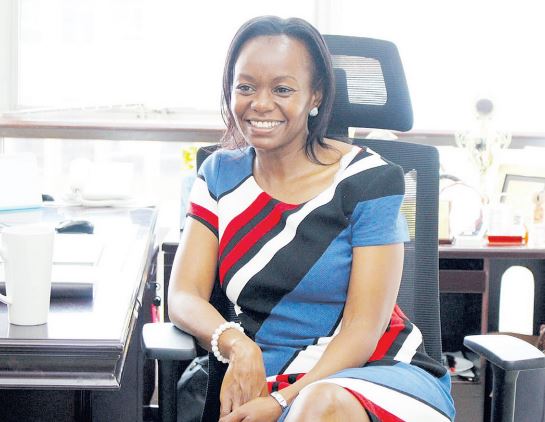
 Kenya Private Sector Alliance (KEPSA) CEO Carole Kariuki /HANDOUT
THE story of Kenya’s economy in the past two decades will be incomplete without a special page for Carole Kariuki.
A private sector titan, she oozes social economic blue prints that not only ensures business sustainability for investors both local and foreign, but also projects that translate into feasible revenue streams for the government service to the public.
The Star spoke to the Kenya Private Sector Alliance (KEPSA) CEO on an array of issues including her journey, the state of the country’s private sector and the huge growth potential.
Excerpt:
Who is Carole Kariuki, where was she born, school and career path?
I was born in a hospital in Nyeri. Lived in Kirinyaga my first two years then moved to Egerton University, and that is where I grew up until after high school. I went to Bahati Girls High School then to University of Nairobi.
What was your dream growing up?
Growing up, I was intrigued about what was happening in the country. Of course, I would see the president come for graduations at Egerton and other government officials but also it was a college first then university that was very focused on development. I also come from a civil service family from grandparents, and over 90 per cent of my relatives not dudes of the family. So, I always wanted to be part of what was happening in the country and service to country was big in my ecosystem.
What was your first job after campus?
I did economics and sociology so I was very intrigued in the banking sector at first. A lot of my friends would do holiday jobs in banking so I also did the same. I worked at the then Barclays Bank, now Absa. When I finished school, I went back realised I needed to do something different. I wanted to be involved in the country's development so I left after seven months and took what I would call a gap year, almost two years. I did a leadership training then went back to school for my masters in the US where I did public administration and international affairs. I felt that was my place and I have never looked back.
When did you join KEPSA?
When I came back in 2005, a lot had changed in the country. I met the KEPSA chair at that time and we talked and I felt, Yes, that is where I want to start , private sector but at intermediary between government and other stakeholders and business. KEPSA had just been formed two years earlier as the umbrella of private sector bringing businesses together and assisting companies under one body. It had like four members of staff. I came in as a volunteer first then became the manager of the public-private dialogue department later. When the CEO position opened, i applied. The first time I did not get it as my former CEO had come back then left after a month. I was given an opportunity to act as CEO for about five months then they did recruitment the second time. That is when I took over, in 2010. The rest is history.
How would you describe this journey?
It has been the most fulfilling, stretching, stressful, beyond-my-imagination journey I could ever describe.
Public sector is rife with corruption, but the private sector is accused of funding it, what is your take?
It is true. The public sector is more visible to the society. But there are many others who are corrupt, it is just because you don't see them. There is always the giver and the taker or the one who makes it difficult to ensure nothing moves until they get something personal. We have to change the whole system and values to deal with corruption in this country. Can we be corrupt free? I don't think so entirely because no country is , But I think if you have a better system, then you are able to catch those who are corrupt. In Japan for instance, if you are caught being corrupt, you actually commit suicide. In China, they hang you. In Europe and the West you get jailed. What about us? What do we do? We need to make a decision and make sure that the system makes it harder for people to be corrupt. KEPSA championed the writing of the Bribery Act and put hope of for implementation , we co-organised with government the first national conference on corruption bringing all sectors of the nation together and all levels of government and commitments were made, but not much has been achieved.
What are some of the big strategic shifts that you have overseen as CEO?
We were part of the team on ERS then work of Vision 2030 and every other work around the economic and social sectors. We have built a lot of partnerships over the years. We got involved in the formulation of the new constitution. We are working on sectors that need to be revived. We were the only treated voice after the 2007 post election violence yo speak to the two sides of political divide alongside Uzbek Kofi Annan . We had airlines that had left this country. We have worked with the government to bring businesses into the country. We have seen key projects like SGR and others and influenced business friendly policies including driving the conversation on the ease of doing business. We have to transform ourselves to become globally competitive, something that we continue to do.
What would you say are some of the biggest lessons that you learned during Covid?
I think the most important lesson for me and where I sit, and I think even for Kenya and Africa, was that we are on our own. It was very clear when the vaccines were done and everyone tried to pull for themselves. The wealthy countries kept as much as they could for themselves and we faced scarcity. However, it was a moment that we really became innovative as a country. The government tried with easing the tax burden, but businesses also innovated beyond my expectations. It was a good lesson and it brought out a lot of entrepreneurship which some are driving the economy as we speak.
What is the biggest challenge in investing in Kenya?
It is the cost of doing doing business. I think what we sorted out was the ease of doing business but we also need to look at how these businesses survive and thrive so we need to ensure a business friendly environment including a predictable tax environment, easing the licensing burden among other measures. For instance, why would a manufacturer or agribusiness and others pay taxes in all the counties when for instance moving goods from Kisumu to Mombasa instead of creating a one stop shop and counties share? We had gone into a place where we had a single permit for doing business but we have fallen back to numerous licenses, we must address this. We can do better as a country. The other thing is the cost of power, we must address this to be competitive. If we are to get to the 20 per cent target on manufacturing contribution to the GDP, then we need to solve these things, we must lower costs.
We have seen a number of incentives in Special Economic Zones and Export Processing Zones, is the private sector taking up these opportunities or there are still challenges?
Very good incentives but we need to look at issues such as access to finance. Government crowds-off private sector from local finance which makes it hard for the private sector to access finance and when they do, it is expensive. The SEZ concept is very important. I was a chair of the SEZs for three years when we really put the regulations and would hope that they are implemented as they are because as I said, our biggest problem is implementation and also short cuts . We have very good concepts but if we don’t implement them, then we will not get the results.
What is your take on the tax environment?
What we are asking for is a predictable tax environment. Businesses don’t make decisions overnight. Investment decisions are made over a period of time so if we could have a tax environment that does not change at least three to five years, that would really help so that businesses can able to make long-term investments.
Kepsa has round table meetings with the government, what are some of the biggest achievements?
During the Kibaki administration, I think the biggest thing was infrastructure development and financial stimulation to the economy. We needed that as a country. That is also when SGR was conceptualised and many others, securing our borders of Somalia, and all that. Then came the Uhuru administration and infrastructure continued and expanded across the country as well an influx of foreign investors . There was a lot of focus on the ease of doing business too which was excellent and Kenya by 2020 was 56 from 136 in the rating and third in Africa two years in a row. We are now focusing with current Ruto administration on reducing the cost of doing business. If we do so, we will become globally competitive. The infrastructure is there, the policies are there but we must implement the good policies fully.
What is your take on the recent ban by Tanzania on foreigners engaging in small businesses?
I think Tanzania, like any other country going through elections, has to do what is best for their citizens. I don't think they are targeting Kenya, I think they are just trying to see what works for their citizens especially being an election year. But we have EAC and we are the focal point of East African Business Council, so if we realise that it has a negative impact, then we will raise issues under those platforms. At the moment, is the Kenya private sector concerned? It just happened yesterday, so it is hard to tell anything so we wait and see.
What of Trump tariffs?
Kenya has not had a major impact yet because for Kenya it only takes 10 per cent but we are still operating under AGOA, once AGOA goes, then we will see what happens but we should also try and be innovative including tapping opportunities in other markets including those coming with the African Continental Free Trade Area.
What would you tell that young girl who wants to be like you?
Understand your calmly and your skills then just go for it, you know what you are capable of, work towards it, don’t let anyone say you are not able to do it. Another thing is to avoid shortcuts because you will pay for that and you will never be able to achieve or sustain what you should have become if you take shortcuts. Then understand the seasons of your life and live within them.