Staff at State House have come out to defend plans for the construction of a new chapel within the premises, saying it was their initiative and not a directive from President William Ruto.
Speaking to the media after a guided tour of the facility, police chief chaplain bishop Benard Njagi clarified that the Nairobi State House interdenominational chapel, first set up in 2005, has long served the spiritual and emotional needs of staff, uniformed officers, and their families.
He stated that the request for a modern facility was made by the staff to gather for their spiritual needs.
“This was not a religious or political push. We asked for it as staff. Not as Christians or Muslims, but because we needed a permanent structure that fits the stature of the State House,” said Njagi.
While recounting the history of the church, Njagi said the idea was first conceived in 2003 when he and a few others began gathering for prayer under a shade within the compound.
As their numbers grew, they mobilised funds and purchased iron sheets to create a simple shelter for worship.
Njagi later wrote to the then Commandant, requesting the formal establishment of an interdenominational church to accommodate the growing and diverse spiritual needs of staff from all religious backgrounds.
Following the request, a designated space was allocated for the church, discreetly tucked within the staff quarters.
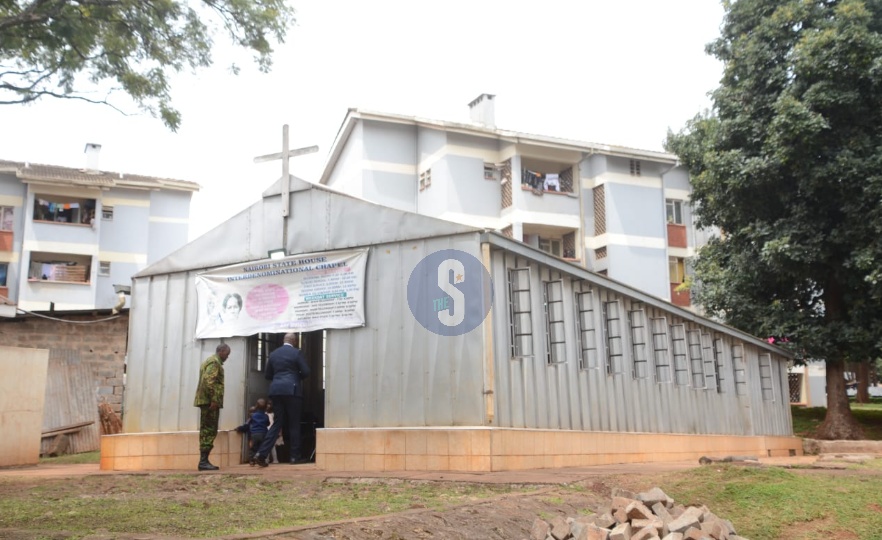
The interdenominational chapel was initially built as a temporary iron-sheet structure through contributions by staff.
It served the community until 2019, when it became too dilapidated for use.
During one of her runs around the area, former First Lady Margaret Kenyatta took note of the structure's condition and mobilised resources through sponsors and well-wishers to fund a refurbishment, he explains.
On May 15, 2019, the same year, the facility currently in use was dedicated and officially reopened by then-Chief of Staff Joseph Kinyua and the State House Comptroller after its completion.
“The church has played a big role here, emotionally, socially, and spiritually,” Njagi tells us in an interview moments after concluding sermon.
“We support each other through counselling and prayer. It helps our families too, especially considering how difficult it is to go in and out of the State House due to security protocols.”
According to him, State House is home to at least 400 families, estimated to be a population of 1,000 people, most of them staff. Since the chapel’s inception, the number of worshipers has grown by over 85 per cent.
Njagi, the Chief Inspector of police, served in the GSU from 1997 until 2016 when he was moved Kenya Railway before being named the State House chaplain as well as Presidential Escort Unit (PEU) chaplain.
In 2020, during the COVID-19 lockdown, a Catholic prayer section was established within the State House compound to serve Catholic faithful who could no longer attend services outside due to movement restrictions.
Njagi explained that before its construction, Catholic staff used to pray in a tent set up in the same area.
“Previously, we would invite a priest from the Department of Defence (DOD) to offer mass,” he said, noting that the restrictions made that arrangement unsustainable.
The modest chael, located at the right corner near Gate D, has about 105 plastic chairs, some of them visibly worn or broken. Despite its condition, the space remains in use and is attended by staff and their families.
He notes that both the Catholic and Interdenominational chapels are occasionally graced by senior officials, including First Lady Rachel Ruto, who joins worship services from time to time.
When we visited the Interdenominational church, a mid-morning service was underway. A few uniformed officers and civilian staff were singing a worship song ahead of a brief sermon, which Njagi said typically lasts about 30 minutes. The church accommodates up to 150 worshippers and is structured to allow staff members to attend prayer sessions without disrupting their tight work schedules.
“This church has helped us, it has impacted State House fraternity through spiritual, emotional, physical and social support,” he states.
“It is a need within this community. The spiritual leaders offer counselling to families, staff, and support each other in times of need as we coexist as a family without discrimination.”
He adds that every Wednesday, they have special prayers for their families, the President and the country.
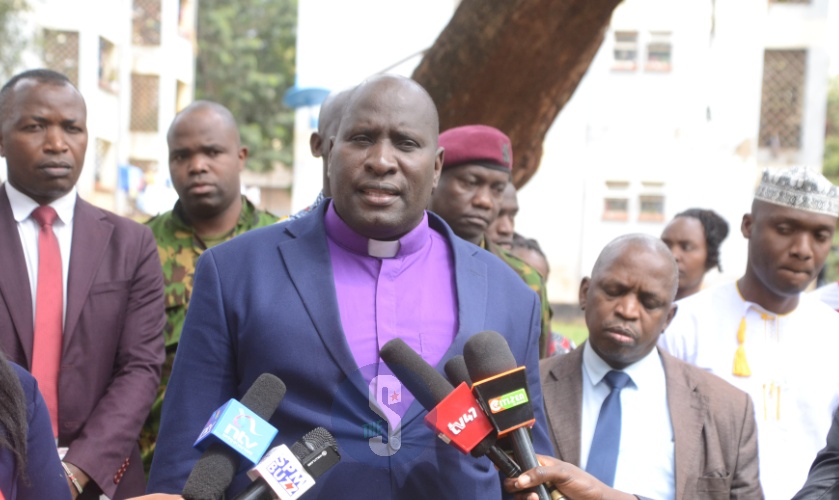
On recent reports that construction of a new chapel had already begun and would cost taxpayers Sh1.2 billion, Njagi was categorical that nothing had started yet.
“We, too, were shocked by those reports. There is no such figure. We have not even seen any official plans, and we do not even know where it would be located,” he remarks.
He dismissed the Sh1.2 billion price tag as unfounded and insisted that, should the construction process commence, staff would be present to participate and dedicate the structure.
“That was false information. We requested the President, and as you can see for yourselves, we have suffered a lot. When it is sunny, there is a lot of heat inside, and the same as when it is cold, we shiver a lot,” he says.
“If the church accommodates 300 or 400 people, it will not even go past a million.”
President Ruto has already publicly defended the proposal, saying it is a continuation of the existing chapel, not a new mega-church.
He added that the project would be privately funded and cost nowhere near the reported Sh1.2 billion.
The matter has since sparked public debate, with a legal challenge filed in court seeking to stop the construction because it violates the constitutional principle of separation of church and state.