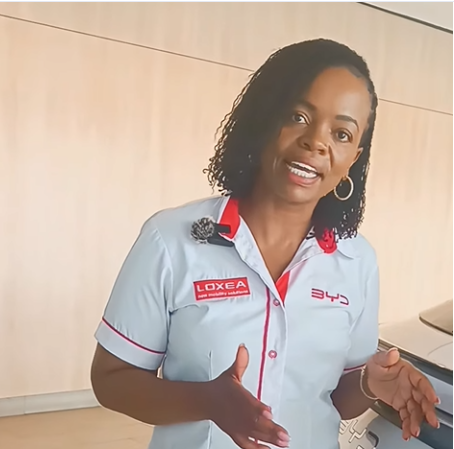
Kenya is actively promoting e-mobility as part of its broader climate change and
sustainability goals. The country has a growing electric
vehicles (EVs) market driven by government policies,
private sector
investments, renewable energy and a developing charging
infrastructure. The Star Spoke to Jennifer Kinyoe, managing
director of Loxea, a subsidiary of CFAO Mobilityand the official sole distributor of Chinese BYDvehicles in Kenya,about e-mobility and leasing.
In a nutshell, who is Loxea?
It is a leading mobility solutions provider and we specialise in long-term leasing and fleet managementprimarily for corporate clients. Loxea is present in 25 countries and we serve Pan-African companies that are running across Africa. Our headquarters is in France. We are actively driving the leasing and adoption of electric vehiclesand we are doing this through innovation, flexible leasing solutions and strategic partnerships. In Kenya, we are contributing to the country’s sustainable transport future. We provide flexible leasing solutions that are tailored to client needs, which include financing, maintenance, insurance, roadside assistance, replacement of vehicles in case an accident or breakdown and we also do driver management.We offer vehicles that are fully serviced by the manufacturer. Esentially, we enable companies to outsource fleet management so that they can focus on their core operations
Which sectors of the economy do you support?
What I can say is that we have a lot of customers in FMCG (Fast-Moving Consumer Goods). We have a lot of customers manufacturing, taxi companies, high-end private companies that do security and transportation of dignitaries. We also have a lot of customers in the oil industry.I would also say logistics companies as well so cut across almost all the sectors.
Why Kenya for BYD and how has the market responded so far?
So, we introduced BYD in September last year. The entry into Kenya was after a long time of doing feasibility study to understand our electricity, the type of fuel we use, because we also have plug-in hybrids that are BYD. And the most important thing is the population in Kenya and the growing demand for sustainable transport. So there is a demand for cleaner, more sustainable transportation in Kenya and BYD saw this as an opportunity to bring low carbon emission vehicles to the market. Then obviously there are some supportive government policies for instance the excise duty on EVs that was reduced from 20 per cent to 10 per cent. This was the beginning of what we believe will be future policies that are forward thinkingthat the government will actually bring to the market. We are working with the government to see how well they can reduce the taxes, because the taxes are quite high right now. Kenya is a strategic location and a regional hub so it is a natural base for BYD to expand its presence in the region. The partnership with CFAO Mobility has already seen us become a leading fleet management company with CFAO as a leading distributor of other models. The partnership made it easier for BYD to access the market, which is huge where we have 11 brands within CFAO Mobility.
How would you rate Kenya’s EV market?
It is not yet where we want itbut there is good progress, there are charging stations in Kenya, about 50 of them, so this is the beginning of what will come in the future in terms of development. And then really just the untapped market potential. We only have about 2,500 EVs in Kenya. There is potential to grow this with the projections of tripling this number in the medium-term. Kenyans are early adopters and BYD sees Kenya as a key emerging market with significant potential for growth.
Why should I buy an
electric vehicle and not a fuel-powered vehicle?
I would say lower operating costs. With an electric vehicle, most of the vehicles on average will have 60 kilowatts of a battery.Charging a 60-kilowatt battery will cost you Sh1,500 and it will take you to a range of 400 kilometres. That is just Sh3.75 per kilometre.There is no internal combustion engine that will give you that. So that is a very important factor.The other one is the maintenance. This vehicle does not have an engine and it does not have a gearbox. There are no oils.So managing and maintaining this vehicle will be much cheaper than the petrol or diesel vehicles. Then the other one is environmental benefits.These are zero emission vehicles so we are reducing the air pollution and carbon footprint. EVs also provide a very smooth and quick acceleration, some of the vehicles are moving from zero to 100 kilometres in 4.5 seconds.
What is your take
on Kenya's policy in regards to driving the e-mobility agenda?
The e-mobility policy is actually drafted and this is a very positive step for providing a foundation for growth, so with those incentives that have been suggested and the strategic planning that will be coming with that, it gives positive step towards a sustainable future. However, we still need to move towards continued policy refinement. We need investments in charging infrastructure.We need public awareness campaigns to accelerate adoption and building some consumer confidence around the EVs. The government is saying they want to achieve per cent new EVs registration this year but to meet these targets, they have to do a lot. Like, they need to increase the financial incentives in the tax breaks and subsidies for EV buyers.
Why is the uptake of EVs still low what are the challenges?
I would say mainly because of high upfront costs.Kenya primarily has been a market for used units that come from Japan and other countries at cheaper prices. The EVs seem expensive for Kenyans because they are also new.We also don't have the culture of going to the showroom to buy cars so we end up at the yards on Ngong Road or Kiambu Road and we settle on used vehicles that are seven years old, but we are doing a lot of education. That is where we can begin. Kenyans should also remember that buying a second-hand car comes with higher maintenance costs so if possible, try and be the first owner and that is going for a new car. The other challenge is the limited charging infrastructure. This slows down consumer confidence in adoption.The other one is obviously the policy and regulatory gaps so if the government can adopt quickly the policies that have been presented, lower the taxes, we will see an increase in the uptake of EVs.
What is the e-mobility sector’s benefits to the country?
First, we are driving the greening of Kenya's transport sector. We are also creating jobs including local assembly by CFAO. But beyond that, there is the value chain which includesparts,suppliers, logistics, the marketing, after-sales services so we have a lot of direct and indirect jobs, supporting the broader economic goal of contributing to the GDP growth and industrial diversification.
Talking of infrastructure, what are you doing yourselves?
First let me start with the maintenance infrastructure. We have invested in our services to support the electric vehicles. We have a service centre for BYD here at the head office in Nairobi. We have also partnered with companies that are developing charging infrastructure. We are supporting them with areas where our customers are found so that they can go and put up their charging network there. There are also ongoing efforts to work with the government, even at policy on where to put in the charging infrastructure. The government recently did a tender for 250 chargers, which I believe will be a game changer for Kenya.Kenya Power is also investing in charging infrastructure, alot of malls are putting up charging stations in basementsso there is ongoing efforts to develope a supporting ecosystem for EV users in Kenya and Loxea and BYD are the forefront of this ecosystem.
For that reader who wants to buy an EV or already has one, help him understand usage?
So, most vehicles when fully charged have the mileage that they will take you. Always be keen on the charge. For instance, if doing a journey between Nairobi and Mombasa, you will probably get to Mtito Andei when you are at 40 per cent. When you get there, go to a DC charger, which is the fast charger.Top up your charge to another 100 per cent and that way you can be assured of getting to Mombasa. So each vehicle, as you move along, it will tell you how many kilometres you have left on the charge. There are warnings, you can tell and we recommend that you don't let your vehicle go below 20 per cent charge. Always get information about charging infrastructure along the route you are using so that when your vehicle is getting lower, you can be assured of a top to recharge. These vehicles also comewith portable charger so if you are totally unable to get a fast charger, you can plug in on a normal socket and top up to enable you complete your journey but this could take longer to recharge.
How long will it take me between a fast charger and normal socket?
There is 50-kilowatt charger that takes 30 minutes to charge, full charge, from zero. But if you are charging at home, if you have a seven-kilowatt charger and you have a 16-kilowatt battery, if you just do the math, you need about eight hours. If you are using 11 kilowatts that is about 5.5 hours to full charge. But in most cases, you will not be charging from zero so the time it takes will be lesser.
Kenya aims at achieving 30,000 EVs by 2030. Is this achievable?
I
believe it is and especially if the
industry gets the
support it needs. If we educate corporate
clients and the public on the benefits of EV and the usage, and government extends
the right policy and business environment, we will be able to actually
achieve these 30,000 units even before
2030. There is a huge opportunity of having EVs in
the public transport, we have seen that in Nairobi’s matatu industry already,
and commercial vehicles. This can help Kenya
achieve its goal to reduce carbon emissions by 32
per cent by
2030, and also to reduce the oil import reliance.
These targets are ambitious at the moment but achievable if some
things can be put in place. The future
is green and it is here