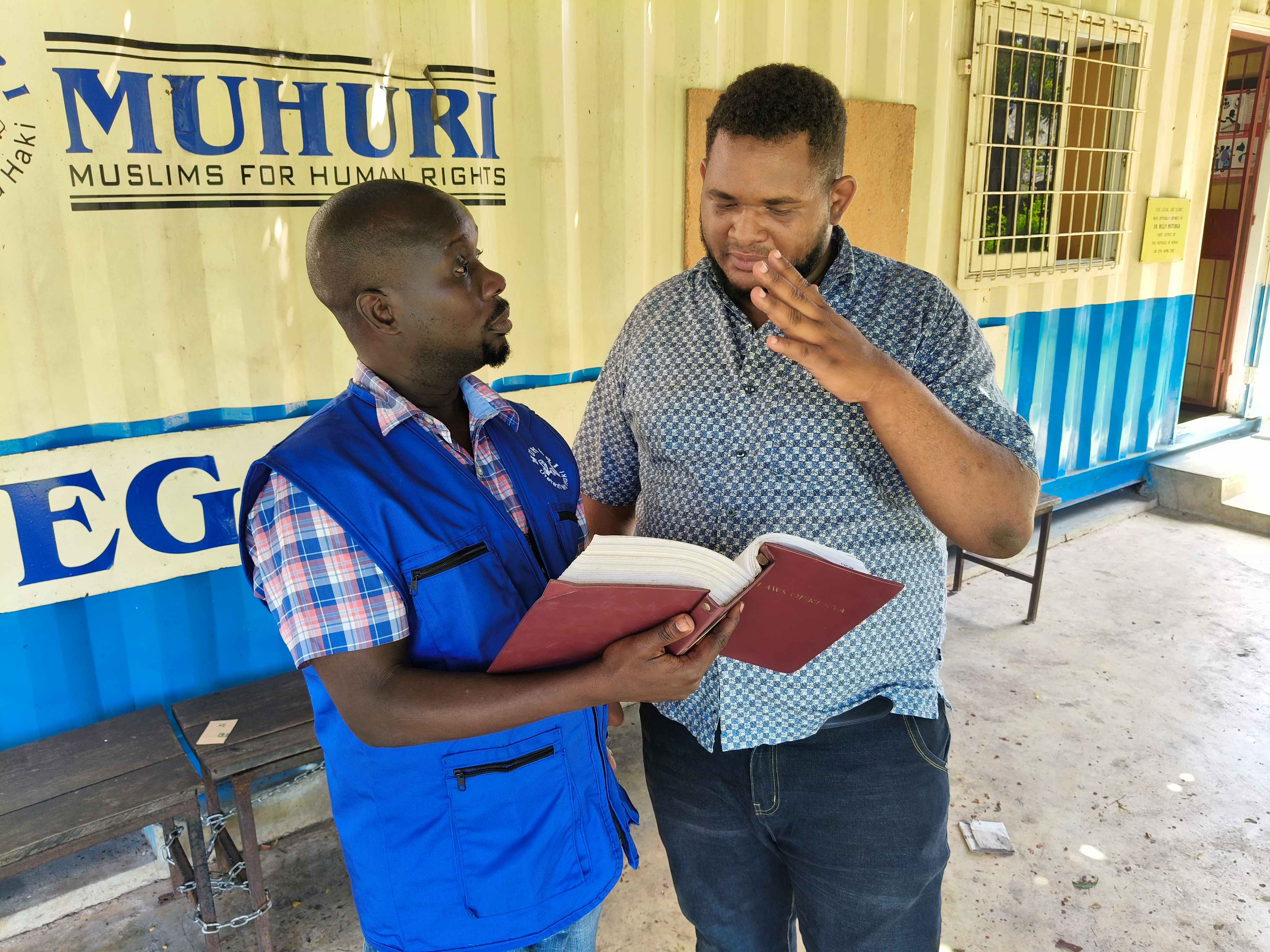
 Muhuri’s Francis Auma and executive director Walid
Kassim on Tuesday / BRIAN OTIENO
Muhuri’s Francis Auma and executive director Walid
Kassim on Tuesday / BRIAN OTIENOMonday’s Supreme Court ruling allowing children born out of wedlock to Muslim fathers to inherit their property has elicited different reactions among Muslims in Mombasa.
Some Muslims differed over the ruling with those against the ruling saying it interferes with Islamic law, while those supporting it saying a child born out of wedlock still has the father’s blood and DNA thus should inherit his property.
According to Islamic law, a child born out of wedlock can only inherit from the mother and not the father.
The ruling stems from a prolonged case in which a woman sought to exclude three children born by her late husband from his previous relationships with two other women from inheriting his estate.
The High Court and Court of Appeal had allowed the children to inherit their deceased father’s estate.
The woman sought the Supreme Court’s help to try and overturn those rulings.
However, Justices Martha Koome, deputy chief justice Philomena Mwilu, Mohamed Ibrahim, Smokin Wanjala, Njoki Ndung’u, Isaac Lenaola and William Ouko unanimously reasoned that denying inheritance to children born out of marriage was unjustifiable.
Fuad Abdalla, a community leader, said the ruling goes against Islamic doctrines.
“The Supreme Court has wronged us as Muslims. They should leave us with the Kadhi’s Court so we can have our own rulings based on Islamic law,” Abdalla said.
He said the Kadhi’s Court is a creation of the Constitution of Kenya and must be respected.
The government, he said, must not interfere with Islamic laws and doctrines, likening the ruling to oppression of Muslims.
“What is the work of the Council of Imams and Preachers of Kenya? The council should come out strong and speak against this ruling.
“What are they waiting for? Their work, we see, is to only praise the President and his government every now and then!” a furious Abdalla told the Star.
Veteran human rights defender and activist Khelef Khalifa said the ruling makes sense and he agrees with it.
“Personally, I agree with the Supreme Court decision. If it happened - and it never happened, but if it did and I had a child like that (out of wedlock), I would never disown my child. Never.
“Because it would have been my DNA, 100 per cent. Never. No matter what,” Khalifa told the Star on phone.
He argued the child has no sin and is not responsible for their parents’ actions.
“The child has no sin. It is their parents who committed sin,” he said.
He explained that in Islamic thinking, they did not want to legitimise an illegitimate thing and allowing inheritance for such a child would be akin to allowing adultery.
“To their interpretation, it is like encouraging that. But I don’t think it does. I am talking as Khelef Khalifa,” he said.
He noted that the matter is subject to interpretation.
Muslims for Human Rights executive director Walid Kassim said there was a jurisdiction problem with the Supreme Court ruling, which led to an interpretation problem.
Kassim said the Constitution of Kenya envisioned different cultures and beliefs and put in place structures to protect the different cultures and beliefs through Chapter 4 on the Bill of Rights.
That is why it created the Kadhi’s Court to interpret matters according to Islamic law.
“If you ask me, the Kadhi’s Court was better placed to address the matter than the Supreme Court.
“It was the duty if the Supreme Court to seek guidance and direction from the Kadhi’s Court because the kadhis are specifically there to interpret Islamic religious issues,” Kassim said.
He said anyone who wants to have their matter addressed according to Islamic law should be allowed.
However, he noted, the Supreme Court has now set precedent that will clash with the Kadhi’s Court in many other matters now and in future.
“How many cases have the kadhis ruled over according to Islamic law? This ruling may reverse all those cases,” he said.
The Judiciary, he noted, should sit down and set a precedence that is accommodative to both the secular and the Kadhi’s court.
He said the ruling robs the Kadhi’s Court of its authority.
“The logic that the Supreme Court has used makes a lot of sense, but the jurisdiction is different,” Kassim said.
Instant Analysis
Muslims in the country fought hard to include the Kadhi’s Court in the Constitution of Kenya 2010, forming one of the sticking points during the referendum campaigns in 2010. The role of the Kadhi’s Court was to rule over matters according to the Islamic law.