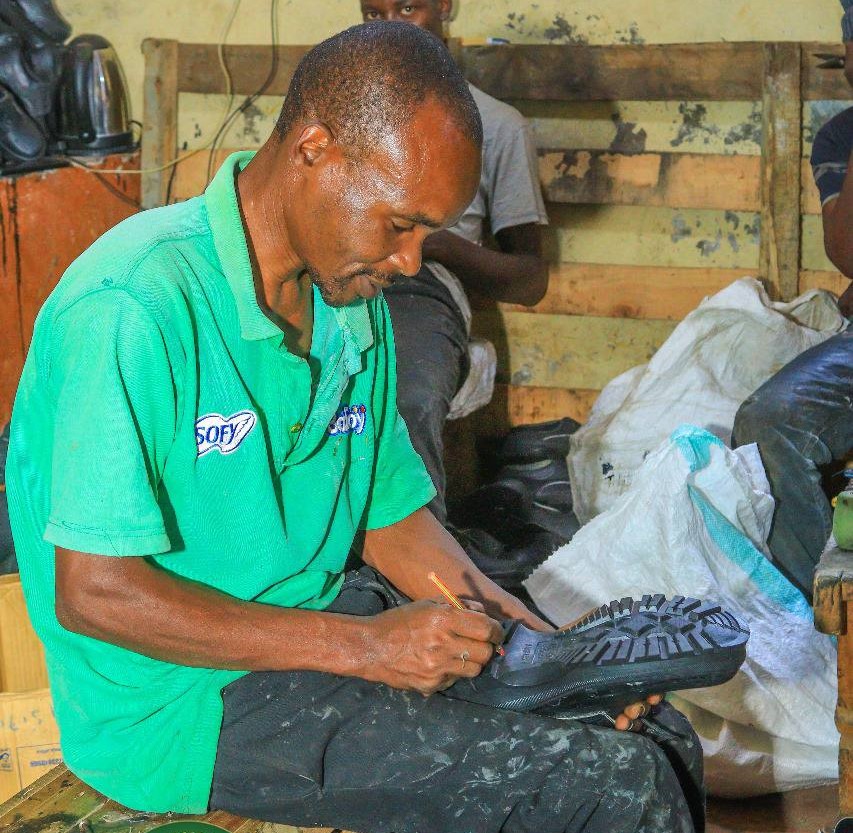
 A worker making leather shoes at Njonde Leather Works located at Sabasaba in Maragua, Murang'a
A family from Murang’a has received Sh1 million from President William Ruto to expand a leather products’ business established in their home in Sabasaba.
James Ndegwa met the President during the Murang'a Investors Conference held on June 14 and 15, which brought together thousands of local and international investors.
Ndegwa, who received the money on Monday through Maragua MP Mary Waithera, said the President spotted his stall and led a group of leaders to it.
“I saw the President point at my stall and walk towards me. I was very surprised. He asked where I get my products and said he’s been making efforts to support the leather industry,” Ndegwa said.
The President said local processors should source hides locally and pledged to help the family establish a leather processing factory at their home.
In celebration, the business donated hundreds of pairs of shoes to pupils from Gathuri primary school while locals benefitted from belts.
Ndegwa told the Star they inherited Njonde Leather Works from their father, who brought them up using proceeds from the business.
“My father, now 72, had a business at Burma market in Nairobi and that’s how he educated us. We grew up watching him make shoes, belts and other products and eventually learnt the trade,” he explained.
His father would get tenders from the National Police Service to make gun holsters which boosted his business.
Over time, he handed over the business to his five children, who moved the establishment to Makongeni estate in Nairobi.
Later, the siblings converted a home they had built for their parents and two of theirs in Sabasaba, their rural home, into workshops, storage and living quarters for the 35 youths who are permanently employed in the business.
“When Covid-19 hit and we went into lockdown, we relocated the business to cut on costs but the machine we use to cut belts is still in Makongeni.”
They source for raw hide from Njiru slaughterhouse before processing into leather for use in the factory.
Ndegwa said when they took over the business, they focused on making leather shoes, bags and belts and have since opened two outlets in Thika town and Kariokor where they sell them.
“The Kariokor shop is the main outlet because it attracts customers from all parts of the country who visit the area to do their shopping.”
The peak season is January, when schools reopen and parents are buying new uniforms for their children, while others are enrolling theirs in Form 1.
Normally, the business makes about 30,000 pairs in preparation for the school reopening period.
This year, however, they prepared 20,000 because there were no Form 1 enrollments, as the pioneer class of the Competency Based Education progressed to Grade 9.
Instead, the business focused on making uppers – the top part of the shoe without the sole – which will then be completed for next year.
“These funds will help us to boost our stock to about 40,000 pairs by next January because learners will be joining both Junior and Senior Secondary Schools. We will be able to employ more youths and increase our production,” Ndegwa said.
The business is capital intensive, he added, as the sales reduce once schools re-open and they have to wait until the next peak season.
“But once it’s the peak season, we sell all our stock and then start making others afresh,” he said.
Despite being provided with food and quarters, Ndegwa expressed concerns that local youth shun job opportunities provided in the business.
The MP hailed the business, saying it serves as a cornerstone of economic growth within their community, creating substantial job opportunities and elevating livelihoods.
“This is a noteworthy investment that has provided jobs to youths and helped reduce poverty in the area. They have established a successful leather business that has set the standard for premium products and their good quality has solidified their brand as a trusted name nationwide,” Waithera said.
The MP also commended the family for supporting locals through corporate social responsibility efforts that have seen children provided with shoes, bettering the welfare of the community.
She urged political leaders to focus on empowerment drives that create such opportunities in a bid to lessen the rate of unemployment in the country.