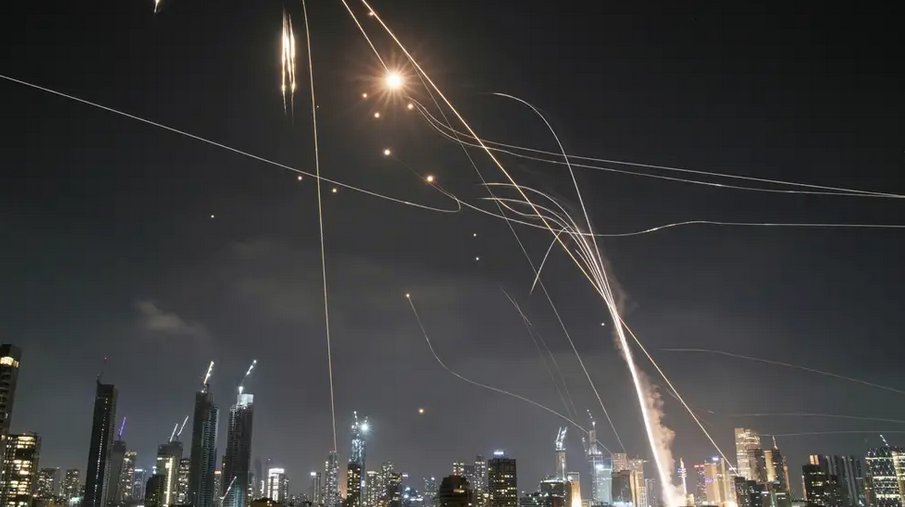
As hostilities between Iran and Israel entered their fourth day, attention has turned to Israel’s sophisticated missile defence system, the Iron Dome, which reportedly came under unprecedented strain.
Iran’s Revolutionary Guards claimed they used a new attack method that caused the system to misfire or “target itself,” leading to breaches in what has long been considered one of the world’s most reliable air defence shields.
The attack left at least 80 people dead and nearly 300 injured.
“The initiatives and capabilities used in this operation, despite the comprehensive support of the United States and Western powers and the possession of the most up-to-date and newest defence technology, led to the successful and maximum hitting of the missiles on the targets in the occupied territories,” Iran’s Revolutionary Guards said in a statement.
What is the Iron Dome?
The Iron Dome, known in Hebrew as “Kippat Barzel,” is a short-range air defence system designed to intercept and destroy rockets, artillery shells and mortars launched towards Israel’s populated areas.
First deployed in 2011, the system was developed by Israel’s state-owned Rafael Advanced Defense Systems with financial and technical support from the United States.
Between 2011 and 2021, Washington is reported to have contributed $1.6 billion (approximately Sh208 billion) towards its development.
In 2022, the US Congress approved an additional $1 billion (Sh129.25 billion) to bolster the system after it was heavily used during escalations with Gaza-based militants.
Development on the Iron Dome began in earnest in 2007, with successful testing conducted in 2008 and 2009.
It was created in response to the increasing threat of rocket attacks from groups such as Hamas and Hezbollah.
According to Israel’s Ministry of Defense, the Iron Dome has been “upgraded several times” and has “successfully prevented countless rockets from hitting Israeli communities.”
The system reportedly boasts an interception success rate of between 80 and 90 percent.
How does the Iron Dome work?
The Iron Dome operates as a short-range, mobile, all-weather air defence system.
It is comprised of three core components, including radar detection units, a battle management and control system and the launchers equipped with Tamir interceptor missiles.
When a rocket is fired towards Israeli territory, the radar detects it almost instantly.
The command-and-control system then analyses the trajectory of the projectile, calculates its likely impact point, and determines whether it poses a threat to civilian areas.
If it does, the system fires a Tamir interceptor missile to destroy the incoming threat mid-air.
However, unlike conventional surface-to-air systems that aim to hit targets head-on, the Tamir interceptor is designed to explode near the threat, destroying it with a blast radius rather than a direct hit.
This sometimes results in falling debris that can still cause injuries or damage.
Each interceptor missile costs about $50,000 (approximately Sh6.46 million), making the system effective but costly to operate, particularly during prolonged conflict.
The Iron Dome's selective targeting system is also programmed to ignore rockets heading towards uninhabited areas, conserving resources for more significant threats.
Coverage and capabilities
Each Iron Dome battery includes three to four launchers, each capable of carrying up to 20 Tamir missiles.
These batteries are strategically positioned across the country to maximise coverage.
A single battery can defend an area of roughly 60 square miles (around 155 square kilometres).
The system can intercept threats within a range of 2.5 to 43 miles (4 to 70 kilometres), making it ideal for defending cities, towns, and critical infrastructure against short-range projectiles.
Highly transportable and quick to deploy, the Iron Dome units are truck-mounted and can be operational within hours.
The missiles themselves are about three metres long, 15 centimetres in diameter, and weigh approximately 90 kilogrammes.
According to the security analysis firm IHS Jane’s, each warhead contains around 11 kilogrammes of high explosives.
Limitations and vulnerabilities
Despite its acclaimed performance, the Iron Dome is not without weaknesses.
Analysts have long warned about the system’s potential vulnerability to saturation attacks, where dozens or even hundreds of rockets are launched simultaneously from multiple directions.
In June 2021, the Center for European Policy Analysis noted that such an attack could potentially overwhelm the system's tracking and interception capabilities.
This concern may have materialised during the recent Iranian offensive.
Reports suggest that the attackers employed tactics aimed at exploiting the system’s limitations, possibly by confusing the radar or by overwhelming it with simultaneous barrages.
The Israeli Defence Forces (IDF) acknowledged the complexity of operating the system under such conditions.
IDF noted that yhe Iron Dome system involves many elements, from the soldiers manning it around the clock, to the radar technology, to the high-level command decisions.
Israel’s multi-layered defence strategy
The Iron Dome is just one component of Israel’s broader, multi-tiered air defence system.
For threats beyond the Iron Dome’s short-range scope, Israel relies on other systems, including David’s Sling and the Arrow 2 and Arrow 3 interceptors.
These are designed to intercept medium- to long-range ballistic missiles, including those that travel outside the earth’s atmosphere before re-entering.
On the opposing side, Iran is believed to operate a number of air defence systems, including the Russian-made S-300, which is capable of intercepting certain types of ballistic missiles.
Experts however say it is less effective than the Iron Dome for short-range threats.