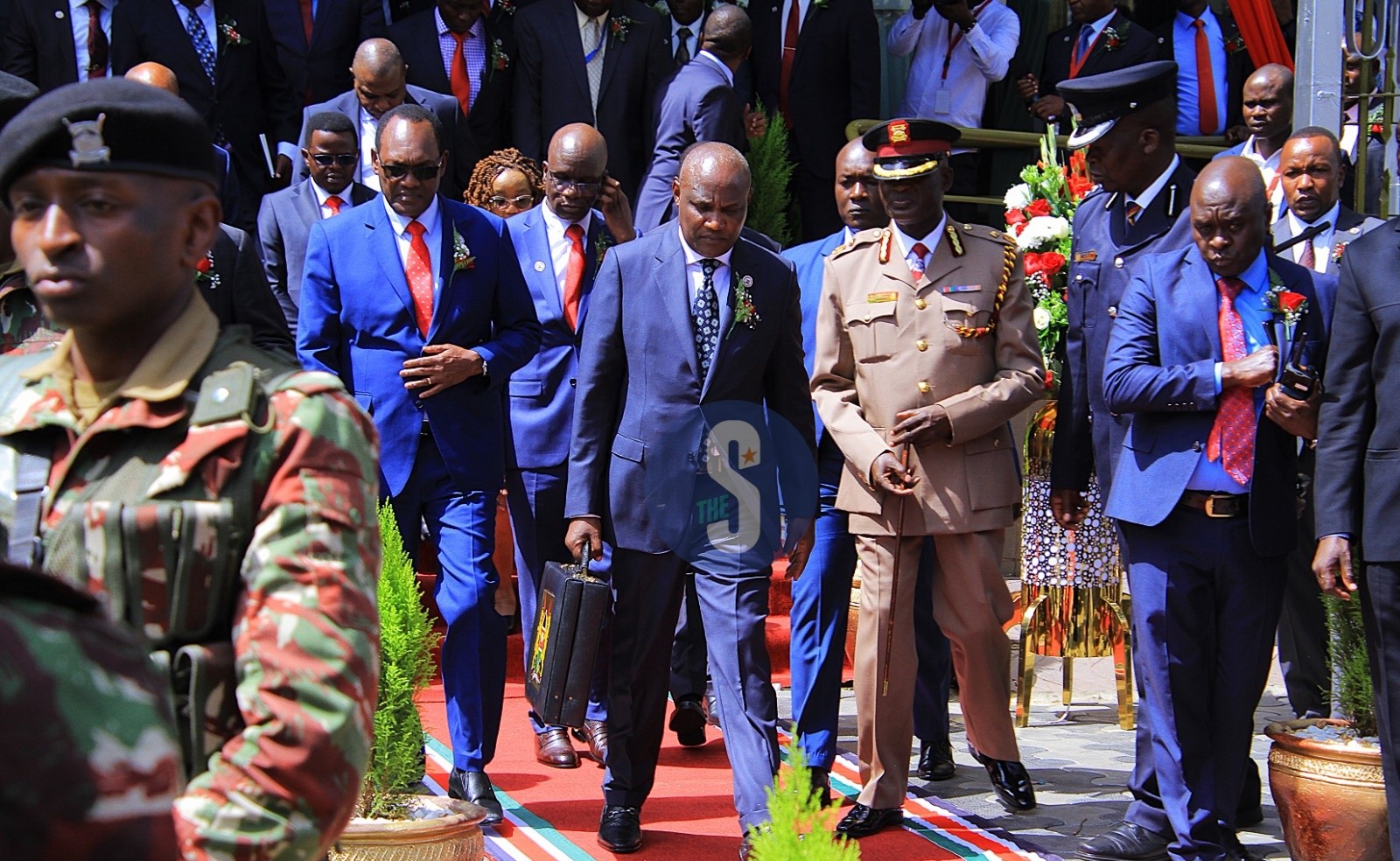
 CS John Mbadi leaves Treasury for Budget presentation in the National Assembly, June 12, 2025. /EZEKIEL AMING'A
For the first time in Kenya’s history, every government ministry, department, and agency was required to justify every budget item from scratch in the 2025-26 financial year—a radical shift designed to curb unrealistic projections and align spending with actual national priorities.
The zero-based budgeting (ZBB) approach, announced by Treasury Cabinet Secretary John Mbadi on Thursday during budget presentation in the National Assembly, marks a dramatic departure from the incremental budgeting of previous years, where past allocations often dictated future spending regardless of changing needs or effectiveness.
The move comes in response to persistent public concerns over government wastage, over-ambitious revenue targets and a disconnect between budget allocations and real outcomes.
“There has been public perception and concerns in the past that our budgets tend to be unrealistic. To address these concerns, we adopted zero-based budgeting where every budget item has to be justified at the beginning of every financial year,” Mbadi told Parliament.
What was foregone
Implementing ZBB meant tough choices and real sacrifices, Mbadi revealed.
He said ministries could no longer rely on “historical” budgets - they had to demonstrate the necessity and impact of each proposed expenditure.
The result: several programmes and projects were either scaled back or dropped entirely to ensure funds flowed only to the most impactful initiatives.
Key areas that faced cuts or restructuring included non-essential administrative costs like travel, hospitality and office refurbishments, unless directly tied to service delivery.
Ministries had to prove why each shilling spent on administration was necessary, leading to a sharp reduction in such overheads.
Mbadi said stalled or underperforming projects that had consistently missed targets or shown little impact were either restructured or discontinued.
This included some infrastructure projects that had been delayed for years, as well as certain grants and subsidies that lacked clear outcomes.
He said overlapping initiatives, particularly in social protection and youth empowerment, were also consolidated.
For example, some youth employment schemes were merged under the new Climate WorX program to avoid duplication and maximise impact.
Mbadi said unrealistic revenue projections had to also be avoided, even as he revealed that the Kenya Revenue Authority (KRA) has been tasked to generate Sh3.321 trillion in the 2025-26 fiscal year, equivalent to 17.2 per cent of GDP.
He said the Treasury reduced revenue projections to match actual economic growth trends, ending the cycle of over-promising and under-delivering on government income.
This forced spending plans to be more conservative and realistic projects.
Mbadi said adoption of the zero-based budgeting was informed by unprecedented public engagement, including open forums he personally attended and media outreach.
Some believe the public engagements were driven by the 'fear of the Lord' that Kenyans instilled in the government last year, when attempts to pass what many termed as 'punitive' taxes in the Finance Bill, 2024, were overwhelmingly rejected—sparking mass protests that nearly brought President William Ruto's administration to its knees.
Mbadi said during the forums, Kenyans voiced their desire for less wastage, lower taxes and more targeted support for the poor and unemployed.
These views, he said, directly influenced what was funded and what was left out in the 2025-26 national budget.
“Every item in this budget had to earn its place. We are determined to end the era of unrealistic budgets and ensure government spending is anchored in the realities and aspirations of our people,” Mbadi explained.
As such, he said the bulk of the Sh4.29 trillion budget prioritised spending on areas with the highest impact on livelihoods and economic recovery.
These include agricultural subsidies and reforms to boost food security, Universal Health Coverage (UHC) expansion, teacher recruitment and education reforms, affordable housing projects (where Sh11 billion was allocated for Jua Kali and MSMEs for local fabrication), social protection for vulnerable populations and youth employment through the expanded Climate WorX programme.
As the new fiscal year begins, all eyes will be on how this fresh approach translates into tangible results—and whether the culture of justification and prudence will endure.