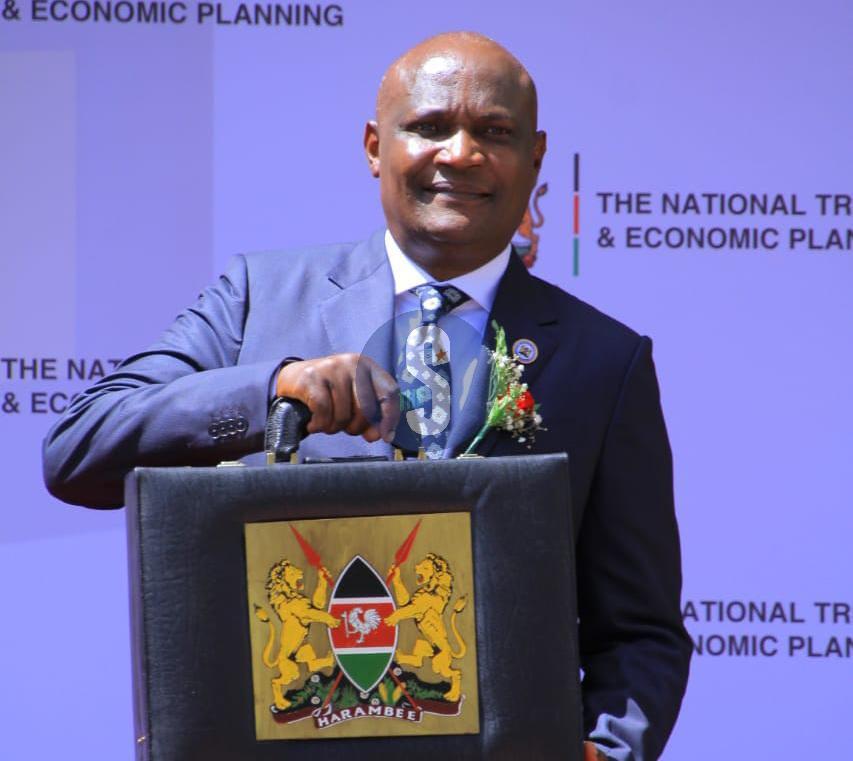
 Treasury CS John Mbadi/EZEKIEL AMING'A
The government will rely on a mix of domestic borrowing, external financing, and tighter fiscal discipline to fund the Sh4.29 trillion 2025-26 national budget, Treasury Cabinet Secretary John Mbadi announced on Thursday.
Speaking during the budget presentation to the National Assembly, CS Mbadi acknowledged the challenge of revenue shortfalls amid economic pressures, noting that total revenue—including Appropriation-in-Aid—is projected at Sh3.32 trillion, or 17.2 per cent of GDP.
This leaves a fiscal deficit of Sh923.2 billion, equivalent to 4.8 per cent of GDP.
“To close this gap, the government will mobilise Sh287.7 billion through external borrowing and Sh635.5 billion from the domestic market,” Mbadi said.
He also reaffirmed the government’s commitment to fiscal consolidation, aimed at slowing public debt growth while protecting critical services.
The fiscal deficit is expected to reduce progressively, falling to 2.7 per cent of GDP by 2028-29.
Mbadi said revenue performance remains under pressure following the withdrawal of the Finance Bill 2024 and recent economic disruptions, including public protests.
In response, he said the Treasury revised its fiscal framework and reprioritised spending, focusing on core sectors like health, education and social protection.
Mbadi cited zero-based budgeting—which requires every expenditure to be justified from scratch—as a key reform to curb wastage.
“We are cutting funding to low-priority areas and redirecting resources towards the Bottom-Up Economic Transformation Agenda,” he said.
To improve tax administration and compliance, the CS said the Kenya Revenue Authority (KRA) has expanded its digital platforms, including GAVA Connect, simplified VAT and PAYE returns, and real-time tracking systems for rental and fuel transactions.
The government is also reducing tax expenditures and broadening the tax base in line with the Medium-Term Revenue Strategy.
In a further move to enhance transparency, Mbadi said the Treasury is integrating the Commonwealth Meridian debt management system with the Central Bank and IFMIS platforms.
This, he said, will support efficient debt servicing and reporting.
Despite mounting debt concerns, Mbadi assured that Kenya’s public debt remains sustainable.
“In present value terms, we expect debt to decline from 63 per cent of GDP in 2024 to the target range of 55±5 per cent by 2028,” he noted.
To diversify funding sources, the government will also explore sustainability-linked bonds, diaspora bonds, and debt swaps.
As Kenya navigates a tough fiscal environment, Mbadi urged unity and discipline in managing limited resources.
“We must all pull in the same direction to secure long-term economic stability,” he said.