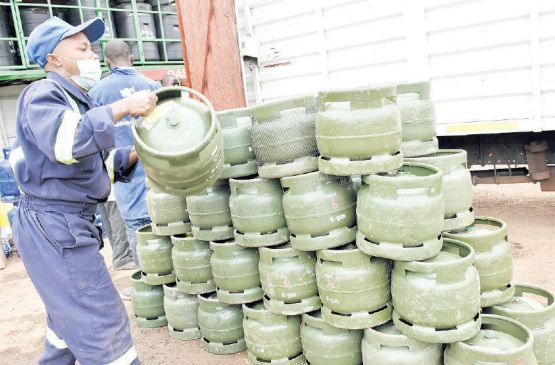
 Man arranging gas cylinders/FILE
Kenyans could enjoy cooking gas price controls by the fourth quarter of this year, Petroleum PS Mohamed Liban has hinted, a move that could save households from unscrupulous dealers who have traditionally manipulated prices.
This, even as the government moves to implement an LPG growth strategy that includes the provision of affordable clean cooking gas to low-income households.
This is through the distribution of 6kg gas cylinders and seed gas to public institutions, which has been developed.
According to PS Liban, the Energy and Petroleum ministry has engaged terminal users and industry stakeholders ahead of the move to set monthly prices similar to that of petroleum products which are reviewed every fourteenth of every month.
"We are at the tail end of the process and we should be able to implement the price caps with LPG products being imported under the Open Tender System,” Liban told the Star.
Liquefied Petroleum Gas (LPG) terminal users are diverse, including induatrial and domestic consumers, as well as various businesses involved in the LPG chain.
The Energy and Petroleum Regulatory Authority (EPRA) is putting in place structures for bulk importation by market players, including Oil Marketing Companies (OMC) where bidders will the lowest costs will be considered to ensure households enjoy cheaper products.
This follows December’s Cabinet approval through which the government seeks to lower the cost of LPG by ending monopoly in the industry.
Lowering prices is expected to increase the use of clean energy by households with the government targeting to increase annual uptake of gas from 7kgs per capita to 15kgs.
The government also targets to enhance penetration from the current 24 per cent to 70 per cent by 2028.
According to EPRA, a study has been conducted on streamlining and standardising prices in the LPG sector, while improving safety and standards.
The study was conducted by energy sector consulting firms – Kurrent Technologies Ltd and Channoil Consulting Ltd, which analysed parameters that define the pricing value chain. The report recommended a price determination mechanism based on market conditions.
“Households should be in place to enjoy affordable cooking gas products in the retail market. This is a government commitment. We are working towards realising the plan,” Liban said.
LPG is currently not price-regulated with monopoly in the industry, leaving consumers at the mercy of importers and retailers, who set their own markups.
During a Cabinet meeting in December chaired by President William Ruto at State House, Nairobi, the key decision-making organ also okayed the importation of heavy fuel oil and bitumen through a centrally coordinated bulk procurement system, in addition to LPG.
Importing LPG through the Open Tender System will be based on agreed terms and conditions, and the price is made up of import costs, market prices and local currency components, with bidders competing to offer lower price marks.
LPG price controls will be pegged on components similar to those used in setting petrol, diesel and kerosene prices, where a formula is in place to determine the maximum retail and wholesale prices.
The formula considers the landed cost of products, the volume of a cargo and the unit cost of a cargo.
The government is working with the private sector to establish a common-user import facility at the Kenya Petroleum Refineries Limited (KPRL) in Mombasa.
An OTS is expected to trigger more interest from OMCs in the country, ending a monopoly where Africa Gas and Oil Ltd has been handling up to 90 per cent of imported volumes, with a 10,000-tonne storage facility in Mombasa.
Cooking gas prices increased by 0.3 per cent in April, data by the Kenya National Bureau of Statistics indicates.
“The housing, water, electricity, G=gas and other fuels’ index rose by 0.3 per cent between March 2025 and April 2025. The increase was mainly on account of rise in the prices of 50kWh electricity, 200 kWh electricity and gas/LPG by 3.8, 3.4 and 0.3 per cent between March 2025 and April 2025,” KNBS director general Macdonald Obudho noted.
Average price for a 13-kg cylinder closed the month at Sh3,156 up from Sh3,146 in March.
Meanwhile, the government has completed the pilot phase of the LPG in schools programme which involved 20 schools.
The government has opened the schools' cooking gas programme to the private sector in a move expected to speed-up the plan that targets at least 11,000 boarding schools and institutions.
According to the State Department for Petroleum, the LPG (Liquefied Petroleum Gas) Adoption Project in the remaining 10,980 institutions will be developed in partnership with the private sector, before moving to affordable housing projects, police stations, public hospitals, prisons, among other government institutions.
“This is not just about gas. It is about our health, our forests and our future,” the PS said.
The government’s LPG agenda seeks to enhance penetration from the current 24 per cent to 70 per cent by 2028.
There have been calls by the government to ensure cooking gas consumption in the country.
Energy CS Opiyo Wandayi has said with a target of achieving a per capita consumption of 15kg per year by 2030.
This is up from the consumption of 7.5kg per year recorded in 2021, and remains below 10kg as at this year.
The CS said, will be driven by a robust LPG growth strategy that includes the provision of affordable clean cooking gas to low-income households through the distribution of 6kg gas cylinders and seed gas to public institutions, which has been developed.