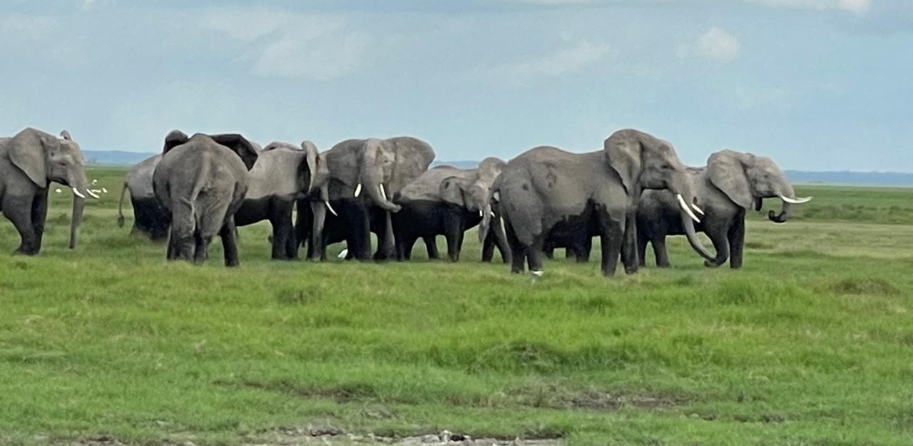
 Elephants at Amboseli National Park/ GILBERT KOECH
A new study within the Amboseli landscape has shown that conservation and tourism generate Sh 2.36 billion in economic value annually.
In 2018, the economic value was Sh 1.36 billion.
The latest survey, commissioned by the Amboseli Ecosystem Trust and Amboseli Trust for Elephants, collected data from the financial year of July 2022 to June 2023.
The analysis is based on data collected from 23 respondents out of 42 approached, representing a 54 per cent response rate.
It presents an in-depth analysis of the ecosystem's socio-economic contributions from July 1, 2022, to June 30, 2023, highlighting the significant interplay between conservation and community well-being.
The survey tracks trends in employment, education, tourism and fiscal contributions from wildlife-related activities at the national park and the larger community land around it.
The findings offer compelling evidence of how conservation delivers tangible economic returns to local families and businesses.
It reveals the role that nature-based businesses – including tourism, conservation and related community enterprises – play in supporting local livelihoods and driving regional development across the 1.4 million-acre landscape that surrounds the 100,000-acre Amboseli National Park.
According to the report, conservation and related activities provide employment to more than 1,500 full-time staff, of whom 1,073 are members of the Maasai community, 219 are part-time staff and 742 casual workers per month.
Monthly salaries exceeding Sh68 million reinforce the ecosystem’s role as a major economic driver.
Amboseli Ecosystem executive director Jackson Mwato said the initiative highlights their commitment to understanding the vital contributions of conservation and tourism to the development and livelihoods of the local community.
"We extend our deepest appreciation to all who contributed to this crucial survey, which informs the progress in conservation and tourism, supporting the national economy and local livelihoods."
Mwato said this year’s report builds on the foundation laid in 2018, reaffirming their commitment to tracking economic trends every five years.
“By consistently capturing and analysing this data, we aim to inform policies and interventions that enhance sustainable tourism and improve the welfare of Amboseli communities.”
Investment in education supported 127 teachers and provided 1,723 scholarships for primary, secondary, and tertiary students.
Over Sh 72 million was allocated to scholarships, enhancing access to quality education for local communities.
Cynthia Moss, director, Amboseli Trust for Elephants, said the survey will be conducted every five years.
She said they hope that in future, even more partners—from NGOs and research institutes to tourist facilities, community projects and other businesses—will join the effort.
“Collectively, we can ensure Amboseli remains a place where people and wildlife thrive, with human development always mindful of conservation,” she said.
Efforts to address human-wildlife coexistence solutions resulted in Sh54 million paid in compensation for losses related to predator attacks and other wildlife-related incidents, providing crucial support to affected families.
The survey says the ecosystem welcomed more than 84,000 guests, excluding visitors to the park, maintaining an average occupancy rate of 51.7 per cent, generating revenue of Sh 340 million from bed night fees and land leases, and contributing an additional Sh 328 million in gate fees.
Partners invested Sh272 million in initiatives such as healthcare, drought relief and livelihood programmes, while an additional Sh148 million was allocated for community support projects, improving the well-being and resilience of local communities.
Over Sh397 million was spent on goods and services procured from local businesses, and stakeholders contributed Sh 627 million in taxes, reinforcing Amboseli’s economic impact on the region.