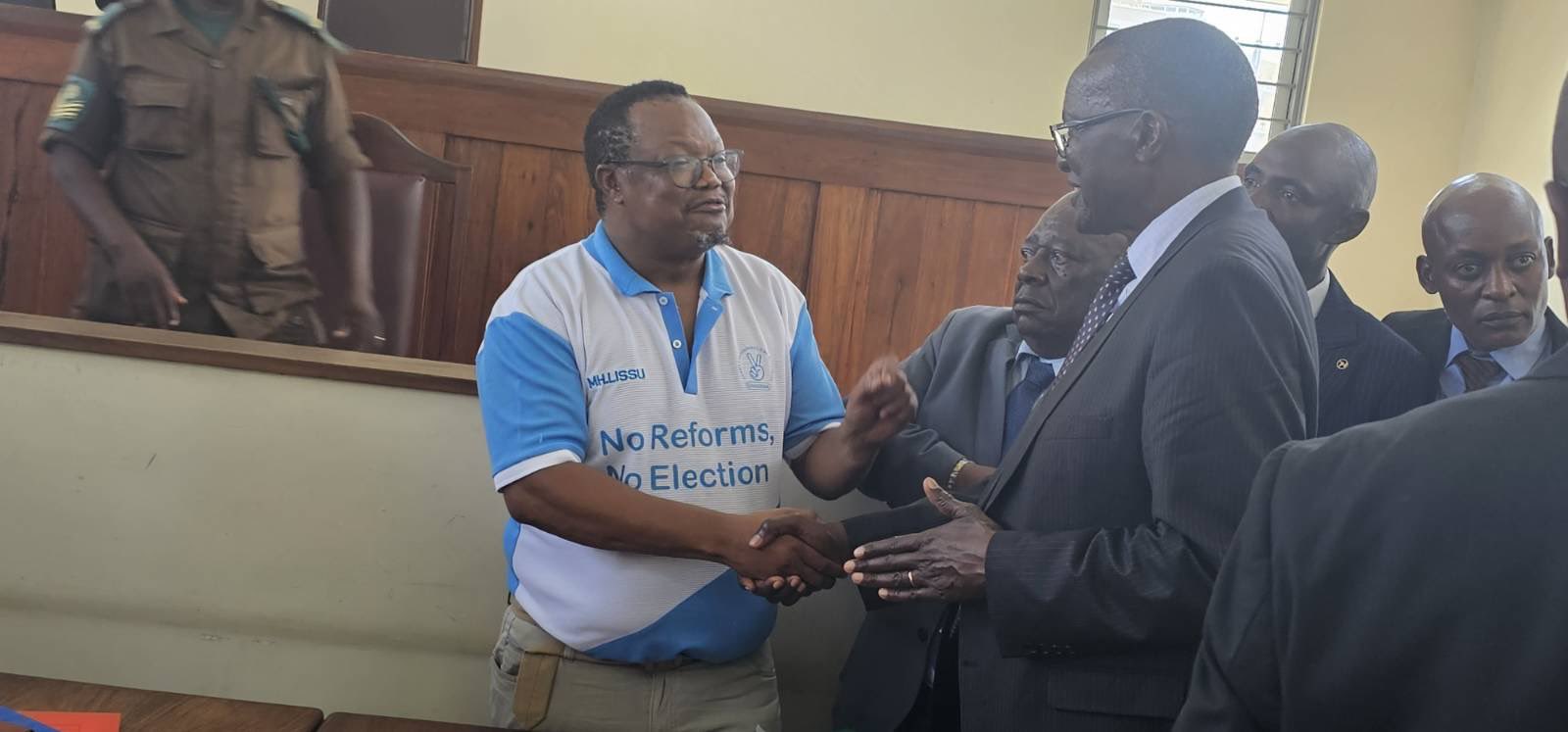
 Chadema Party leader Tundu Lissu has a brief conversation with Kenya's former Chief Justice David Maraga when he appeared in court on treason and incitement charges, May 19, 2025. /DAVID MARAGA/X
On September 7, 2017, Tanzania's main opposition leader and Chadema party leader Tundu Lissu was shot multiple times in an assassination attempt near his residence in the capital, Dodoma.
He was ambushed in the parking lot during a break from a parliamentary session and shot 16 times by unknown assailants using AK-47 rifles.
Lissu received emergency treatment at Dodoma General Hospital, but due to safety concerns, he was airlifted to Aga Khan Hospital in Nairobi for further medical care.
He was later transferred to Belgium, where he underwent extensive medical treatment, including 19 operations, during a prolonged recovery period.
The motive behind the assassination attempt remains unclear, although Lissu and his supporters have claimed the attack was politically motivated, citing his bold criticism of the then administration under the late President John Pombe Mahufuli.
No individuals have been arrested or charged in connection with the incident.
After recovery, Lissu briefly returned to Tanzania in 2020 to contest the presidential elections but went back into exile shortly after, citing threats to his life.
However, following President Samia Hassan's decision to lift a six-year ban on opposition political rallies, Lissu returned to Tanzania from exile on January 25, 2023.
He was treated to a rousing welcome by opposition party officials and supporters at Julius Nyerere International Airport in Dar es Salaam.
Lissu's survival and subsequent return to Tanzanian politics have solidified his status as a resilient figure in the country's political landscape and revitalised opposition activities in the country.
Despite the severity of his injuries that left him with a permanent limp, Lissu returned to political life, further cementing his reputation as a "great survivor" and one of the most persecuted politicians in the country.
The attempt on his life profoundly radicalised Lissu, making him more uncompromising and fearless in his pursuit of political reforms.
Political observers in and outside Tanzania say the event intensified his resolve to challenge the government and advocate for democracy, even in the face of significant personal risk.
Currently, Lissu is facing treason and incitement charges, which could see him sent to prison for life if convicted.
Despite this realisation, Lissu has reaffirmed his stance to push for reforms in Tanzania, stating that nothing comes easily in politics.
His pronouncement that courage is required to demand reforms "on the streets and in the villages" demonstrates the emboldened stance he adopted after the attempt on his life.
Lissu's radical approach to politics started from within his own party, where he became more critical of moderate approaches adopted by Chadema and eventually ousted Freeman Mbowe and took over the party’s leadership.
He argued that only a more confrontational approach could bring about meaningful change.
Lissu was elected chairman of Chadema on January 22, 2025, during the party's annual general meeting, effectively ending Mbowe's 21-year tenure.
His election marked a significant shift within the party, reflecting a desire for renewed leadership and a more assertive approach to political advocacy.
Lissu's survival story has played a major role in rallying supporters who view him as a fighter for democracy and human rights in Tanzania.
Despite his outspoken activism keeping him in the crosshairs of Tanzanian authorities, leading to multiple arrests and charges, Lissu is uncompromising when it comes to speaking his mind an championing reforms, even on foreign land.
In an interview published by The Standard on November 3, 2023, Lissu made a bold comparison between Kenya's free political space and Tanzania's, which he described as repressive of dissenting voices.
"In Kenya, you can hold rallies, criticise the government, and organise freely. In Tanzania, such actions can lead to arrests or worse," Lissu remarked, underscoring his concerns about the state of political freedoms and human rights in Tanzania compared to its neighbour.
Amid brute pushback, Lissu has continued to use his voice to call for international pressure on the Tanzanian government regarding human rights abuses, evoking sympathy and empathy from rights defenders from outside.
Kenya's former Chief Justices David Maraga and Willy Mutunga, alongside People's Liberation Party (PLP) leader Martha Karua, traveled to Tanzania to stand in solidarity with Lissu as he made his first physical appearance in court relating to the treason charges.
Even though Karua and Mutunga were denied access to Tanzania, Maraga made it to court on Monday and followed proceedings to the end.
Lissu was arrested on April 9, 2025, on charges of incitement and treason after calling for electoral reforms at a rally.
But even behind bars, he has continued to demonstrate that he is a fearless and determined political leader who is not ready to compromise even when caught between a rock and a hard place.
Authorities in Tanzania had insisted that he attend court sessions virtually, but he refused and went on a hunger strike, demanding that he appears in court in person.
A magistrate court responded by ordering Lissu's arraignment in person before Kisutu Resident Magistrate's Court for his hearing on May 19, 2025, marking his first physical court appearance since his arrest.
Among the reforms Lissu is pushing for include establishment of an independent national electoral commission whose members are not connected to the government.
He has dismissed as cosmetic any reforms that merely rename the electoral body as “independent” without substantive changes.
Lissu is further calling for reforms so that, in the event of electoral disputes, the burden of proof should rest with the commission rather than with the complainants to demonstrate that the vote was free and fair.
He is also advocating for clear, enforceable ethical guidelines for candidates during campaigns and for the process to be fair and open to all parties.
Lissu wants the reforms to address procedures for voter registration and the nomination process for candidates with the aim of preventing the disqualification of legitimate opposition candidates and ensure all eligible citizens can register and vote.
Lissu is also calling for a clear definition and limitation of the involvement of security forces in the electoral process to prevent intimidation or manipulation, and a guarantee that party agents will be allowed to observe all stages of voting, counting, and results declaration to enhance transparency and trust in the process.
Lissu has made it clear that Chadema will not participate in future elections unless these key reforms are implemented, emphasising that only genuinely free and fair elections can restore public trust and democratic legitimacy.
He has adopted the “No Reform, No Election” slogan to push for the enactment of the reforms even as he faces the possibility of life in jail on the strength of the treason charges he is currently facing.
Tanzania is scheduled to hold its general elections on October 28, 2025.
The elections will encompass both the presidential and parliamentary contests.
The ruling Chama Cha Mapinduzi (CCM) has nominated incumbent President Samia Hassan as its presidential candidate.
However, Lissu's Chadema has been disqualified from participating in the elections for what the Independent National Electoral Commission (INEC) said was because the party failed to sign a mandatory code of conduct agreement by the required deadline.