When Zahir Salim left active employment in 2018, he had a dream of building a company that would shape Kenya’s bulk Liquefied Petroleum Gas (LPG) storage and water tanks industry.
In November 2019, him and two other Kenyan engineers–Daniel Edward and Evans Maroa started Steel Tank Africa, specialising in design and manufacturing of tanks in the Kenyan market.
This was fueled by the governments’ “Buy Kenya Build Kenya” strategy, mooted in April 2017, aimed at inculcating in the mind of Kenyan citizens, patriotism and preference for Kenyan goods and services as a means of supporting the domestic economy.
“We saw several market opportunities and economic factors that favour local production and we said why not, lets go Kenyan,” Salim told the Star as he inspected a bulk LPG tank undergoing welding works at the company’s workshop in Athi River, a short distance from the Crytal Rivers Mall along the Nairobi-Mombasa Highway.
Having built experience with South African based Pipeco Tanks South Africa-one of the best water storage tank manufacturers and suppliers in Africa, which Steel Tank Africa is still a partner to date, the three Kenyans dared to dream.
Riding on the strong network of global suppliers, the trio started sourcing the finest materials and components for tanks, ensuring high standards and competitive pricing as they built the company.
“At Steel Tank Africa, our commitment goes beyond providing tanking solutions for the oil and gas industry. We are dedicated to creating lasting value for diverse sectors, from agriculture to water supply, by delivering high-quality, reliable storage solutions that empower industries,” Salim affirmed.
This is based on sustainable engineering that focuses on creating solutions that meet current needs without compromising the ability of future generations to meet their own, considering environmental, social and economic impacts throughout a project's lifecycle.
The company is now rivaling imports from China, India and Europe in providing local solutions for the energy and water sectors not only in Kenya but the entire East African Community countries of Tanzania, Uganda, Rwanda, Burundi, DRC and beyond.
This is on the back of the government’s LPG agenda that seeks to enhance penetration from the current 24 per cent to 70 per cent by 2028.
In December, President William Ruto launched a programme that seeks to shift all the schools and public institutions in the country from using firewood to cooking gas.
This, even as the government encourages the use of cooking gas in homes.
In 2023, the government exempted cooking gas from Value Added Tax (VAT), the 3.5 per cent Import Declaration Fee (IDF) and the two per cent Railway Development Levy (RDL) to promote its use and reduce reliance on charcoal.
LPG consumption has since increased to 414,861 metric tonnes, latest data by the Energy and Petroleum Regulatory Authority (EPRA), Biannual energy and petroleum statistics report for the financial year 2024-25, shows, up from 360,592 metric tonnes in 2023 and 333,829 in 2022.
“Kenya’s LPG market has grown significantly due to increased adoption for domestic and commercial use. The government promotes LPG as a cleaner alternative to charcoal and kerosene. The government is pushing for LPG adoption through tax reductions on LPG imports and equipment, which is a very positive move that we believe will have a significant impact if local companies are supported by incentives while taming imports,” Salim said.
Currently, most LPG tanks are imported from China, India and Europe, which increases costs due to import duties, logistics and foreign exchange fluctuations, therefore, creating an opportunity for local production which offer competitive prices, reduce import dependency and ensure faster supply to distributors and consumers.
The company targets to drive uptake in hotels, restaurants and manufacturing industries which are increasingly using LPG, creating demand for larger bulk storage tanks.
“We have witnessed encouraging trends in Liquefied Petroleum Gas consumption aligning with the government’s commitment to implementing the LPG growth strategy. The demand is expected to continue its upward trajectory as the government advances the LPG growth strategy, focusing on promoting its use in schools and hospitals,” EPRA director general Daniel Kiptoo said.
Kenya’s Vision 2030 supports industrialisation, local manufacturing and job creation.
EPRA regulations have strengthened compliance, increasing demand for certified high-quality LPG cylinders.
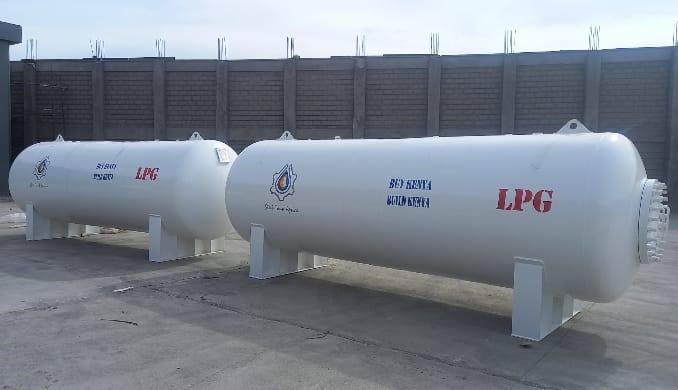
Steel Tank Africa specialises in bulk LPG storage tanks (above ground, mounded and buried ), suitable for commercial installations (bottling plants, autogas), real estate developments, and bulk consumer sites such as hotels, schools and industries.
It also builds products for LPG tankers and mobile bobtail trucks for safe LPG transportation and distribution.
For water tanks, it deals in glass-reinforced plastic, hot-dip galvanised and stainless steel products.
“Steel Tank Africa enjoys an exclusive dealership with Pipeco Tanks South Africa, a leading manufacturer, supplier and exporter of water storage solutions, specialising in glass-reinforced plastic water tanks. The dealership covers the East Africa region,” Salim said.
Both LPG and water tanks by the company are manufactured under stringent quality controls and have received certifications such as ISO and Water Regulations Approval Scheme, an independent UK certification body for plumbing products and materials.
The firm is however focused on fueling the Kenyan dream of shifting both households and institutions to the use of clean energy.
“Kenya is undergoing a transformative shift toward clean and modern energy solutions. Liquefied Petroleum Gas (LPG) presents a unique investment opportunity as the country seeks to reduce reliance on charcoal, firewood and kerosene, which currently serve over 70 per cent of households,” Salim said.
It mainly sources its raw materials and accessories from China, Jordan, Turkey, India and the UAE.
The materials undergo pre-export verification of conformity (PVoC) checks by the Kenya Bureau of Standards and are supplied with valid mill test certificates.
For water tanks, STAK sources the products from Pipeco Tanks South Africa factories in South Africa, Malaysia and China.
“The company’s products are manufactured under stringent quality controls and have received certifications such as ISO and WRAS, ensuring compliance with global standards,” Salim affirmed.
He believes Kenya, with the guidance of EPRA, could turn around the story of firewood and kerosene into clean cooking gas.
Firewood and charcoal, while traditionally used for cooking and heating, have significant environmental and health impacts, including deforestation, air pollution and respiratory illnesses.
According to experts, burning firewood for cooking and heating can negatively impact health, leading to respiratory problems, cardiovascular issues, and an increased risk of certain cancers. The country’s Economic Survey indicates that indoor air pollution from cooking fuels like charcoal and firewood is killing an estimated 21,600 Kenyans annually.
Of these deaths, about 40 per cent are children (exceeding the burdens of disease of malaria, tuberculosis, and diarrhoea combined).
Cases of respiratory diseases reported in health facilities were 19.6 million in 2023, up from 17.1 million, latest Kenya National Bureau of Statistics indicate.